Préparation du rapport

Chargement des informations et références disponibles

Connexion au corpus archéologique…

Collecte des archives antiques

Aller au contenu principal
Toca do Enoque Hunter-Gatherer Genome
Profil culturel

Toca do Enoque Hunter-Gatherer Genome

A late Holocene cave lineage from Serra da Capivara revealed by one ancient genome

1681 CE - 1533 BCE
Piauí, Brazil (Serra da Capivara)
Faites défiler pour commencer
Chapitre I

Le récit

Comprendre la culture Toca do Enoque Hunter-Gatherer Genome

Ancient DNA from a single individual (1681–1533 BCE) from Toca do Enoque, Serra da Capivara, Piauí, Brazil links a hunter-gatherer context with Native American maternal A2e and paternal Q lineages. Conclusions are preliminary given the single sample.

Time Period

1681–1533 BCE

Region

Piauí, Brazil (Serra da Capivara)

Common Y-DNA

Q (observed: 1)

Common mtDNA

A2e (observed: 1)

Chapitre II

Chronologie

Moments clés de l'histoire de cette culture

1600 BCE

Toca do Enoque individual dated

An ancient genome from Toca do Enoque is dated to 1681–1533 BCE, providing a Late Holocene genetic snapshot from Serra da Capivara.

Chapitre III

Origins & Emergence

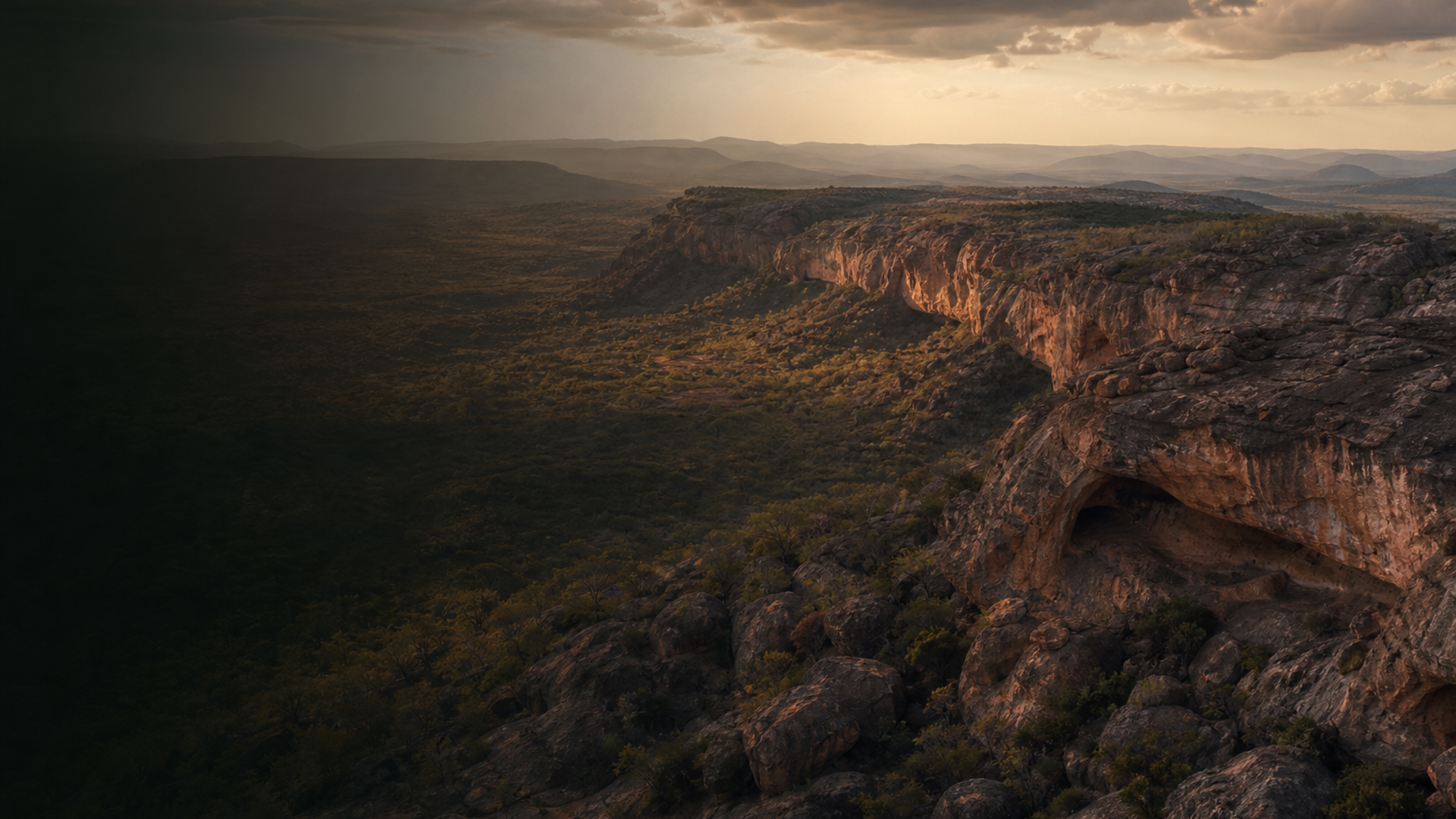
Toca do Enoque sits within the dramatic sandstone landscapes of Serra da Capivara in Piauí, a region rich in rock shelters and long human histories. The single sampled individual dates to 1681–1533 BCE (radiocarbon range). Archaeological data from the broader Serra da Capivara area indicate repeated use of caves and open-air sites by Late Holocene hunter-gatherer groups, but specific excavation details for this burial or context remain limited.

The cinematic cliffs and painted rock surfaces of the region belie an equally complex human story: seasonal mobility across riverine and dry woodland mosaics, opportunistic foraging, and the use of sheltered caves for short-term occupation or mortuary practices. Limited evidence suggests stone tools, hearth features, and patchy faunal remains characterize contemporaneous sites nearby, but careful excavation records are needed to link material culture directly to the sampled individual.

Because only one genome is available, any reconstruction of population emergence here is cautious. This specimen provides a temporal anchor for a hunter-gatherer presence in Serra da Capivara during the late second millennium BCE, hinting at continuity of deep South American lineages in northeastern Brazil.

  • Sample from Toca do Enoque Cave, Serra da Capivara (Piauí)
  • Direct date: 1681–1533 BCE (Late Holocene)
  • Regional archaeology indicates long-term hunter-gatherer use of caves
Chapitre IV

Daily Life & Society

Archaeological patterns in northeastern Brazil suggest a lifeway tuned to seasonal cycles of the cerrado and gallery forests. Foragers likely moved across a landscape of rivers, rock shelters, and open plains, exploiting fish, small game, plant resources, and seasonal fruits. Hearths and stone-tool scatters at nearby sites imply short-term occupations punctuating larger movement networks.

Socially, small mobile bands are a reasonable model: flexible residency, kin-based networks, and exchange of raw materials and finished tools between valleys. Funerary evidence from Serra da Capivara and analogous regions shows varied mortuary treatments; however, the specific burial context for the Toca do Enoque individual is not fully published, so behavioral inferences remain provisional.

Material culture in the area often includes expedient flaked stone tools and simple groundstone implements where plant processing was important. Artistic expression in the region's rock art speaks to deep symbolic landscapes, but linking that directly to this genome is speculative. Overall, daily life was likely adaptive and intimate with the patchwork ecology of late Holocene Piauí.

  • Mobility across rivers, woodlands, and rock-shelter networks
  • Small, kin-centered bands with seasonal resource focus
Chapitre V

Genetic Profile

The genetic data come from a single individual (sample count = 1), so conclusions are preliminary. The paternal lineage is assigned to haplogroup Q, a lineage widely associated with Native American populations and with deep roots in the initial peopling of the Americas. The maternal lineage is A2e, a subclade of haplogroup A2 commonly observed among indigenous populations of the Americas. Together, these markers are consistent with ancestry deriving from ancient Beringian and early American gene pools rather than recent extra-continental input.

Genome-wide ancestry from one Late Holocene individual can hint at continuity with earlier South American hunter-gatherer populations, but cannot resolve regional diversity, sex-biased migration, or subtle admixture events on its own. With only one sample, observed Y and mtDNA haplogroups confirm local representation of pan-American lineages but do not quantify their frequency or variability in Serra da Capivara populations.

Future sampling across stratified contexts and direct comparison with other ancient genomes from Brazil and neighboring regions will be essential to test hypotheses about demographic continuity, population structure, and interactions with emerging agricultural groups elsewhere in South America.

  • Paternal haplogroup Q aligns with ancient Native American lineages
  • Maternal haplogroup A2e fits broader A2 diversity among indigenous Americans
Chapitre VI

Legacy & Modern Connections

This genome creates a tangible genetic link between the late Holocene inhabitants of Serra da Capivara and the broader tapestry of Native American ancestry. That connection may resonate with living Indigenous communities in northeastern Brazil, but genetic continuity should not be assumed without broader sampling and dialogue with descendant groups.

Archaeology and genetics together can illuminate deep time connections, yet each ancient genome is one thread in a vast fabric. Respectful collaboration with local communities, careful curation of remains, and expanded ancient DNA sampling will be necessary to translate these scientific findings into responsible narratives about ancestry and cultural heritage.

  • Connects Serra da Capivara late Holocene individuals to pan-American lineages
  • Highlights need for more samples and community collaboration
Propulsé par l'IA

Assistant IA

Posez des questions sur la culture Toca do Enoque Hunter-Gatherer Genome

Assistant IA par DNAGENICS

Débloquer cette fonction
Posez des questions sur la culture Toca do Enoque Hunter-Gatherer Genome. L'assistant IA peut expliquer les résultats génétiques, le contexte historique, les preuves archéologiques et les liens génétiques avec les populations actuelles, dans les limites de l'interprétation.
Exemple d'analyse IA

La culture Toca do Enoque Hunter-Gatherer Genome représente un chapitre fascinant de l'histoire humaine…

L'analyse génétique met en évidence des similarités avec des populations antérieures et des signes d'adaptations propres. Les échantillons d'ADN ancien éclairent les schémas migratoires et les liens entre populations, avec des limites qui dépendent de l'étude et du contexte archéologique.

Il s'agit d'un aperçu de l'analyse IA. Accédez à l'assistant complet pour explorer :

  • Composition et similarité génétique
  • Schémas migratoires et origines
  • Vie quotidienne et pratiques culturelles
  • Contexte génétique actuel

Explorez d'autres cultures antiques

Découvrez les récits de civilisations issues du monde antique