Aller au contenu principal
Profil culturel

Voices of Petko Karavelovo

A glimpse into a 4700–4400 BCE Bulgarian Chalcolithic community through archaeology and DNA.

4700 CE - 4400 BCE
Veliko Tarnovo prov., central/northern Bulgaria

Le récit

Archaeological remains from Petko Karavelovo (Veliko Tarnovo province) dated 4700–4400 BCE reveal a small Chalcolithic community. Four ancient genomes hint at diverse paternal ancestries and mostly European maternal lines, offering a cautious window into Balkan population dynamics.

Time Period

4700–4400 BCE

Region

Veliko Tarnovo prov., central/northern Bulgaria

Common Y-DNA

M (2), V88 (1), CTS (1)

Common mtDNA

H (2), HV+ (1), U (1)

Chronologie

4700 BCE

Occupation at Petko Karavelovo

Settlement and material culture at Petko Karavelovo date to ca. 4700 BCE, marking local Chalcolithic activity within northern Bulgaria.

Origins & Emergence

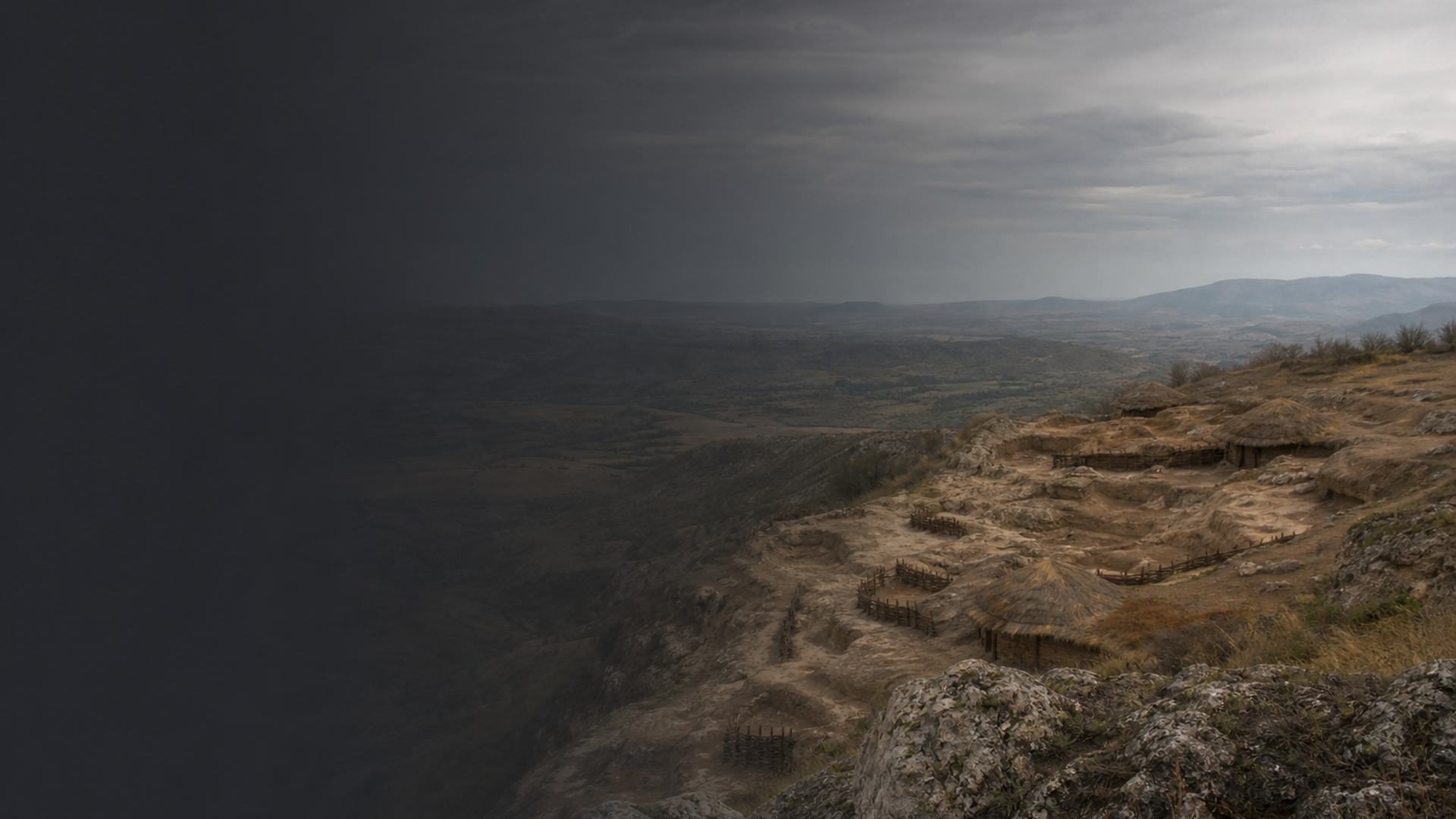
On the low terraces overlooking tributary valleys of central northern Bulgaria, the Petko Karavelovo locality yields the quiet material traces of people who lived during the Chalcolithic horizon (ca. 4700–4400 BCE). Archaeological data indicates settlements organized around household clusters with pottery assemblages and early copper items that link this place to the broader Chalcolithic Bulgarian Culture known by the Petko Karavelovo name.

Material culture—thin-walled painted ceramics, small copper tools, and worked bone—speaks of communities negotiating new technologies and long-distance networks. The site lies within a landscape of river corridors that enabled contact between the Danube corridor, interior Balkan plateaus, and more distant Aegean and Pontic shores.

Limited evidence suggests cultural continuity with earlier Neolithic farming traditions in the region, while also reflecting innovations associated with Copper Age lifeways. The archaeological record at Petko Karavelovo is modest and episodic: house pits, ephemeral hearths, and curated grave deposits hint at social practices but stop short of a complete story.

Genetic data from four individuals provides a slender but evocative thread connecting these excavation contexts to population history. Because the sample size is small, interpretations of migratory direction or cultural transmission remain preliminary and should be treated as working hypotheses rather than settled fact.

  • Site: Petko Karavelovo, Polski Tyrambesh, Veliko Tarnovo prov.
  • Chronology: ca. 4700–4400 BCE, Chalcolithic Bulgarian Culture
  • Archaeology indicates household settlements, pottery, early copper use

Daily Life & Society

Archaeological traces at Petko Karavelovo evoke a day-to-day world of cultivation, craft, and social ritual. Soil chemistry and plant remains from nearby Chalcolithic sites in the region indicate mixed farming—wheat, barley and pulses—paired with animal husbandry of sheep, goats and cattle. Domestic buildings were likely timber and daub structures set in small clusters rather than dense urban cores.

Ceramic assemblages show both local styles and decorative motifs that resonate with neighboring communities, suggesting exchange of ideas or goods. Small copper tools and ornaments—often found in hoards or burials at contemporaneous sites—signal the growing value of metal as both practical technology and social marker. Burial practices, where preserved, range from extended inhumations to secondary deposits; this variability points to complex kinship and ritual behaviors.

Craftspeople working in bone, stone and metal would have been central to daily economy, while seasonal mobility for grazing or exchange along river routes likely supplemented locally produced food. Archaeological data indicates households were embedded in wider networks of trade and alliance, but the scale and intensity of such contact remain incompletely documented for Petko Karavelovo itself.

The human remains sampled for DNA were recovered from contexts consistent with these domestic and funerary activities, allowing us to pair lived experience with genetic signatures—albeit from a very small number of individuals.

  • Economy: mixed farming plus pastoralism, local craft specialization
  • Material culture: decorated pottery, bone tools, early copper objects

Genetic Profile

Four individuals from Petko Karavelovo (sample count = 4) dated to 4700–4400 BCE have been analysed for ancient DNA. Despite the small sample size, the observed genetic markers provide intriguing but provisional signals. Paternally, the Y-DNA pool includes two individuals assigned to M, one to V88, and one to a lineage labelled CTS. M and V88 are uncommon in later European Bronze Age assemblages; V88 in particular has a complex geographical distribution in later millennia and may reflect deep or unexpected links across the Mediterranean, North Africa or the Near East. The CTS label likely denotes a broader clade marker and should be interpreted cautiously without finer subclade resolution.

Maternally, the mtDNA diversity is anchored by haplogroups H (two individuals), an HV+ lineage, and U (one individual). Haplogroup H is widely observed in European Neolithic and later populations; U lineages are also common in Mesolithic and Neolithic Europe. This maternal composition suggests appreciable continuity with the broader maternal gene pool of Neolithic and Chalcolithic Europe.

Taken together, the pattern—a mix of largely European maternal haplotypes and heterogeneous paternal markers—could indicate sex-biased gene flow or the incorporation of diverse male lineages into a core farming population. However, with only four genomes, these inferences remain preliminary. Additional sampling, finer Y-chromosome subclade resolution, and genome-wide analyses are required to test scenarios of local continuity versus incoming male-mediated inputs.

  • Small dataset (n=4): preliminary—interpret cautiously
  • Maternal continuity (H, HV+, U) with European Neolithic pools

Legacy & Modern Connections

The whisper of Petko Karavelovo reaches into modern Balkans genetic landscapes primarily through maternal lineages that are widespread in Europe today. Haplogroups like H and U form part of a long-standing maternal legacy that threads from Mesolithic and Neolithic populations into later Chalcolithic and Bronze Age groups.

The unusual mix of paternal haplogroups seen at Petko Karavelovo raises the possibility that the Chalcolithic Balkans was a crossroads where multiple male lineages intersected with more stable maternal ancestry. Such patterns, if confirmed by larger datasets, could help explain pockets of genetic diversity in the region and illuminate routes of mobility that archaeological artifacts alone cannot fully trace.

Because the genetic sample is small, these connections are suggestive rather than definitive. The real legacy of Petko Karavelovo is methodological as much as historical: combining careful excavation, contextual archaeology, and targeted ancient DNA sampling transforms fragmentary human remains into narratives about migration, exchange, and identity in prehistoric Europe.

  • Maternal haplogroups reflect wider European continuity
  • Paternal diversity hints at complex male-mediated contacts; more samples needed

Assistant IA

Assistant IA par DNAGENICS

Débloquer cette fonction
Posez des questions sur la culture Voices of Petko Karavelovo. L'assistant IA peut expliquer les résultats génétiques, le contexte historique, les preuves archéologiques et les liens génétiques avec les populations actuelles, dans les limites de l'interprétation.
Exemple d'analyse IA

La culture Voices of Petko Karavelovo représente un chapitre fascinant de l'histoire humaine…

L'analyse génétique met en évidence des similarités avec des populations antérieures et des signes d'adaptations propres. Les échantillons d'ADN ancien éclairent les schémas migratoires et les liens entre populations, avec des limites qui dépendent de l'étude et du contexte archéologique.

Il s'agit d'un aperçu de l'analyse IA. Accédez à l'assistant complet pour explorer :

  • Composition et similarité génétique
  • Schémas migratoires et origines
  • Vie quotidienne et pratiques culturelles
  • Contexte génétique actuel