Préparation du rapport

Chargement des informations et références disponibles

Connexion au corpus archéologique…

Collecte des archives antiques

Aller au contenu principal
West Liao River Neolithic Echoes
Profil culturel

West Liao River Neolithic Echoes

Banla Mountain lives—fragments of people, pottery and DNA from 3550–3050 BCE

3550 CE - 3050 BCE
Liaoning, Northeast China
Faites défiler pour commencer
Chapitre I

Le récit

Comprendre la culture West Liao River Neolithic Echoes

Archaeological remains from Banla Mountain (Chaoyang, Liaoning) dated 3550–3050 BCE reveal Middle Neolithic lifeways on the West Liao River. Limited ancient DNA (3 samples) points to mtDNA D and a single Y O2a, suggesting ties to northeastern East Asian lineages but remaining preliminary.

Time Period

3550–3050 BCE

Region

Liaoning, Northeast China

Common Y-DNA

O2a (1 sample)

Common mtDNA

D (2 samples)

Chapitre II

Chronologie

Moments clés de l'histoire de cette culture

2500 BCE

Middle Neolithic occupation in the West Liao River

Archaeological occupation at Banla Mountain reflects Middle Neolithic lifeways within the West Liao River tradition, with pottery, hearths and early cultivation evidence.

Chapitre III

Origins & Emergence

Banla Mountain, perched in the rolling loess and river terraces near Chaoyang city, is a quiet archive of human lives from the Middle Neolithic West Liao River tradition. Archaeological data indicates settlement and ritual activity here between 3550 and 3050 BCE, within a broader web of communities exploiting riverine resources and early cultivation of millet. Excavations have recovered pottery sherds, hearths and pit features that align with regional Neolithic assemblages along the West Liao River basin.

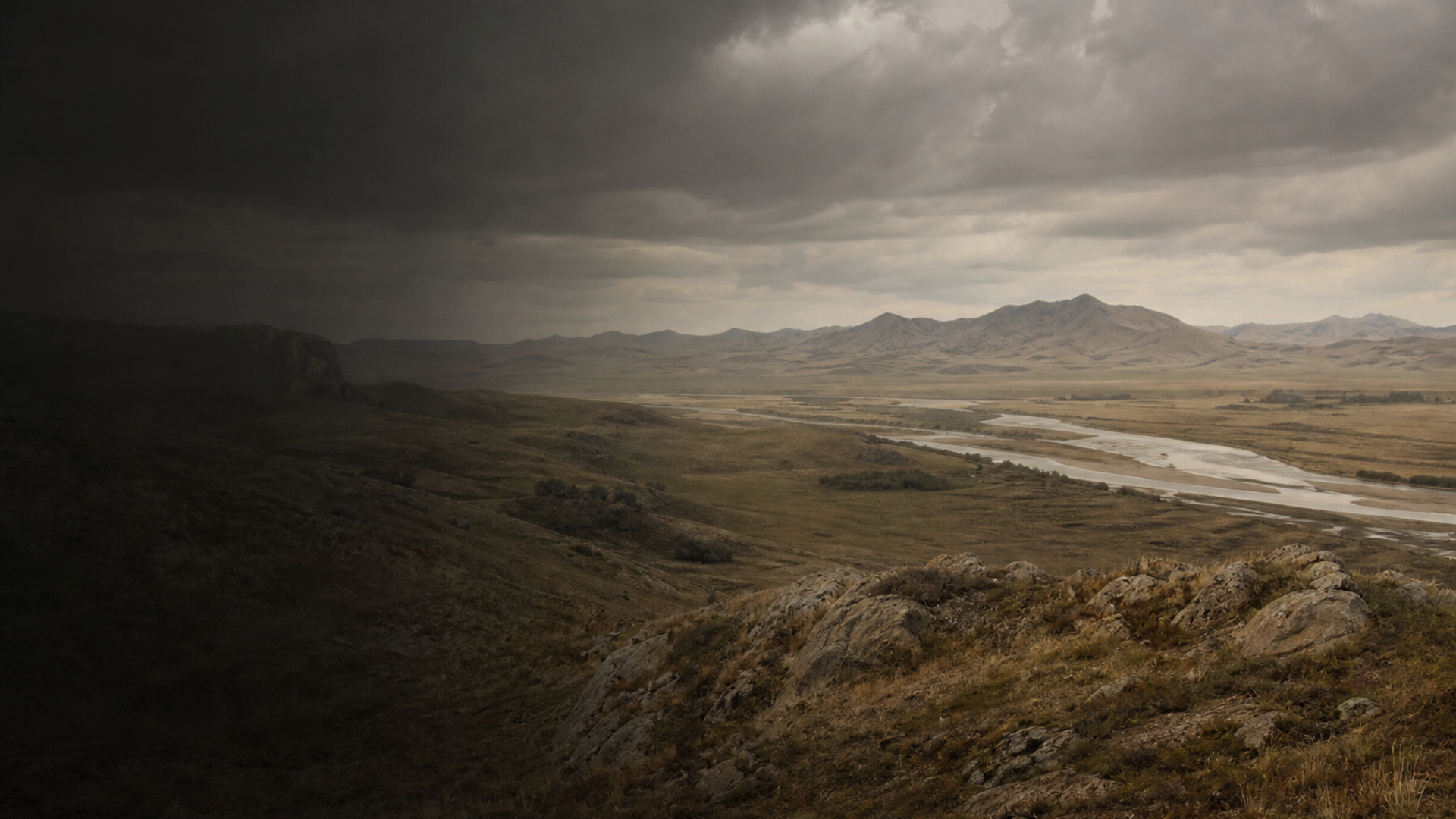
Limited evidence suggests these communities were neither isolated nor monolithic: material styles point to interaction spheres stretching across northeastern China, while the environmental setting implies seasonal scheduling between upland hunting and lowland cultivation. The cinematic image of smoke and small hearths against a cold northern sky evokes a people adapting to a temperate landscape, where food production and foraging coexisted.

Caution is required: with only three ancient DNA samples from Banla Mountain, inferences about population origins must remain tentative. Archaeology provides the cultural framework—pottery, pits, and settlement patterns—while genetic data begins to sketch biological relationships with later and neighboring groups. Together, they offer complementary views of emergence, movement and local persistence in the Middle Neolithic West Liao River world.

  • Site: Banla Mountain, Chaoyang city, Liaoning
  • Cultural context: Middle Neolithic West Liao River tradition
  • Dates: 3550–3050 BCE (radiocarbon and stratigraphic correlation)
Chapitre IV

Daily Life & Society

Archaeological data indicates a domestic life organized around pits, hearths and small households at Banla Mountain. Pottery fragments recovered from excavations show utilitarian forms—cooking and storage vessels—whose wear-scars and soot suggest routine food preparation. The landscape around Chaoyang would have offered a mosaic of riverine wetlands, grasslands and wooded slopes; seasonal exploitation of fish, wild game and early millet cultivation is consistent with regional patterns.

Material culture hints at craft specialization at a small scale: ceramic tempering choices and decorative motifs reflect learned traditions passed within communities. Burial evidence is sparse and fragmentary at Banla Mountain; where present, it indicates modest social differentiation rather than extreme inequality. Social life was likely organized in flexible kin groups, cooperating in planting, harvesting and hunting cycles.

Archaeological interpretations must remain tentative because direct evidence for social hierarchy, long-distance exchange and household size is limited. Nonetheless, the remains evoke a resilient Middle Neolithic lifeway adapted to northeastern China’s seasonal rhythms.

  • Economy: mixed subsistence—early millet cultivation, fishing, hunting
  • Settlements: pit features, hearths, and domestic pottery
Chapitre V

Genetic Profile

Ancient DNA recovered from three individuals at Banla Mountain provides an initial, cautious window into biological ancestry in the West Liao River Middle Neolithic. Two mitochondrial genomes belong to haplogroup D, a lineage widespread in northern and eastern Asia today and frequently observed in Holocene East Asian samples. One Y-chromosome sample is assigned to haplogroup O2a, a paternal lineage common across modern East and Southeast Asia.

These genetic signals align with the archaeological expectation of northeastern East Asian ancestry in the region, suggesting continuity or substantial contribution from populations that share deep roots in northern East Asia. However, the sample count is very low (n=3). When sample counts are under ten, conclusions about population structure, migration, or admixture must be considered preliminary. Limited evidence suggests local continuity with broader East Asian gene pools rather than strong input from distant western Eurasian sources.

Future sampling across more individuals and sites in the West Liao River basin will be essential to test hypotheses about demographic stability, sex-biased mobility, and links to later Neolithic cultures. For now, the genetic data from Banla Mountain complements the archaeological picture: modest, regionally typical lineages that intimate deep northeastern Asian connections.

  • Sample count: 3 (preliminary evidence; interpret cautiously)
  • mtDNA: Haplogroup D (2 individuals); Y-DNA: O2a (1 individual)
Chapitre VI

Legacy & Modern Connections

The genetic and archaeological imprint of Banla Mountain resonates with the living populations of northeastern Asia. Haplogroup D and O2a are today carried by many groups across China and neighboring regions, hinting at threads of biological continuity over millennia. Archaeological continuities in pottery, settlement placement and subsistence strategies suggest cultural traditions that contributed to the long-term tapestry of northeastern Chinese prehistory.

Because the DNA sample set is small, links to specific modern populations should be framed as possibilities rather than certainties. Nonetheless, by weaving together material culture and genetic ancestry, Banla Mountain helps illuminate the deep past of Liaoning and the West Liao River corridor—a landscape that fostered adaptive communities whose descendants still inhabit East Asia.

  • Modern genetic echoes: lineages seen today in Northeast and East Asia
  • Cultural continuity: pottery and settlement patterns mirror regional Neolithic trends
Propulsé par l'IA

Assistant IA

Posez des questions sur la culture West Liao River Neolithic Echoes

Assistant IA par DNAGENICS

Débloquer cette fonction
Posez des questions sur la culture West Liao River Neolithic Echoes. L'assistant IA peut expliquer les résultats génétiques, le contexte historique, les preuves archéologiques et les liens génétiques avec les populations actuelles, dans les limites de l'interprétation.
Exemple d'analyse IA

La culture West Liao River Neolithic Echoes représente un chapitre fascinant de l'histoire humaine…

L'analyse génétique met en évidence des similarités avec des populations antérieures et des signes d'adaptations propres. Les échantillons d'ADN ancien éclairent les schémas migratoires et les liens entre populations, avec des limites qui dépendent de l'étude et du contexte archéologique.

Il s'agit d'un aperçu de l'analyse IA. Accédez à l'assistant complet pour explorer :

  • Composition et similarité génétique
  • Schémas migratoires et origines
  • Vie quotidienne et pratiques culturelles
  • Contexte génétique actuel

Explorez d'autres cultures antiques

Découvrez les récits de civilisations issues du monde antique