Préparation du rapport

Chargement des informations et références disponibles

Connexion au corpus archéologique…

Collecte des archives antiques

Aller au contenu principal
Xiaohe Bronze Age Echoes
Profil culturel

Xiaohe Bronze Age Echoes

Burials from Xinjiang’s Xiaohe reveal a desert crossroads of maternal East Eurasian lineages and western paternal markers.

2050 CE - 1623 BCE
Xinjiang (Tarim Basin), China
Faites défiler pour commencer
Chapitre I

Le récit

Comprendre la culture Xiaohe Bronze Age Echoes

Xiaohe (2050–1623 BCE), a Bronze Age cemetery in Xinjiang's Tarim Basin, preserves wooden coffins, textiles and genomes. Eleven ancient samples show overwhelmingly maternal C4 lineages and two R Y-lineages, suggesting a tapestry of East–West contacts in a harsh oasis landscape.

Time Period

2050–1623 BCE

Region

Xinjiang (Tarim Basin), China

Common Y-DNA

R (2/11)

Common mtDNA

C4 (10/11), R (1/11)

Chapitre II

Chronologie

Moments clés de l'histoire de cette culture

2050 BCE

Earliest Xiaohe burials

Radiocarbon dates place the onset of burial activity at Xiaohe around 2050 BCE, marking Bronze Age occupation of an eastern Tarim oasis.

Chapitre III

Origins & Emergence

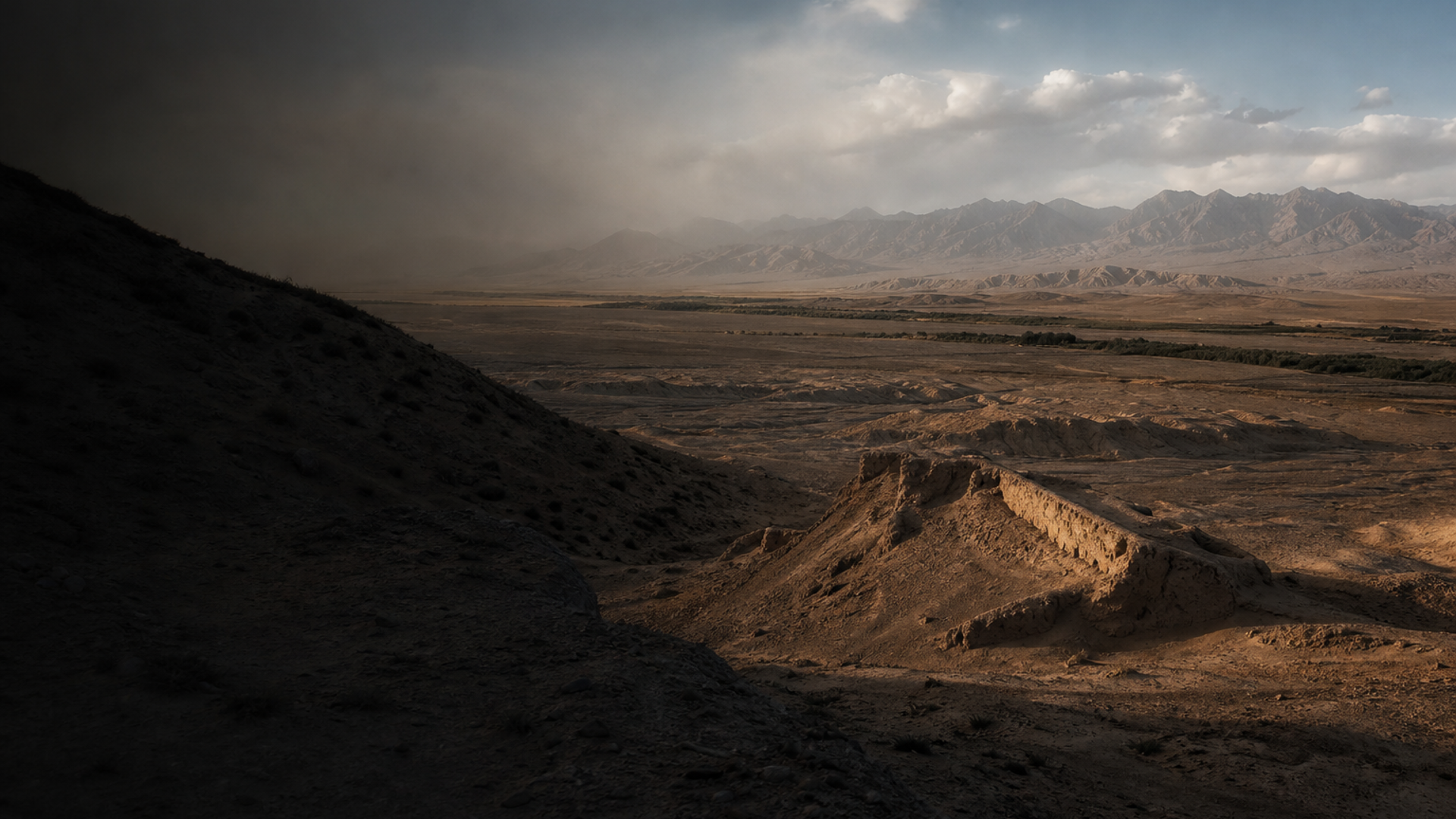
The Xiaohe cemetery, set in the wind-sculpted oases of the eastern Tarim Basin, captures a frozen moment of Bronze Age life between roughly 2050 and 1623 BCE. Archaeological evidence indicates small, dispersed funerary clusters with distinctive wooden, boat-shaped coffins and well-preserved organic goods — textiles, leather and elements of basketry — that survive in the hyper-arid sediments. The material record hints at a community rooted in local oasis exploitation but touched by broad networks: objects and burial rites show affinities with both eastern Siberian traditions and material forms seen farther west across the steppe.

Genomic data from eleven individuals gives a clearer biological silhouette. Maternal lineages are dominated by mtDNA C4, a haplogroup frequent in northern and northeastern Eurasia, while Y-chromosome R haplotypes appear in a minority of male samples. This pattern suggests asymmetric ancestry inputs — for example, widespread East Eurasian maternal ancestry paired with a minority of western-affiliated paternal lines — though the limited sample size tempers bold narratives. Archaeological dating and radiocarbon determinations anchor Xiaohe firmly in the Middle–Late Bronze Age, at a time when long-distance mobility and exchange accelerated across Eurasia. In cinematic terms, Xiaohe stands as a desert amphitheater where distant peoples left genetic and material echoes, but many details of origin and migration remain probabilistic rather than settled.

  • Xiaohe cemetery located in the eastern Tarim Basin (Xinjiang, China)
  • Principal dates: ca. 2050–1623 BCE (Bronze Age)
  • Material culture shows mixed eastern and western affinities
Chapitre IV

Daily Life & Society

The harsh Tarim Basin environment shaped subsistence and social life at Xiaohe. Archaeological data indicates reliance on oasis resources: small-scale irrigation, pastoral herding and the use of wild and domestic animals adapted to arid plains. Grave assemblages preserve garments, felt and woven textiles, implying skilled fiber technologies and a material culture attentive to cold nights and desert winds. Funerary practice — careful placement of bodies in wooden coffins, often accompanied by perishable goods — points to structured ritual and an emphasis on memory.

Goods recovered from burials suggest people who participated in exchange networks: organic materials that survive here would have rotted elsewhere, so their preservation offers rare windows into Bronze Age clothing, cordage and containers. Tool types and the presence of certain animal remains indicate animal husbandry (sheep/goat) and likely mobile pastoral strategies, although evidence for settled agriculture is limited and localized. Social organization may have been kin-based groups tied to particular burial locales, with ritual specialists or elders signaled by richer grave goods. Overall, Xiaohe’s daily life was pragmatic and mobile, yet suffused with symbolic practice — a community negotiating survival and identity on the desert’s edge.

  • Economy centered on oasis resources, pastoralism, and limited cultivation
  • Rich perishable artifacts (textiles, leather) indicate advanced fiber crafts
Chapitre V

Genetic Profile

Eleven ancient genomes from Xiaohe provide a compact but revealing genetic portrait. Ten of the eleven individuals carry mtDNA haplogroup C4, a lineage with strong presence in northern and northeastern Eurasia; this overwhelming maternal signal implies deep East Eurasian maternal ancestry in the sampled community. One individual bears an mtDNA R lineage, underscoring some mitochondrial diversity.

On the paternal side, two of the males carry Y-chromosome haplogroup R. Haplogroup R is heterogeneous and includes branches common in West Eurasia and the Eurasian steppe; its presence at Xiaohe is consistent with at least some west-to-east male-mediated gene flow during the Bronze Age. Taken together, the uniparental picture suggests asymmetric ancestry inputs: dominant local or northerly maternal lines with a minority of western-affiliated paternal markers. Autosomal data from other Tarim Basin individuals (where available) have often shown mixtures of West Eurasian and East Eurasian components; while Xiaohe’s small sample (n=11) restricts sweeping claims, the uniparental patterns align with a model of contact and admixture across the southern steppe and oasis corridors.

Caveats: with only eleven samples, patterns should be treated as preliminary. More genomes across broader chronological intervals are needed to resolve the timing and sources of admixture, the social structure behind sex-biased gene flow, and continuity with later populations.

  • Dominant maternal lineage: mtDNA C4 (10/11)
  • Minority paternal signal: Y haplogroup R in 2 males; suggests west‑to‑east male input
Chapitre VI

Legacy & Modern Connections

Xiaohe’s genetic and material legacy reaches into modern conversations about Eurasian connectivity. The heavy presence of mtDNA C4 resonates with lineages still found among Siberian and some Central Asian groups, implying partial maternal continuity in northern Eurasian gene pools. The occurrence of Y haplogroup R hints at Bronze Age movements that carried western paternal markers into the Tarim Basin, prefiguring later, more extensive admixture events that shaped historic populations of Central Asia.

Cultural echoes — textiles, burial forms and signs of long-distance exchange — foreshadow the later intensification of east–west contact along routes that would become the Silk Road. However, direct, unbroken descent between Xiaohe people and any single modern ethnic group should not be assumed: demographic turnovers, migrations and cultural transformations over millennia complicate simple lines of continuity. Instead, Xiaohe best informs a richer narrative: an arid crucible where diverse peoples met, left material and genetic traces, and contributed threads to the vast tapestry of Eurasian prehistory.

  • mtDNA C4 links to broader northern Eurasian maternal lineages
  • Y-R presence suggests early west-to-east paternal connections; continuity with modern groups is complex and indirect
Propulsé par l'IA

Assistant IA

Posez des questions sur la culture Xiaohe Bronze Age Echoes

Assistant IA par DNAGENICS

Débloquer cette fonction
Posez des questions sur la culture Xiaohe Bronze Age Echoes. L'assistant IA peut expliquer les résultats génétiques, le contexte historique, les preuves archéologiques et les liens génétiques avec les populations actuelles, dans les limites de l'interprétation.
Exemple d'analyse IA

La culture Xiaohe Bronze Age Echoes représente un chapitre fascinant de l'histoire humaine…

L'analyse génétique met en évidence des similarités avec des populations antérieures et des signes d'adaptations propres. Les échantillons d'ADN ancien éclairent les schémas migratoires et les liens entre populations, avec des limites qui dépendent de l'étude et du contexte archéologique.

Il s'agit d'un aperçu de l'analyse IA. Accédez à l'assistant complet pour explorer :

  • Composition et similarité génétique
  • Schémas migratoires et origines
  • Vie quotidienne et pratiques culturelles
  • Contexte génétique actuel

Explorez d'autres cultures antiques

Découvrez les récits de civilisations issues du monde antique