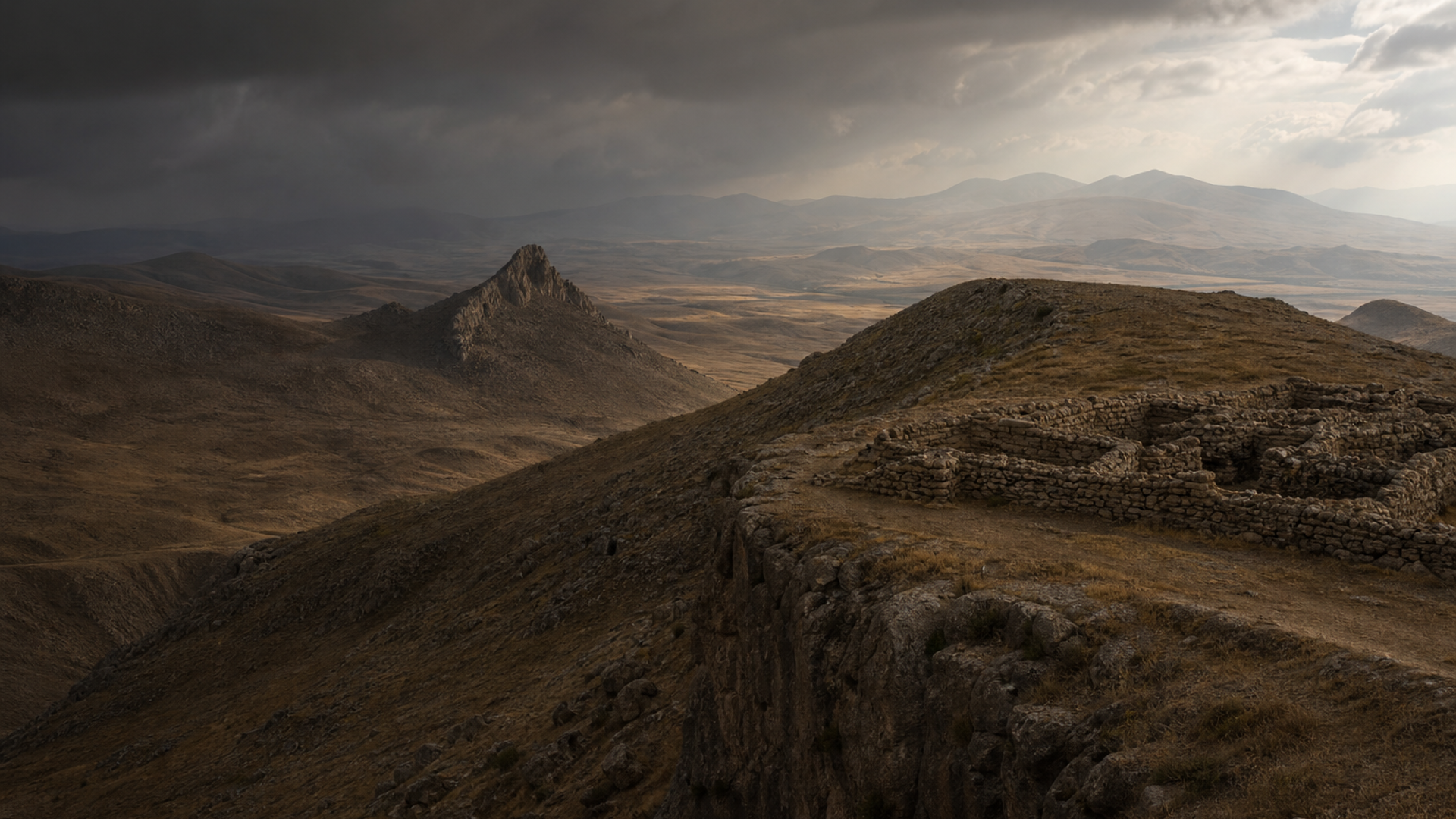
Anatolian Hearths: Turkey Early Bronze Age

下载的 PDF 是图像副本。如需可选中文本及更好的辅助技术支持,请使用打印功能。

Anatolian Hearths: Turkey Early Bronze Age

揭开一个失落的文明

正在加载考古记录……

正在收集古代记录

跳转到主内容
Anatolian Hearths: Turkey Early Bronze Age
文明焦点

Anatolian Hearths: Turkey Early Bronze Age

Lives and genes from 3340–2000 BCE across Anatolia’s varied landscapes

3340 CE - 2000 BCE
Turkey (Anatolia)
滚动开始
Chapter I

剧情

了解 Anatolian Hearths: Turkey Early Bronze Age 文化

Archaeological and genetic evidence from 27 Early Bronze Age individuals across Turkey (3340–2000 BCE) reveals a patchwork of local Anatolian ancestries and maternal diversity. Sites span the Mediterranean, Aegean, Southeast and Black Sea regions, linking material culture to emerging genetic patterns.

Time Period

3340–2000 BCE

Region

Turkey (Anatolia)

Common Y-DNA

J (1/27)

Common mtDNA

K (4), U (4), H (3), R (2), T (2)

Chapter II

时间线

这种文化历史上的关键时刻

3340 BCE

Earliest sampled contexts

Earliest individuals in this dataset date to ~3340 BCE, from tell-sites in western and southeastern Anatolia.

2500 BCE

Expansion of exchange networks

Around 2500 BCE archaeological evidence suggests increased long-distance exchange and the appearance of new metalwork styles at several Anatolian sites.

2000 BCE

Regional reorganization

By 2000 BCE many Early Bronze Age settlements show reorganization or transformation, signaling transition toward later Bronze Age polities.

Chapter III

Origins & Emergence

Across Anatolia the Early Bronze Age (3340–2000 BCE) marks a time when long-established Neolithic farming traditions met expanding regional networks. Archaeological data indicates intensified settlement at tell-sites and new craft specializations at places like Harmanören-Göndürle Höyük (Isparta), Oylum Höyük (Kilis) and Yassıtepe (İzmir). These settlements preserve layered sequences of occupation: domestic floors, kiln complexes and grave deposits that record changing social rhythms.

Material culture—wheel-made pottery, bronze tools in later phases, and regional burial practices—suggests both local continuity from the Chalcolithic and connections with neighboring Anatolian and Levantine communities. The spatial spread from Mediterranean highlands to the Black Sea plain (Devret Höyük, Amasya) points to diverse ecological adaptations and inter-regional exchange. Limited evidence suggests increasing long-distance contacts after ~2500 BCE, visible in exotic raw materials and stylistic influences, but the pattern is uneven across sites.

Taken together, archaeological layers and stratigraphic sequences reveal an Anatolia that is neither uniform nor static: a mosaic of village cores, emerging towns and regional interaction spheres that set the stage for demographic and cultural change in the later Bronze Age.

  • Sites sampled include Harmanören-Göndürle Höyük, Tilbe ar Höyük, Oylum Höyük, Tatika, Yassıtepe, Devret Höyük
  • Material change shows local continuity plus episodic external influence after ~2500 BCE
  • Landscape diversity produced varied settlement and economic strategies
Chapter IV

Daily Life & Society

Archaeological contexts portray domestic routines framed by herding, cereal agriculture and localized craft specialization. At tell-sites, excavations reveal mudbrick houses, storage pits and hearths that sustained multi-generational households. Pottery assemblages—bowls, jars and fine burnished wares—served everyday needs and ritual functions; in some locations, specialized workshops processed metals, stone and pigments.

Economies were rooted in mixed farming: archaeobotanical remains and faunal assemblages from nearby Early Bronze Age sites indicate wheat, barley and sheep-goat herding as staples. Craft production of copper-alloy objects and standardized pottery forms points to growing artisan roles and nascent craft economies. Burial practices vary regionally: inhumations with grave goods occur alongside more modest interments, implying social differentiation but not uniform hierarchy.

Seasonal mobility, local trade routes and river corridors likely structured household resilience. Archaeological data indicates both stable village life and episodes of reorganization—abandonment or rebuilding—that reflect environmental pressures, social negotiation and wider exchange networks across Anatolia.

  • Mixed farming (wheat, barley; sheep-goat) underpinned household economies
  • Workshops and bronze artifacts indicate increasing craft specialization and trade
Chapter V

Genetic Profile

Genome-wide data from 27 Early Bronze Age individuals sampled across Turkey provide a window into population structure during 3340–2000 BCE. The Y-DNA record in this set is sparse: a single observed J haplogroup (1/27), a lineage commonly associated with Near Eastern and Anatolian populations. Maternal lineages are more diverse—mtDNA haplogroups include K (4), U (4), H (3), R (2) and T (2)—reflecting multiple maternal ancestries persisting in the region.

These maternal haplogroups mirror a long-standing Anatolian and Near Eastern genetic substrate: K and H appear frequently in farming-derived populations, while U and T can reflect both Neolithic continuity and later inputs. Archaeogenetic signals suggest that Early Bronze Age Anatolia retained substantial local ancestry linked to earlier Neolithic and Chalcolithic groups, with regional heterogeneity between sites. Limited evidence in some Anatolian samples points to episodic additional ancestry components—potentially from steppe-related or Levantine sources—particularly in later EBA contexts after ~2500 BCE, but these signals vary by site and are not uniform across the dataset.

With 27 samples, conclusions are cautiously supported: the dataset is sufficient to observe broad patterns of maternal diversity and local continuity, yet finer-scale demographic processes (sex-biased migration, minor admixture pulses) require larger and denser sampling to resolve. Future sampling across more sites and time slices will clarify the timing and scale of external genetic inputs into Anatolia during the Bronze Age.

  • Y-DNA: J observed (1/27), consistent with Anatolian/Near Eastern male lineages
  • mtDNA diversity (K, U, H, R, T) indicates mixed maternal ancestries and regional continuity
Chapter VI

Legacy & Modern Connections

The genetic and archaeological signatures of Early Bronze Age Anatolia echo into later millennia. Material continuity in settlement patterns and craft traditions helps explain how Anatolia remained a cultural crossroads between the Near East and the Aegean. Genetically, much of the region’s foundation derives from earlier Neolithic and Chalcolithic populations; later admixture events layered new elements onto this substrate, contributing to the complex ancestry seen in modern populations of Turkey and neighboring regions.

Modern genetic gradients in Anatolia preserve echoes of these deep processes, but they result from many subsequent movements—Iron Age migrations, historical empires and medieval exchanges—that complicate simple lines of descent. Archaeogenetic study of Turkey_EBA therefore provides an essential chapter: it anchors local continuity and reveals the first broad contours of demographic change in a region that would remain pivotal for Bronze Age connectivity.

  • Provides a genetic baseline for later Anatolian population history
  • Highlights long-term continuity punctuated by episodic external inputs
AI 电源

AI 助手

就 Anatolian Hearths: Turkey Early Bronze Age 文化提问

AI 助手 由DNAGENICS公司制作

解锁此特性
Ask questions about the Anatolian Hearths: Turkey Early Bronze Age culture. Our AI assistant can explain genetic findings, historical context, archaeological evidence, and modern connections.
AI 样本分析

Anatolian Hearths: Turkey Early Bronze Age 文化是人类历史中值得了解的一章……

遗传分析揭示了与早期种群的联系,同时显示了独特的适应和文化创新的证据。 古代DNA样本提供了对迁徙模式、社会结构以及古代种群之间的生物关系的深刻见解。

这是人工智能分析的预览。 解锁全AI 助手, 以探索关于:

  • 遗传组成和祖先
  • 移徙模式和起源
  • 日常生活和文化习俗
  • 现代遗传遗产

探索更古老的文化

揭开古代世界文明的故事

使用优惠码 可减免 35% • 11月12日 到期