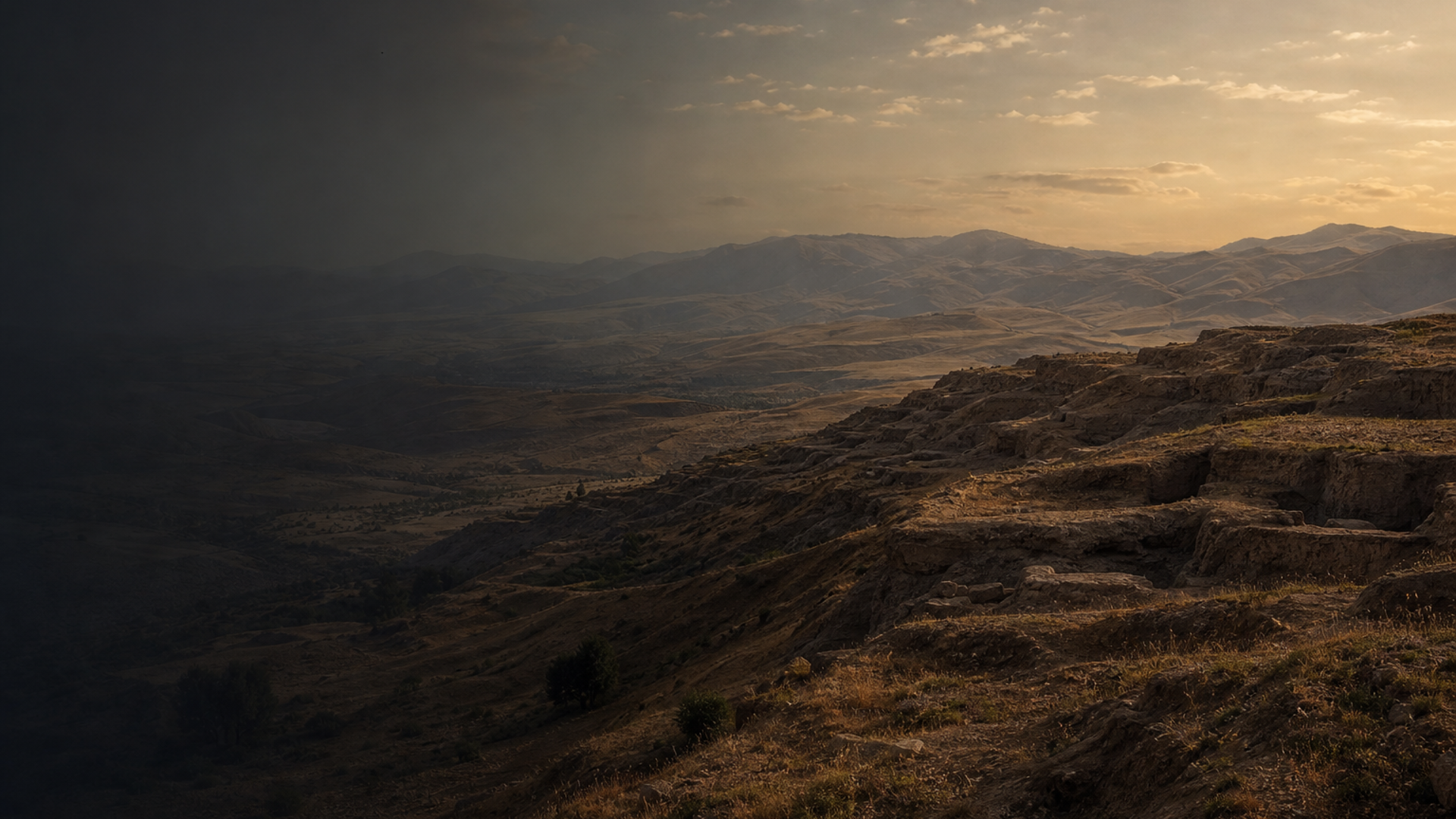
Arslantepe: Late Chalcolithic Echoes

下载的 PDF 是图像副本。如需可选中文本及更好的辅助技术支持,请使用打印功能。

Arslantepe: Late Chalcolithic Echoes

揭开一个失落的文明

正在加载考古记录……

正在收集古代记录

跳转到主内容
Arslantepe: Late Chalcolithic Echoes
文明焦点

Arslantepe: Late Chalcolithic Echoes

A fortified Anatolian mound where pottery, metals and genomes tell a story of contact and continuity

3946 CE - 3032 BCE
Malatya Province, Arslantepe, Turkey
滚动开始
Chapter I

剧情

了解 Arslantepe: Late Chalcolithic Echoes 文化

Arslantepe_LateC (3946–3032 BCE) is a Late Chalcolithic community in Malatya Province, Turkey. Archaeology and 18 ancient genomes reveal a mixed Near Eastern genetic profile and diverse maternal lineages, offering a window into prehistoric Anatolian social networks and mobility.

Time Period

3946–3032 BCE

Region

Malatya Province, Arslantepe, Turkey

Common Y-DNA

J (5), G (4), H (2), E (1), R (1)

Common mtDNA

K (3), H (2), J1c (2), N (2), X (2)

Chapter II

时间线

这种文化历史上的关键时刻

3600 BCE

Late Chalcolithic flourishing at Arslantepe

Arslantepe's Late Chalcolithic levels show intensified craft production, architecture, and regional exchange networks reflected in artifacts and genomes.

Chapter III

Origins & Emergence

Rising from the silts of the upper Euphrates, Arslantepe is a long-occupied tell whose Late Chalcolithic horizon (c. 3946–3032 BCE) registers increased social complexity across eastern Anatolia. Archaeological data indicates monumental architecture, specialized craft production, and exchange networks that linked the highlands with Mesopotamia and the Aegean margin. Stratigraphic sequences at Arslantepe show phases of rebuilding and fortification, suggesting episodes of competition or external threat.

The genetic signal from 18 individuals sampled at Arslantepe complements the material record. Y-chromosome lineages dominated by haplogroups J and G point toward continuity with broader Near Eastern male ancestry clusters known from contemporaneous Anatolian and Levantine sites. Maternal haplogroups (K, H, J1c, N, X) reveal a mosaic of West Eurasian lineages, reflecting both local continuity and long-range connections. Limited evidence cautions against sweeping narratives: while patterns fit a Near Eastern core with punctuated input, the resolution of demographic events (migration, marriage networks, or elite exchange) remains provisional pending larger comparative datasets.

Arslantepe's emergence should therefore be read as a palimpsest — built of local traditions, regional ties, and episodes of external influence visible in both objects and genomes.

  • Occupied tell in Malatya Province with complex Late Chalcolithic phases
  • Archaeological signs of craft specialization, public architecture, and exchange
  • Genetic data suggest a Near Eastern core with diverse maternal lineages
Chapter IV

Daily Life & Society

Ceramic workshops, storage pits, and metallurgy debris evoke a community of artisans and administrators. Archaeological assemblages at Arslantepe include painted and burnished pottery, metal artifacts, and sealings that imply control over production and redistribution. Residences and public structures in the Late Chalcolithic levels imply differentiated household sizes and craft specialization, while burial practices—variable in grave goods and treatment—hint at social hierarchy.

Subsistence likely combined dry farming, herding, and irrigation-fed plots along the Euphrates tributaries. Botanical and faunal remains from the region (where published) indicate cereals, pulses, sheep, goats and cattle as staples; such economies support both local consumption and surplus generation for exchange. Isotopic and skeletal analyses remain limited for this dataset, so reconstructions of diet and mobility are provisional.

Material culture and skeletal finds together sketch a lived world where kin networks, craft production, and long-distance exchange shaped daily rhythms. The presence of sealings and standardized weights in related stratigraphic layers suggests administrative practices that would later characterize Bronze Age urbanism.

  • Artisan production (ceramics, metalworking) visible in Late Chalcolithic strata
  • Household and burial variability suggest emerging social differentiation
Chapter V

Genetic Profile

Eighteen genomes from Arslantepe_LateC offer a moderately sized window into Late Chalcolithic population structure. Y-DNA is dominated by haplogroups J (5/18) and G (4/18), lineages frequently associated with long-standing Near Eastern male ancestries in Anatolia and the Levant. Smaller counts of H (2), E (1) and R (1) indicate some heterogeneity: haplogroup H—while more common in South Asia—appears sporadically in West Eurasian contexts and may reflect low-level gene flow or ancestrally diverse paternal lines.

Mitochondrial diversity is notable: K (3), H (2), J1c (2), N (2), and X (2) together suggest a wide array of maternal origins with strong ties to West Eurasia. Maternal haplogroups such as K and H are common across prehistoric Europe and the Near East, while J1c and X point to lineages with deep regional roots. Archaeogenetic analyses indicate that the Arslantepe community fits a Near Eastern cluster but with detectable internal diversity consistent with trade and interregional marriage.

Caveats: although 18 samples provide better resolution than single graves, this is still a moderate sample size. Patterns observed are robust enough to suggest a Near Eastern genetic backbone with punctuated external inputs, but demographic processes (directionality of gene flow, kinship structures, social transmission) require more samples and ancient DNA from neighboring sites for definitive models.

  • Predominant Y lineages J and G point to Near Eastern male ancestry
  • Diverse mtDNA (K, H, J1c, N, X) reflects mixed maternal origins and mobility
Chapter VI

Legacy & Modern Connections

The genetic and archaeological imprint of Arslantepe_LateC contributes to our understanding of how Late Chalcolithic Anatolia was both locally rooted and regionally connected. Modern populations in eastern Anatolia carry a complex tapestry of ancestries; elements of the Near Eastern genetic substrate identified at Arslantepe persist in the region today, albeit reshaped by millennia of migrations and social change. Archaeogenetic continuity in some lineages underscores long-term habitation of the upper Euphrates corridor, while rarer haplogroups remind us of episodic contacts beyond Anatolia.

For museum visitors and users of DNA ancestry platforms, Arslantepe offers a cinematic yet cautious narrative: tangible artifacts and genomes together reveal a community woven into broader networks of exchange. However, linking specific modern groups to archaeological peoples requires care — genetic continuity is patchy and mediated by many later events. Continued sampling from neighboring sites and time periods will clarify how the Late Chalcolithic peoples of Arslantepe contributed to the genetic landscape of later Bronze Age and historical Anatolia.

  • Some genetic lineages at Arslantepe echo in later Anatolian populations
  • Caution advised: modern connections are complex and shaped by later events
AI 电源

AI 助手

就 Arslantepe: Late Chalcolithic Echoes 文化提问

AI 助手 由DNAGENICS公司制作

解锁此特性
Ask questions about the Arslantepe: Late Chalcolithic Echoes culture. Our AI assistant can explain genetic findings, historical context, archaeological evidence, and modern connections.
AI 样本分析

Arslantepe: Late Chalcolithic Echoes 文化是人类历史中值得了解的一章……

遗传分析揭示了与早期种群的联系,同时显示了独特的适应和文化创新的证据。 古代DNA样本提供了对迁徙模式、社会结构以及古代种群之间的生物关系的深刻见解。

这是人工智能分析的预览。 解锁全AI 助手, 以探索关于:

  • 遗传组成和祖先
  • 移徙模式和起源
  • 日常生活和文化习俗
  • 现代遗传遗产

探索更古老的文化

揭开古代世界文明的故事

使用优惠码 可减免 35% • 11月12日 到期