Barikot (Swat Valley) — Historic Horizons

下载的 PDF 是图像副本。如需可选中文本及更好的辅助技术支持,请使用打印功能。

Barikot (Swat Valley) — Historic Horizons

揭开一个失落的文明

正在加载考古记录……

正在收集古代记录

跳转到主内容
Barikot (Swat Valley) — Historic Horizons
文明焦点

Barikot (Swat Valley) — Historic Horizons

A compact portrait of settlement and shifting ancestries from 45 BCE to 1395 CE in northern Pakistan.

45 BCE - 1395 CE
Swat Valley, Barikot, Pakistan
滚动开始
Chapter I

剧情

了解 Barikot (Swat Valley) — Historic Horizons 文化

Archaeological layers at Barikot (Swat Valley, Pakistan) record centuries of occupation. Ancient DNA from three individuals offers a tentative window into local ancestry, showing a mixture of South Asian maternal lineages and a West Eurasian paternal signal. Limited samples mean conclusions remain provisional.

Time Period

45 BCE–1395 CE

Region

Swat Valley, Barikot, Pakistan

Common Y-DNA

R (1 sample)

Common mtDNA

M (1), H2b (1), R (1)

Chapter II

时间线

这种文化历史上的关键时刻

45 BCE

Earliest sampled individual

One of the three genetic samples dates near the start of the sequence, offering a deep-time glimpse into local ancestry. Conclusions are tentative due to small sample size.

1395 CE

Latest occupation phase sampled

The most recent sampled individual falls near the late medieval period, reflecting continued occupation and changing cultural horizons in the Swat Valley.

Chapter III

Origins & Emergence

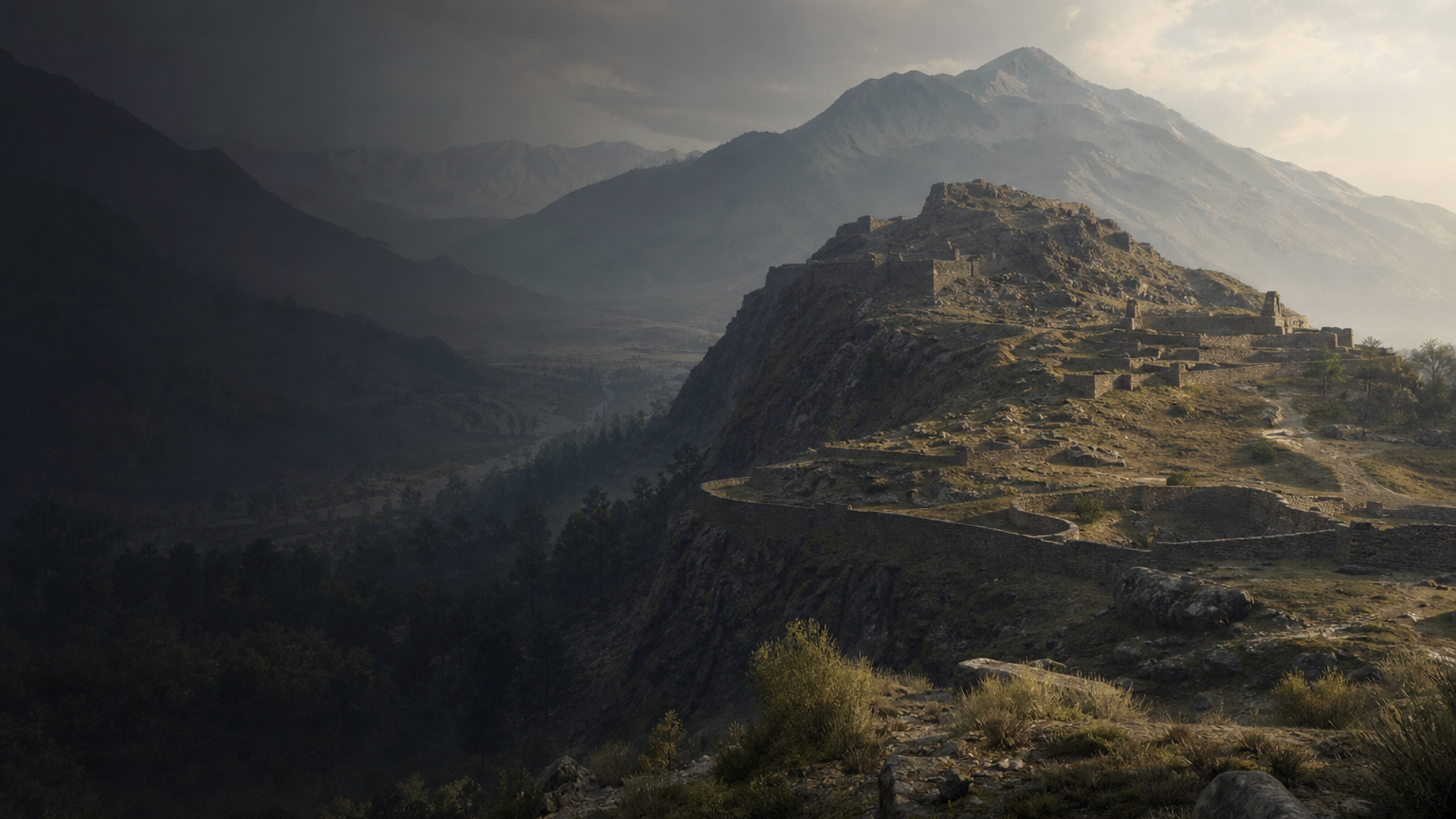
Barikot sits like an archaeological palimpsest in the fertile bowl of the Swat Valley. Excavations reveal a long sequence of occupation across the Historic Barikot era, with evidence for fortified settlements, craft production, and repeated renovation of domestic and ceremonial spaces. The date range represented by our genetic samples — roughly 45 BCE through 1395 CE — spans periods of intense cultural contact across northwest South Asia: trade routes, religious transformations, and periodic political change all left their marks in stratigraphy and material culture.

Limited evidence suggests that the population of Barikot was neither static nor isolated. Ceramic styles, metalwork, and architectural features indicate ties to broader regional networks that link the Indian subcontinent to Central and West Asia. Archaeological data indicates phases of reoccupation and reuse rather than a single, unbroken community. Because the genetic dataset from Barikot is small (three individuals), any narrative of origin must remain cautious: these genomes are snapshots that complement but do not replace the archaeological record. When combined, material culture and DNA hint at a community shaped by both local South Asian continuity and incoming influences over many centuries.

  • Long stratified occupation at Barikot across Historic Barikot era
  • Material culture shows regional connections across South and Central Asia
  • Genetic samples are sparse — interpretations remain provisional
Chapter IV

Daily Life & Society

The streets and workshops of Barikot can be imagined from pottery sherds, hearths, and the fragmentary remains of buildings: artisans working copper and iron, agricultural surpluses sustaining craft specialization, and domestic assemblages reflecting household economies. Religious and funerary features — small shrines, burial pits, and reused ritual spaces — suggest changing belief systems over time, consistent with the wider shifts in the Swat Valley from Buddhist presence into medieval Islamic contexts.

Archaeological indicators point to a mixed economy: cultivation of cereals and pastoral activities supported by riverine resources, with craft production concentrated in particular neighborhoods. Social organization likely combined extended kin-based households with emerging urban forms: fortifications and public architecture imply organized community planning or elite patronage. Yet, the human stories remain partial; osteological data and small-sample genetics offer only fleeting glimpses into health, mobility, and kinship. Where DNA is present, it can illuminate individual life histories — migrants, locals, or mixed-ancestry individuals — but with only three genomes the picture of everyday society is still fragmentary.

  • Evidence for craft specialization, agriculture, and mixed economy
  • Religious and funerary features reflect cultural change over centuries
Chapter V

Genetic Profile

The genetic dataset from Pakistan_H_Barikot comprises three individuals — a very small sample that must be treated as preliminary. Y-chromosome data shows haplogroup R in one individual, a lineage common across West Eurasia and attested at varying frequencies in South Asia; this may indicate a paternal input that resonates with broader regional migrations and contacts. Maternal lineages are diverse: one individual carries mtDNA M, a lineage widespread and deeply rooted in South Asia; another carries H2b, a subclade more frequently observed in West Eurasia and some ancient European contexts; the third carries mtDNA R, a broad maternal macro-haplogroup with wide Eurasian distribution.

Interpreting these signals requires caution. With only three genomes, patterns of admixture, sex-biased migration, or population continuity cannot be robustly quantified. Archaeogenetic comparisons to other regional datasets may suggest that Barikot harbored a mixture of local South Asian maternal ancestry alongside some West Eurasian-affiliated paternal input, consistent with archaeological indications of cultural exchange. However, limited sample count (<10) means these inferences are hypotheses awaiting testing by larger, better-sampled studies. Future DNA from additional burials and precise stratigraphic context will be essential to trace temporal changes in ancestry within the valley.
  • Y-DNA R detected (1/3) — suggests West Eurasian-affiliated paternal input
  • mtDNA shows both South Asian (M) and West Eurasian-associated (H2b, R) maternal lineages
Chapter VI

Legacy & Modern Connections

Barikot's legacy is a layered one: archaeological remains preserve a story of long occupation at a crossroads of cultures, while ancient DNA—though currently sparse—hints at ancestral threads that continue into the present. Modern populations of the Swat Valley and wider northern Pakistan carry a mosaic of South Asian and West/Central Asian genetic components; the limited Barikot samples are consistent with that broader regional mixture but cannot alone define it.

Archaeology and genetics together remind us that human communities were dynamic: trade, migration, and cultural exchange shaped identities over centuries. The Barikot genomes invite further sampling to reveal whether the patterns observed here represent local continuity, episodic migration, or layered admixture. For now, these three individuals are valuable but tentative witnesses to a long and changing human landscape.

  • Modern regional populations show mixed South and West/Central Asian ancestry
  • Three ancient genomes are informative but insufficient — more sampling needed
AI 电源

AI 助手

就 Barikot (Swat Valley) — Historic Horizons 文化提问

AI 助手 由DNAGENICS公司制作

解锁此特性
Ask questions about the Barikot (Swat Valley) — Historic Horizons culture. Our AI assistant can explain genetic findings, historical context, archaeological evidence, and modern connections.
AI 样本分析

Barikot (Swat Valley) — Historic Horizons 文化是人类历史中值得了解的一章……

遗传分析揭示了与早期种群的联系,同时显示了独特的适应和文化创新的证据。 古代DNA样本提供了对迁徙模式、社会结构以及古代种群之间的生物关系的深刻见解。

这是人工智能分析的预览。 解锁全AI 助手, 以探索关于:

  • 遗传组成和祖先
  • 移徙模式和起源
  • 日常生活和文化习俗
  • 现代遗传遗产

探索更古老的文化

揭开古代世界文明的故事

使用优惠码 可减免 35% • 11月12日 到期




