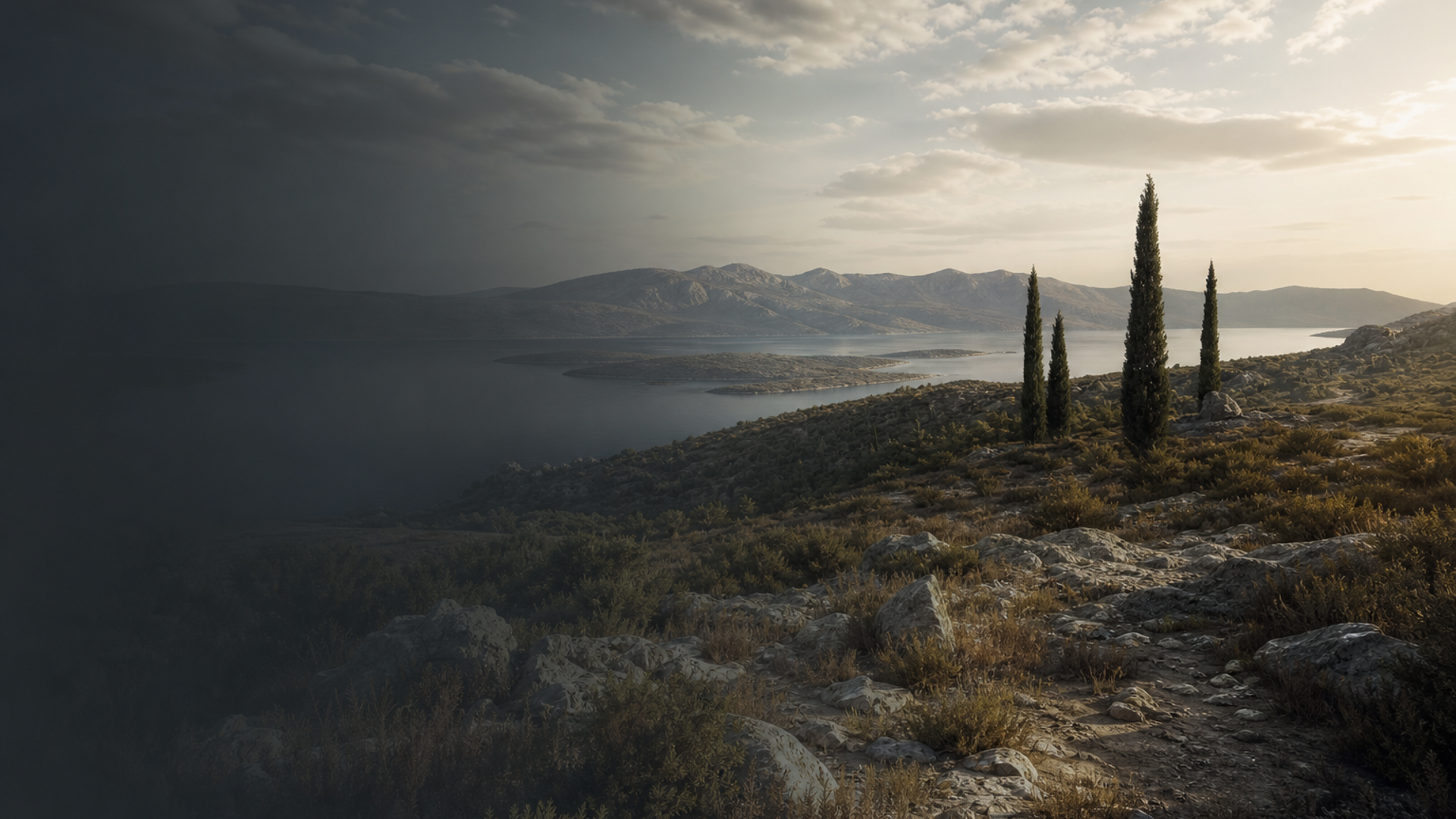
Dalmatian Echoes: Trogir in the Roman Age

下载的 PDF 是图像副本。如需可选中文本及更好的辅助技术支持,请使用打印功能。

Dalmatian Echoes: Trogir in the Roman Age

揭开一个失落的文明

正在加载考古记录……

正在收集古代记录

跳转到主内容
Dalmatian Echoes: Trogir in the Roman Age
文明焦点

Dalmatian Echoes: Trogir in the Roman Age

A coastal Roman-era community in Croatia illuminated by archaeology and ancient DNA

1 CE - 200 CE
Dalmatian coast, Croatia (Trogir-Dragulin)
滚动开始
Chapter I

剧情

了解 Dalmatian Echoes: Trogir in the Roman Age 文化

Archaeological remains and six ancient genomes from Trogir-Dragulin (1–200 CE) reveal a small, regionally rooted Roman-era population with hints of Mediterranean and long-distance connections. Findings are preliminary given the low sample count.

Time Period

1–200 CE

Region

Dalmatian coast, Croatia (Trogir-Dragulin)

Common Y-DNA

E (1 sample)

Common mtDNA

H+ (2), H (1), T (1), T2b (1), C1 (1)

Chapter II

时间线

这种文化历史上的关键时刻

2500 BCE

Early coastal exchange

Coastal Adriatic communities engage in long-distance exchange networks that lay foundations for later Mediterranean connectivity.

Chapter III

Origins & Emergence

Trogir-Dragulin sits on the Dalmatian shore where stone streets once echoed with Latin, Greek and local tongues. Archaeological data indicates that by the early Imperial period (1–200 CE) coastal settlements along the eastern Adriatic were thoroughly integrated into Roman administrative and maritime networks. Graves and habitation layers at Trogir-Dragulin reflect a community living at the threshold of Mediterranean trade: amphora fragments, imported ceramics nearby, and urbanizing architecture point to sustained contact with Italy and the wider Mediterranean.

Genetically, the six sampled individuals provide a cautious glimpse into origins. Limited evidence suggests a predominantly local, Balkan-rooted maternal pool (haplogroups H and T), while the single observed Y-haplogroup E could reflect either continuity with regional male lineages or male-mediated movement from other Mediterranean zones. Given the small sample size, any reconstruction of migration or founding events remains tentative. The archaeological and genetic signatures together paint a picture of a town woven into imperial networks yet retaining local threads — a place where lifetime journeys and inherited ancestries overlapped.

Uncertainties: with only six genomes, distinguishing long-term regional continuity from episodic immigration (soldiers, merchants, sailors) is not yet possible; further sampling across Dalmatia is needed.

  • Coastal settlement integrated into Roman maritime networks
  • Material culture indicates Mediterranean trade contacts
  • Genetic evidence hints at regional continuity with some incoming lineages
Chapter IV

Daily Life & Society

The archaeological record from Trogir and neighboring Dalmatian sites evokes sun-washed harbors, fish-salting workshops, and the bustle of a provincial port where local artisans and itinerant traders crossed paths. Funerary practices recovered at Dragulin—simple inhumations with occasional grave goods—suggest a community with modest wealth and mixed cultural influences rather than grand elite monumentality. Stone-built houses, storage pits and fragments of imported pottery indicate participation in commerce: amphorae carried wine and oil, while everyday ceramics chart the presence of both local and imported wares.

Social life would have been shaped by mobility: Roman military postings, merchant crews, and seasonal work could introduce outsiders and new customs. Epigraphic and architectural evidence from the region more broadly shows Roman civic institutions and infrastructure, yet local traditions persisted in burial customs and craft styles. The interplay of urban Roman frameworks and enduring local identities likely made Trogir a place of blended practices—where foodways, dress, and language reflected layered ancestries and lifeways.

Archaeological data indicates a maritime-focused economy with social ties extending across the Adriatic, but precise household-level reconstructions are limited by uneven excavation coverage.

  • Port economy with trade in amphorae, foodstuffs and crafts
  • Funerary and domestic remains reflect blended Roman and local traditions
Chapter V

Genetic Profile

Six ancient genomes from Trogir-Dragulin (1–200 CE) yield a tentative genetic portrait of a small Roman-era Dalmatian community. Maternal lineages are dominated by H-related haplogroups (H+ in two samples, and H in one), along with T and T2b — mtDNA types common across Europe and the Near East and frequently connected to long-standing post-Neolithic populations in the Balkans. These maternal signatures align with archaeological evidence for local continuity in the population.

Paternal data are sparse: a single Y-chromosome assigned to haplogroup E was observed. Haplogroup E has a wide geographic distribution in the Mediterranean and parts of the Balkans; in this context it may represent either local male continuity or the arrival of individuals linked to broader Mediterranean mobility (merchants, sailors, military personnel). One mtDNA sample was assigned to C1, a lineage that is rare in ancient European datasets and more typically associated with northern/central Eurasian and Native American branches. The presence of C1 in a single individual is striking but must be approached cautiously: possibilities include rare long-range ancestry, post-mortem contamination, or misassignment due to limited coverage.

Because the dataset contains fewer than 10 samples, all genetic interpretations are preliminary. Archaeology and aDNA together suggest a community shaped primarily by regional Balkan ancestry, punctuated by instances of wider Mediterranean or Eurasian contact. Expanded sampling across time and sites is required to clarify patterns of continuity, mobility, and social structure.

  • Maternal pool dominated by European mtDNA (H, T, T2b)
  • Single Y-E and one unexpected C1 mtDNA point to possible mobility or rare lineages; conclusions are preliminary
Chapter VI

Legacy & Modern Connections

The Trogir-Dragulin genomes offer a cinematic fragment of Dalmatia under Rome: a shore where inherited Balkan ancestries mixed with currents from the wider Mediterranean. Archaeological and genetic signals together suggest that modern coastal Croatian populations retain much regional continuity, with layers of Roman-era mobility contributing to genetic and cultural diversity. However, given the small number of ancient samples, it is important not to overstate continuity or to draw direct lines to present-day populations.

Where genetic findings are unexpected — for example the single C1 mitochondrial signal — they raise intriguing possibilities about rare long-distance connections in the Roman world, but also underscore the necessity of rigorous authentication and expanded sampling. As more ancient DNA from Dalmatia and neighboring regions is published, we can better trace how imperial networks, trade, and migration shaped the genetic tapestry that informs modern Croatian heritage.

  • Hints of regional continuity that may contribute to modern Dalmatian ancestry
  • Unusual lineages suggest rare long-distance contacts or require further verification
AI 电源

AI 助手

就 Dalmatian Echoes: Trogir in the Roman Age 文化提问

AI 助手 由DNAGENICS公司制作

解锁此特性
Ask questions about the Dalmatian Echoes: Trogir in the Roman Age culture. Our AI assistant can explain genetic findings, historical context, archaeological evidence, and modern connections.

AI 样本分析

Dalmatian Echoes: Trogir in the Roman Age 文化是人类历史中值得了解的一章……

遗传分析揭示了与早期种群的联系,同时显示了独特的适应和文化创新的证据。 古代DNA样本提供了对迁徙模式、社会结构以及古代种群之间的生物关系的深刻见解。

这是人工智能分析的预览。 解锁全AI 助手, 以探索关于:

  • 遗传组成和祖先
  • 移徙模式和起源
  • 日常生活和文化习俗
  • 现代遗传遗产

探索更古老的文化

揭开古代世界文明的故事

使用优惠码 可减免 35% • 11月12日 到期