Doggerland Mesolithic Echoes

下载的 PDF 是图像副本。如需可选中文本及更好的辅助技术支持,请使用打印功能。

Doggerland Mesolithic Echoes

揭开一个失落的文明

正在加载考古记录……

正在收集古代记录

跳转到主内容
Doggerland Mesolithic Echoes
文明焦点

Doggerland Mesolithic Echoes

Submerged plains, coastal hunters and early DNA signals from the North Sea

9113 CE - 6502 BCE
Netherlands (Doggerland, North Sea)
滚动开始
Chapter I

剧情

了解 Doggerland Mesolithic Echoes 文化

Archaeogenetic and archaeological traces from Doggerland (Netherlands) reveal Mesolithic coastal lifeways between 9113–6502 BCE. Limited sample size (8) makes conclusions preliminary, but mtDNA U and diverse Y-lineages hint at a complex hunter-gatherer population tied to postglacial North Sea landscapes.

Time Period

9113–6502 BCE

Region

Netherlands (Doggerland, North Sea)

Common Y-DNA

M, I, PF (counts: M=3, I=2, PF=1)

Common mtDNA

U (4), K1e (1) — others unassigned/low coverage

Chapter II

时间线

这种文化历史上的关键时刻

9113 BCE

Earliest sampled occupation

One of the oldest radiocarbon dates in this series marks human presence in Doggerland shortly after the Younger Dryas.

Chapter III

Origins & Emergence

When the last ice sheets retreated, a broad low-lying plain known as Doggerland stretched between what is now Britain and continental Europe. Archaeological data indicates human activity in this drowned landscape as early as the 10th millennium BCE. The samples dated here (9113–6502 BCE) come from sediment and trench contexts recovered off the Dutch coast — Brown Bank, Sand Motor, Eurogeul near Rotterdam, Noordhinder trenches, and Maasvlakte-2 — and capture people who lived on dynamic shorelines of lakes, rivers and shallow seas.

These communities emerged from postglacial recolonization processes. Limited evidence suggests cultural affinities with broader northwestern Mesolithic traditions: mobile hunter-fisher-gatherers exploiting rich estuaries and tidal flats. Genetically, Mesolithic Europeans are broadly associated with Western Hunter-Gatherer ancestries; the Doggerland samples appear broadly consistent with this pattern but also show unexpected Y-lineage assignments (see Genetics). Sea-level rise progressively drowned their landscapes, preserving a fragmented archaeological footprint and making direct comparisons with inland Mesolithic sites challenging.

Because only eight individuals are sampled, interpretations about population origins remain provisional. Archaeological and paleoenvironmental work continues to refine the timing and routes by which these coastal groups colonized postglacial northwestern Europe.

  • Occupations dated 9113–6502 BCE from multiple North Sea locales
  • People lived on rich estuaries and tidal flats in a now-submerged plain
  • Genetic signals are broadly hunter-gatherer but show unexpected lineages
Chapter IV

Daily Life & Society

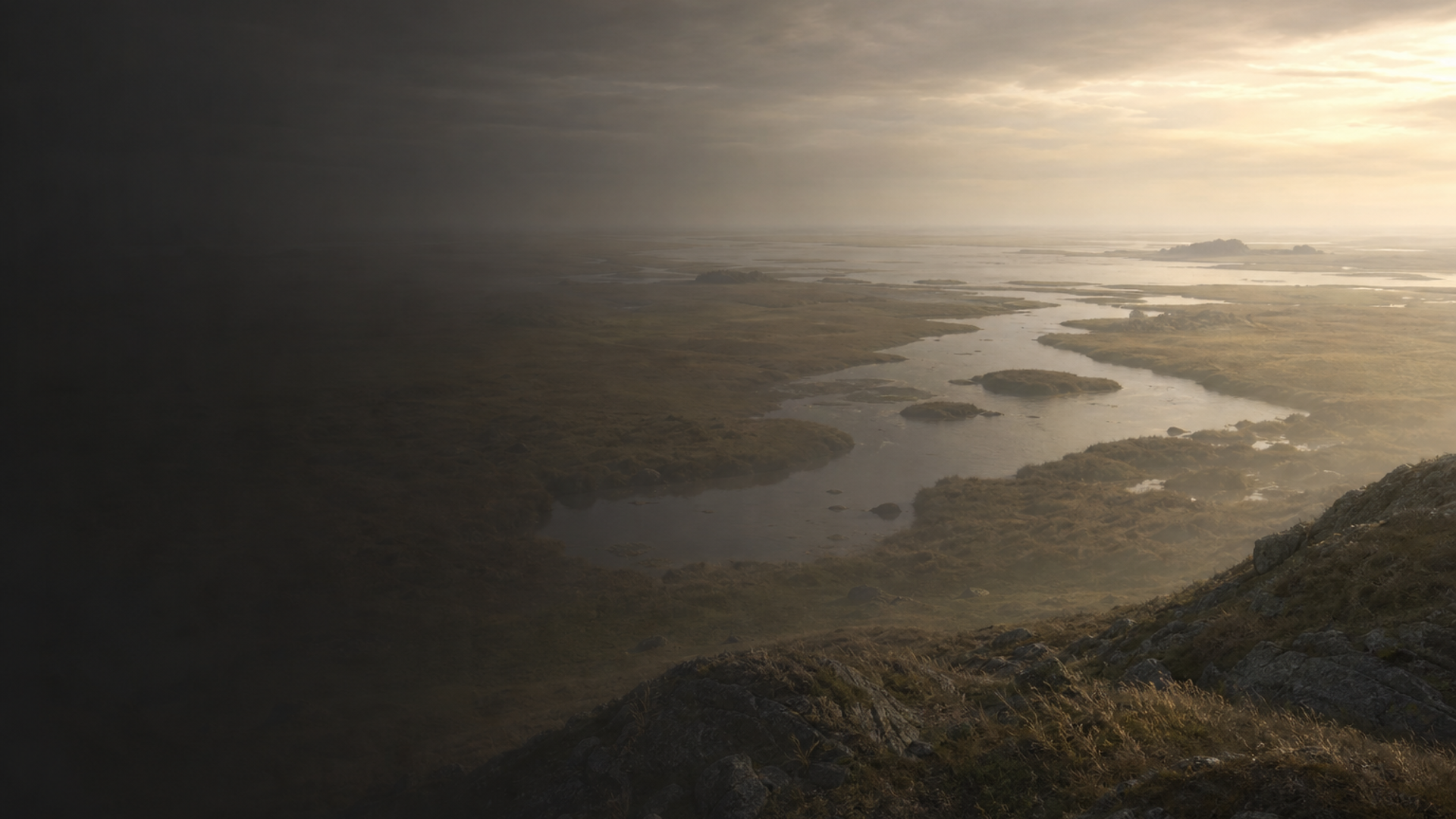
Imagine a mist-shrouded tidal plain where bands of people moved with the rhythms of the sea. Archaeological indicators from submerged Doggerland and nearby coasts suggest a focus on marine and estuarine resources: fishing, shellfish gathering, waterfowl and seal hunting, alongside inland hunting of deer and elk. Flint tools and projectile points, occasionally recovered in seabed sediments, point to a mobile toolkit adapted to both shoreline and riverine environments.

Seasonal movement was likely fundamental. Camps may have been reoccupied at productive estuary mouths or sheltered inlets, with skin-covered shelters and temporary structures that leave little trace underwater. Social groups were small, flexible, and highly knowledgeable about tidal cycles and shifting channels. Limited faunal assemblages and toolkits indicate specialised economies rather than dense sedentary settlements. The material record is fragmentary because rising seas fragmented sites and buried organic structures; pollen and macrofossil data, however, reconstruct a mosaic of willow and pine, reed beds and coastal marshes that sustained rich food webs.

Cultural practices such as raw-material exchange and seasonal aggregation cannot be ruled out but remain speculative without more finds. The cinematic image of Mesolithic Doggerland — fish smoke drifting over reed beds while people mend nets and flint points — is supported by environmental and artefactual clues, yet many details are still beyond our reach.

  • Economy centered on marine and estuarine resources; mixed hunting and fishing
  • Mobile seasonal camps adapted to shifting tidal landscapes
Chapter V

Genetic Profile

Ancient DNA from eight individuals recovered from North Sea contexts offers a preliminary glimpse into the genetic makeup of Doggerland Mesolithic people. Among Y-chromosome calls, three individuals were assigned to haplogroup M, two to I, and one to PF; remaining males were low coverage or unassigned. M is an unexpected result for northwestern Europe based on modern and ancient reference distributions, so this signal may reflect rare lineages, assignment ambiguity, or population heterogeneity. mtDNA shows a dominance of haplogroup U (4 individuals), a lineage commonly associated with European Mesolithic hunter-gatherers; one sample carries K1e, a lineage more often linked with later Neolithic farmers but occasionally found in complex admixture contexts.

These genetic patterns tentatively suggest a core hunter-gatherer mitochondrial heritage alongside diverse paternal lineages. Given the small sample count (<10), stochastic sampling can exaggerate the frequency of rare lineages; any broader population inference is therefore provisional. Nonetheless, the mix of Y-lineages—some typical (I) and some unexpected (M, PF)—raises intriguing questions about male-mediated gene flow, contact zones, and regional microstructure in the North Sea littoral.

Future sampling and higher-coverage genomes will be essential to resolve whether these signals reflect genuine local diversity, transient migrants, or technical/assignation limits. For now, the data illustrate how submerged landscapes can preserve genetic windows into forgotten coastal populations.

  • mtDNA dominated by U (4/8), consistent with Mesolithic hunter-gatherers
  • Y-DNA shows unexpected diversity (M=3, I=2, PF=1); results are preliminary
Chapter VI

Legacy & Modern Connections

The submerged people of Doggerland left few monuments, but their legacy endures in landscapes, genomes and scientific imagination. Archaeogenetics shows continuity of Mesolithic mtDNA lineages across Europe, yet major demographic shifts — Neolithic farming and later Bronze Age migrations — reshaped regional gene pools. Therefore, while some maternal lineages (mtDNA U) have echoes in later populations, broad continuity between Doggerland Mesolithic groups and modern Dutch populations is limited and complex.

Culturally, the study of Doggerland reframes northern Europe as a dynamic coastal heartland in the early Holocene. The combination of archaeology, paleoecology and ancient DNA has transformed drowned seabeds into archives: each recovered bone or flake can change our picture of how people adapted to rising seas. Given the small number of genetic samples, conclusions about long-term legacy should be cautious; future finds may reveal stronger threads connecting these Mesolithic communities to later regional histories.

  • Mesolithic maternal lineages persist in the broader European ancient record, but continuity is partial
  • Doggerland research highlights drowned landscapes as key archives for human prehistory
AI 电源

AI 助手

就 Doggerland Mesolithic Echoes 文化提问

AI 助手 由DNAGENICS公司制作

解锁此特性
Ask questions about the Doggerland Mesolithic Echoes culture. Our AI assistant can explain genetic findings, historical context, archaeological evidence, and modern connections.
AI 样本分析

Doggerland Mesolithic Echoes 文化是人类历史中值得了解的一章……

遗传分析揭示了与早期种群的联系,同时显示了独特的适应和文化创新的证据。 古代DNA样本提供了对迁徙模式、社会结构以及古代种群之间的生物关系的深刻见解。

这是人工智能分析的预览。 解锁全AI 助手, 以探索关于:

  • 遗传组成和祖先
  • 移徙模式和起源
  • 日常生活和文化习俗
  • 现代遗传遗产

探索更古老的文化

揭开古代世界文明的故事

使用优惠码 可减免 35% • 11月12日 到期