Echoes of Iron in the Rhodope Hills

下载的 PDF 是图像副本。如需可选中文本及更好的辅助技术支持,请使用打印功能。

Echoes of Iron in the Rhodope Hills

揭开一个失落的文明

正在加载考古记录……

正在收集古代记录

跳转到主内容
Echoes of Iron in the Rhodope Hills
文明焦点

Echoes of Iron in the Rhodope Hills

Early Iron Age communities in southern Bulgaria seen through archaeology and maternal genomes

1100 CE - 500 BCE
Southern Bulgaria (Rhodope & Haskovo)
滚动开始
Chapter I

剧情

了解 Echoes of Iron in the Rhodope Hills 文化

Human remains (16 samples) from 1100–500 BCE in southern Bulgaria link burial landscapes to maternal lineages (mtDNA H, U, K, J1c). Archaeological contexts and emerging aDNA point to local continuity with episodic gene flow; Y‑chromosome data remain limited.

Time Period

1100–500 BCE

Region

Southern Bulgaria (Rhodope & Haskovo)

Common Y-DNA

Limited / indeterminate (sparse Y‑DNA data)

Common mtDNA

H (6), U (3), K (2), H+ (1), J1c (1)

Chapter II

时间线

这种文化历史上的关键时刻

1100 BCE

Start of sampled Early Iron Age

Beginning of the period represented by the 16 sampled individuals from southern Bulgaria (1100 BCE).

800 BCE

Regional social consolidation

Archaeological patterns suggest increased local differentiation and reuse of hilltop sites in the Rhodope region.

500 BCE

End of sampled period

The upper bound of this dataset (500 BCE), after which different political and cultural dynamics emerge in the region.

Chapter III

Origins & Emergence

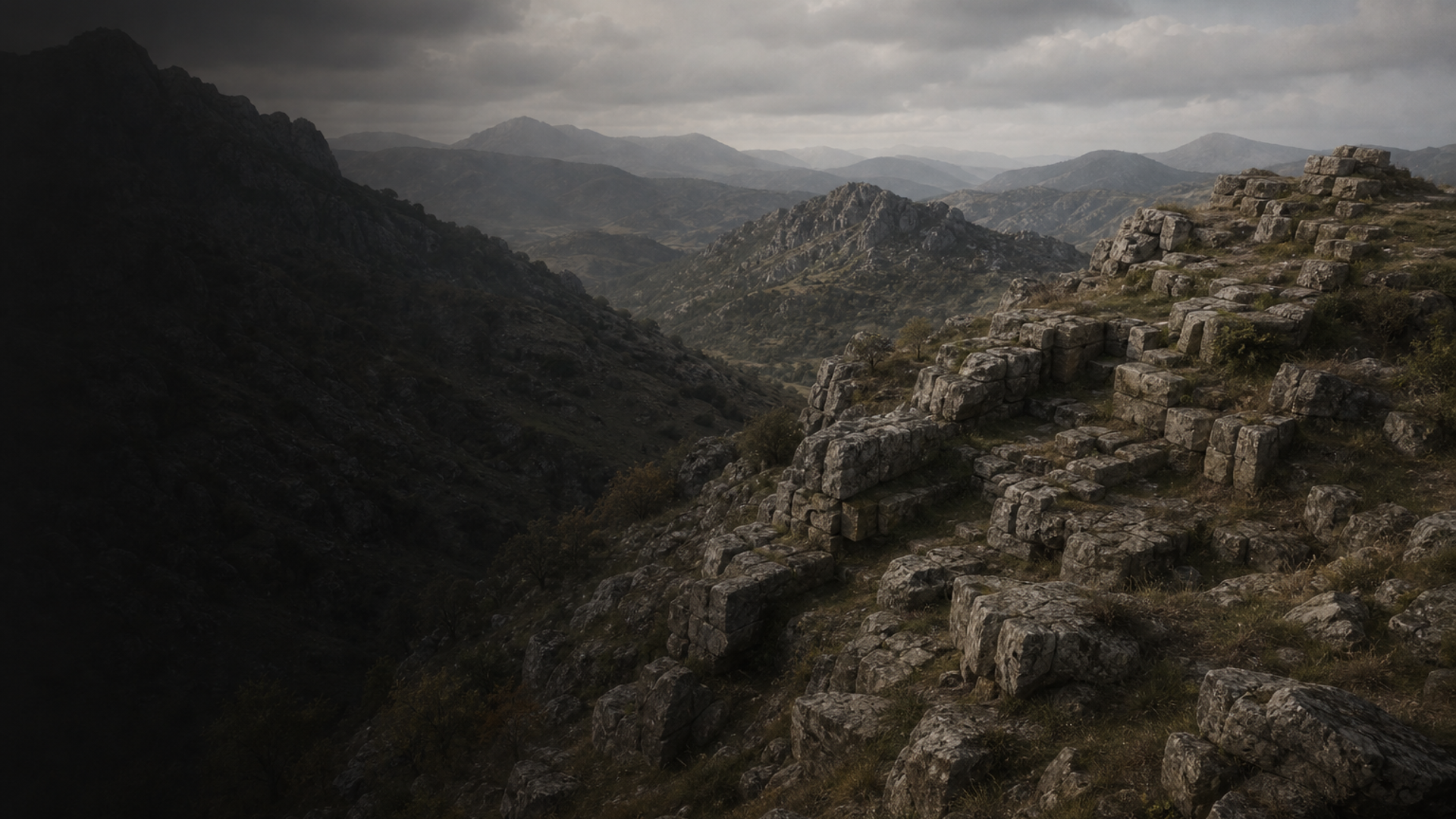
Between 1100 and 500 BCE the landscape of what is now southern Bulgaria — the foothills and valleys around the Eastern Rhodopes and Haskovo province — was a place of slow accretion rather than sudden rupture. Archaeological surveys and cemetery discoveries at sites near Kapitan Andreevo, Stambolovo, Diamandovo and Svilengrad record funerary activity and settlement traces that align with the broader Early Iron Age transformations across the northern Aegean and Balkan interior.

Material culture shows continuity with Late Bronze Age craft traditions alongside new iron implements and regional burial practices. Limited evidence suggests that some communities reorganized around fortified hilltops and river corridors, reflecting changing social hierarchies and intensified local interaction networks. Ceramic styles and metalworking display both local inheritance and stylistic echoes of neighboring Thracian and Aegean spheres — a patchwork of influence rather than a single intrusive culture.

Genetic data from 16 sampled individuals provide a complementary line of evidence: maternal lineages dominated by haplogroup H with notable presence of U, K and J1c suggest substantial continuity with earlier European populations who carried Neolithic farmer and Mesolithic hunter‑gatherer ancestry. While these signals do not map directly to specific ethnic labels, they help anchor the archaeological record in real people whose mitochondrial genomes reflect long threads of maternal descent woven through the region.

  • Sites: Kapitan Andreevo, Stambolovo, Diamandovo, Svilengrad
  • Transition from Late Bronze Age craft to Iron Age metallurgy
  • Archaeological signs of regional continuity with episodic external influence
Chapter IV

Daily Life & Society

The daily world of Early Iron Age inhabitants in southern Bulgaria can be glimpsed through funerary goods, pottery forms, and settlement scatters. Domestic life centered on mixed farming — cereals, pulses and herded animals — managed in terraces and valley fields. Hearths and storage pits in habitation zones indicate seasonal rhythms: sowing, harvest, livestock movements and craft production.

Craftspeople worked in bronze and increasingly iron, producing tools and personal items that circulated across short regional circuits. The archaeological record points to household-based production with occasional specialized smithing, and to pottery traditions that combined local fabrics with decorative motifs seen across the central Balkans. Burial practices vary: inhumations with grave goods coexist with simpler interments, suggesting social differentiation in life and death.

Social organization likely ranged from kin‑based villages to small fortified centers. Exchange networks — for raw materials like copper and finished objects — connected the Rhodope foothills to rivers and trade routes leading to the Aegean and the Danubian corridor. These material connections are mirrored in the genetic landscape, where maternal lineages attest to long‑standing local populations engaged in wider human networks rather than wholesale population replacement.

  • Mixed farming and herding supported village life
  • Local craft production with links to regional exchange networks
Chapter V

Genetic Profile

Sixteen individuals dated between 1100 and 500 BCE yield an initial genetic portrait of Early Iron Age southern Bulgaria. Mitochondrial haplogroups are dominated by H (6 samples), followed by U (3), K (2), a separate H+ (1) designation and one J1c. This distribution is consistent with much of prehistoric and historic Europe, where haplogroup H is the most common maternal lineage, and U retains a legacy from earlier hunter‑gatherer ancestry.

Haplogroup K and J1c often associate with Neolithic farmer-derived maternal lineages across Europe; their presence here supports archaeological interpretations of continuity from the Neolithic and Bronze Age into the Early Iron Age. The relative abundance of H alongside U suggests a mixed maternal heritage: long‑term local ancestry enriched by Neolithic inputs and later regional gene flow. Importantly, available Y‑chromosome data are sparse or not consistently reported for this sample set, so male‑line dynamics — whether marked by continuity, local elite replacement, or incoming male migration — remain unresolved.

With 16 samples, patterns observed are suggestive but not definitive. The sample size allows us to detect broad maternal trends, yet additional genomes (especially autosomal and Y‑DNA) are needed to quantify ancestry proportions, sex‑biased movements, and fine‑scale population structure. Archaeogenetics and archaeology together paint a picture of continuity punctuated by mobility: people who shared mitochondrial lineages common in Europe while participating in new Iron Age cultural landscapes.

  • mtDNA dominated by H, with U, K and J1c present
  • Y‑DNA patterns remain uncertain due to limited data
Chapter VI

Legacy & Modern Connections

The mitochondrial lineages detected among these Early Iron Age burials tie the Rhodope foothills to wider European maternal histories. Haplogroup H’s prevalence links these people to a deep, continent‑wide maternal clade that persists today across Europe; U and K lineages echo older chapters of hunter‑gatherer and Neolithic farmer ancestry. Archaeological continuity in material culture and these genetic signals together suggest that modern populations in Bulgaria descend in part from local Bronze Age and Iron Age communities, though later historical migrations and admixture also shaped the gene pool.

Caveats matter: the 16 samples provide a valuable window but not a complete panorama. Where Y‑chromosome or autosomal data are limited, statements about population movements and social dynamics must remain cautious. Continued sampling, especially from varied contexts and with high‑coverage genomes, will sharpen links between the iron‑streaked landscapes people inhabited and the genetic threads they passed on.

  • Maternal lineages reflect deep continuity with European ancestries
  • Existing sample size gives early insights but requires more data
AI 电源

AI 助手

就 Echoes of Iron in the Rhodope Hills 文化提问

AI 助手 由DNAGENICS公司制作

解锁此特性
Ask questions about the Echoes of Iron in the Rhodope Hills culture. Our AI assistant can explain genetic findings, historical context, archaeological evidence, and modern connections.
AI 样本分析

Echoes of Iron in the Rhodope Hills 文化是人类历史中值得了解的一章……

遗传分析揭示了与早期种群的联系,同时显示了独特的适应和文化创新的证据。 古代DNA样本提供了对迁徙模式、社会结构以及古代种群之间的生物关系的深刻见解。

这是人工智能分析的预览。 解锁全AI 助手, 以探索关于:

  • 遗传组成和祖先
  • 移徙模式和起源
  • 日常生活和文化习俗
  • 现代遗传遗产

探索更古老的文化

揭开古代世界文明的故事

使用优惠码 可减免 35% • 11月12日 到期




