Echoes of Modern Libya

下载的 PDF 是图像副本。如需可选中文本及更好的辅助技术支持,请使用打印功能。

Echoes of Modern Libya

揭开一个失落的文明

正在加载考古记录……

正在收集古代记录

跳转到主内容
Echoes of Modern Libya
文明焦点

Echoes of Modern Libya

Genomic snapshots from migrants and Tripoli, 2000 CE — tracing recent movement and continuity

2000 CE
Libya (Tripoli and migrant contexts)
滚动开始
Chapter I

剧情

了解 Echoes of Modern Libya 文化

Fourteen modern samples collected in Libya and among migrants in Israel (2000 CE) offer a modest genomic window into Libya's recent human landscape. Archaeological context from Tripoli and ancient coastal cities frames patterns of migration, continuity, and admixture.

Time Period

2000 CE (Modern era)

Region

Libya (Tripoli and migrant contexts)

Common Y-DNA

Not reported in this dataset

Common mtDNA

Not reported in this dataset

Chapter II

时间线

这种文化历史上的关键时刻

1951 CE

Independence of the Kingdom of Libya

Libya gains independence and unites its regions, shaping modern national identity and migration policies.

1969 CE

Military coup and new regime

A 1969 coup brings a new government that significantly alters governance, international ties, and population movements.

2011 CE

Revolution and civil conflict

Widespread uprisings and conflict produce large-scale displacement and new diaspora movement across the region.

Chapter III

Origins & Emergence

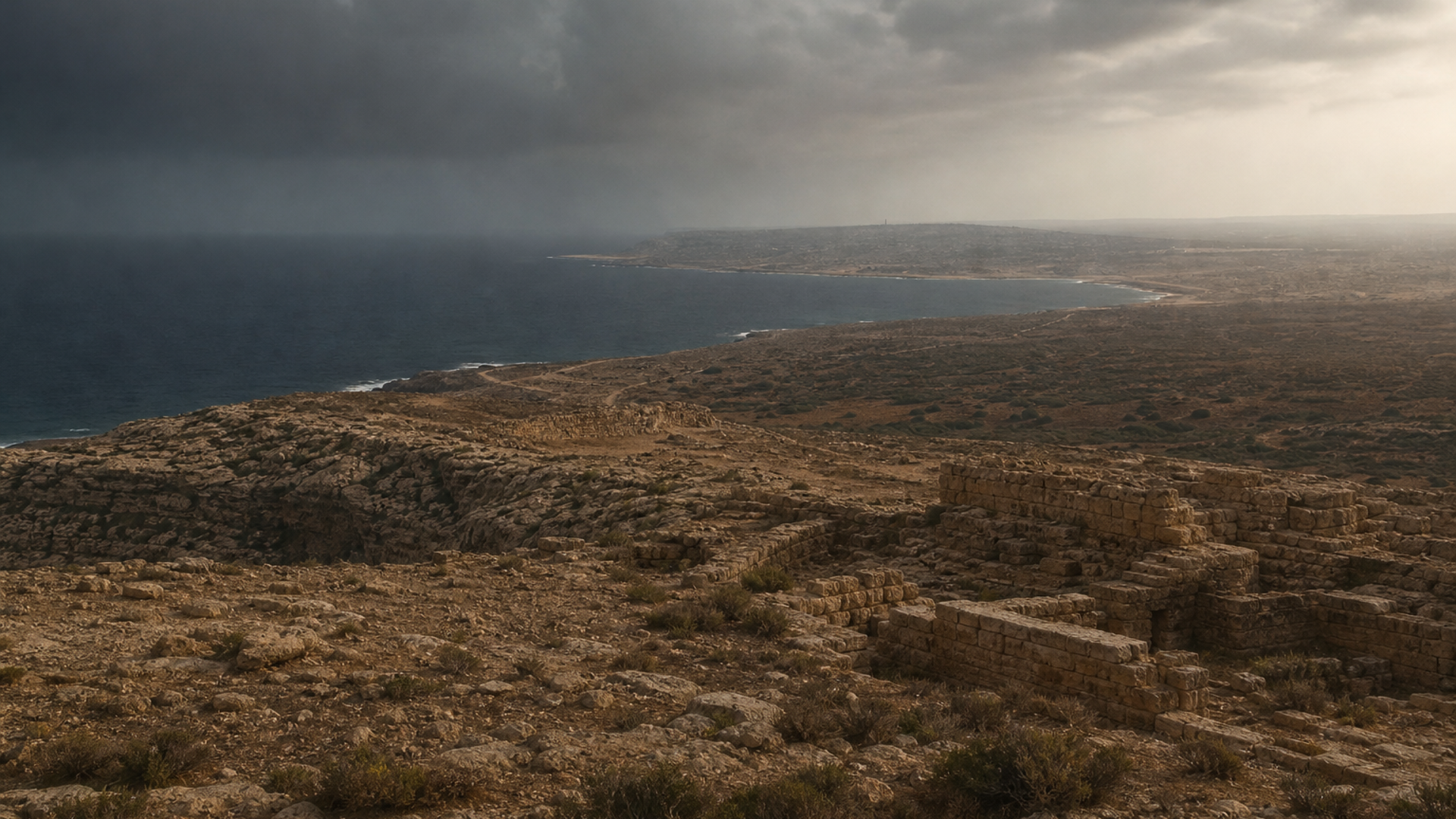
Modern Libya is a palimpsest: millennia of coastal empires, desert trade, and more recent colonial and post-colonial transformations lie beneath contemporary streets. Although the samples in this dataset date to 2000 CE — a single year in a long sequence — archaeological sites such as Leptis Magna (near Al Khums), Sabratha (northwest coast), and Cyrene (eastern plateau) provide a long-term backdrop of Mediterranean connectivity. These ancient ports and inland settlements document centuries of movement between North Africa, the Near East, and Europe.

Archaeological data indicates sustained settlement along the coast and shifting patterns of material culture across eras: Phoenician-Punic trading posts, Roman urbanism, later Byzantine and Islamic phases, Ottoman rule, and Italian colonial infrastructure. For the modern period, urban stratigraphy in Tripoli records 19th–20th century expansion, while migration records and ethnographic observation show intense mobility across the Mediterranean corridor.

Limited evidence from this small, modern sample set cannot reconstruct deep origins, but it aligns with a landscape shaped by repeated contacts and layered ancestries. Where archaeological layers show trade and population movement, genetic signals in living communities often echo those connections — albeit modified by recent demographic events.

  • Modern samples reflect a long history of coastal connectivity.
  • Key archaeological sites: Leptis Magna, Sabratha, Cyrene provide historical context.
  • This dataset is modern (2000 CE) and cannot alone speak to ancient demography.
Chapter IV

Daily Life & Society

Daily life in Libya at the turn of the 21st century combined urban rhythms, Mediterranean commerce, and enduring rural and tribal networks. In Tripoli, markets (souks), ports, and administrative centers concentrated labor and exchange; in smaller towns and oases, pastoralism and agriculture persisted. Archaeological traces of contemporary life — discarded ceramics, 20th-century building foundations, port deposits — help anchor the modern human story in material terms.

Migration and kinship networks play a central role: families often maintain transnational ties across the Mediterranean, and seasonal or long-term migration has shaped household composition. Migrants collected in Israel indicate direct human movement out of Libya into regional diasporas. These movements are recorded both in oral histories and in the stratified debris of urban neighborhoods where new construction sits atop older building phases.

Archaeology of the recent past complements ethnography and genetics: together they reveal how trade, governance, and conflict influence everyday life and mobility patterns.

  • Urban Tripoli as a focal point of trade, administration, and migration.
  • Migration networks link Libyan households to regional diasporas.
Chapter V

Genetic Profile

This dataset contains 14 modern samples from Libya and migrants collected in Israel (2000 CE). The sample count is modest: while larger than very small pilot studies, it remains limited for making population-wide claims. Importantly, the input data does not report common Y-DNA or mtDNA haplogroups, so interpretations must be cautious and framed as provisional.

Comparative genetic studies of North African populations generally document a mosaic of ancestry components: local North African lineages (including Berber/Amazigh-associated genetic signals), gene flow from the Near East and Mediterranean Europe, and contributions from Sub‑Saharan Africa. For modern Libyan individuals, these layers are often visible at varying proportions depending on region, historical connections (coastal cities versus inland communities), and recent migration. The presence of migrant samples collected in Israel highlights contemporary mobility and diaspora formation; such individuals can carry amplified signatures of recent admixture or founder effects tied to migration events.

Without haplogroup detail, useful genetic interpretations focus on structure and context: (1) these samples provide a window into recent population dynamics around 2000 CE; (2) they should be compared to broader North African and Mediterranean reference panels to assess affinities; and (3) any inferred admixture proportions must be treated as provisional given the modest sample size.

Future sampling with explicit uniparental marker reporting (Y-DNA, mtDNA) and autosomal analyses across larger cohorts will clarify how the modern genetic landscape of Libya relates to its archaeological and historical record.

  • Dataset: 14 modern samples (2000 CE); modest sample size — interpretations are provisional.
  • No Y‑DNA or mtDNA haplogroups reported in the provided data; further genotyping needed.
Chapter VI

Legacy & Modern Connections

Modern Libyan identity is formed at the intersection of deep regional histories and rapid 20th–21st century changes. Archaeological monuments from antiquity remain cultural touchstones, while modern migration, political upheaval, and transnational family ties continually reshape demographic reality. Genetic snapshots from migrants and Tripoli capture moments of movement and mixture that mirror maritime trade and historical links across the Mediterranean.

These 2000 CE samples are part of a living legacy: they document the human face of recent mobility and suggest lines of inquiry that bridge material culture, recorded history, and genomes. As genomic datasets grow and are combined with archaeological and archival evidence, we can trace how modern Libyan communities inherit, transform, and transmit biological and cultural lineages through time.

  • Modern samples capture recent migration and diaspora connections.
  • Integrating archaeology and genetics can illuminate continuity and change in Libyan society.
AI 电源

AI 助手

就 Echoes of Modern Libya 文化提问

AI 助手 由DNAGENICS公司制作

解锁此特性
Ask questions about the Echoes of Modern Libya culture. Our AI assistant can explain genetic findings, historical context, archaeological evidence, and modern connections.
AI 样本分析

Echoes of Modern Libya 文化是人类历史中值得了解的一章……

遗传分析揭示了与早期种群的联系,同时显示了独特的适应和文化创新的证据。 古代DNA样本提供了对迁徙模式、社会结构以及古代种群之间的生物关系的深刻见解。

这是人工智能分析的预览。 解锁全AI 助手, 以探索关于:

  • 遗传组成和祖先
  • 移徙模式和起源
  • 日常生活和文化习俗
  • 现代遗传遗产

探索更古老的文化

揭开古代世界文明的故事

使用优惠码 可减免 35% • 11月12日 到期




