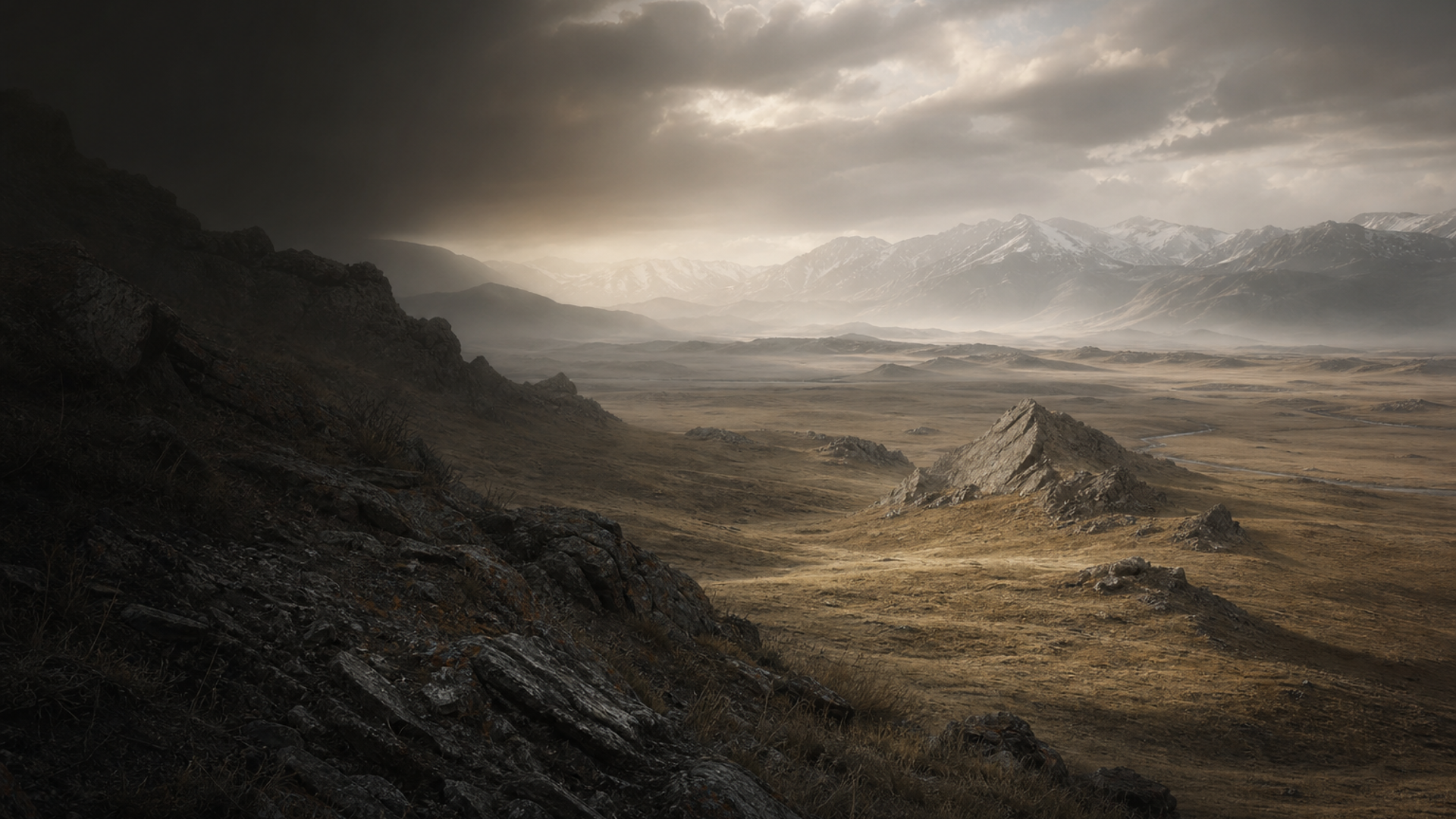
Echoes of the Altai Steppe

下载的 PDF 是图像副本。如需可选中文本及更好的辅助技术支持,请使用打印功能。

Echoes of the Altai Steppe

揭开一个失落的文明

正在加载考古记录……

正在收集古代记录

跳转到主内容
Echoes of the Altai Steppe
文明焦点

Echoes of the Altai Steppe

Afanasievo communities on the Middle Yenisei, where burials and DNA trace Bronze Age movements

3331 CE - 2000 BCE
Altai Mountains & Middle Yenisei, Russia
滚动开始
Chapter I

剧情

了解 Echoes of the Altai Steppe 文化

The Russia_Afanasievo assemblage (3331–2000 BCE) combines kurgan burials in the Altai and Middle Yenisei with genetic signatures dominated by Y haplogroup R and mtDNA U. Archaeology and a 30-sample genetic series illuminate early Bronze Age migrations and contacts in southern Siberia.

Time Period

3331–2000 BCE

Region

Altai Mountains & Middle Yenisei, Russia

Common Y-DNA

R (12), Q (3)

Common mtDNA

U (15), T (6), J (5), H (2), K (1)

Chapter II

时间线

这种文化历史上的关键时刻

3300 BCE

Early Afanasievo expansion into Altai

Kurgan burials and pastoral economies appear in the Altai and Middle Yenisey, marking a steppe-derived cultural presence in southern Siberia.

Chapter III

Origins & Emergence

Beneath the wind-swept ridges of the Altai and the banks of the Yenisey, the Afanasievo horizon appears in the archaeological record as a striking continental pulse during the early Bronze Age. Radiocarbon-calibrated contexts in this dataset span roughly 3331–2000 BCE and include classic funerary sites such as Afanasieva Gora, Kaminnaya Cave, Saldyar-1 cemetery, Podsukhanika II and Ust'-Kuyum. Archaeological data indicates the presence of kurgan-style burials, inhumations with flexed or extended postures, occasional grave goods including metal items and animal remains, and pastoralist indicators consistent with mobile herding economies.

Material culture and mortuary practice suggest cultural affinities with steppe groups to the west, notably elements reminiscent of early Yamnaya-related communities, but localized expressions develop across the Altai. Genetic evidence from 30 individuals provides a moderate sample that supports a substantial steppe-derived ancestry in many Afanasievo-associated burials. Limited evidence points to later, variable admixture with local Siberian groups after the initial appearance of Afanasievo populations. While the overall pattern points to a migration of steppe pastoralists into southern Siberia in the 4th–3rd millennia BCE, uncertainties remain about the precise routes, the number of migration pulses, and the social processes that produced the archaeological diversity observed across sites.

  • First widespread Afanasievo burials appear in the Altai by the 4th–3rd millennium BCE
  • Material culture and kurgan graves show steppe affinities with local variants
  • Genetic and archaeological data together suggest migration followed by local interaction
Chapter IV

Daily Life & Society

Archaeological remains evoke a mobile pastoral lifeway adapted to the high valleys and river corridors of the Altai and Middle Yenisey. Faunal assemblages and grave offerings emphasize domesticated sheep, cattle and horses, hinting at herding economies that moved seasonally across mountain pastures and riverine meadows. Stone toolkits, occasional metal items and carved bone objects reflect an economy balanced between pastoral specialisation and local resource use. Hearths and cave occupations such as Kaminnaya Cave indicate temporary camps or seasonal use areas rather than dense permanent settlements.

Social life is partially visible in cemetery organization: kurgan mounds and clustered graves suggest kin-based groups, with variability in grave goods implying emerging social differentiation. Ritual elements—animal sacrifice traces, specific body orientations, and curated artifacts—evoke community identities and beliefs tied to mobile lifeways and landscape memory. Archaeological evidence indicates a flexible social structure capable of long-distance connections: exchange of metal, raw materials and perhaps people linked Afanasievo groups to wider Bronze Age networks stretching westward and along mountain corridors.

Interpretations remain partly conjectural: preservation biases and uneven excavation of sites (for example, Elo Bashi and Inskoy Dol) mean household patterns are inferred mainly from burial evidence rather than abundant domestic strata.

  • Economy centered on sheep, cattle, and horses—seasonal pastoral mobility
  • Kurgan cemeteries and grave variability suggest kin groups with social differentiation
Chapter V

Genetic Profile

The Russia_Afanasievo dataset of 30 genome-wide samples offers a substantial window into the genetic makeup of early Bronze Age communities in southern Siberia. Y-chromosome data are dominated by haplogroup R (12 individuals) with a smaller presence of Q (3 individuals). This predominance of R-lineages aligns with a broader pattern seen in many western steppe pastoralist groups and supports the interpretation that Afanasievo populations carried western steppe male-line ancestry into the Altai region.

Mitochondrial DNA is likewise informative: U-lineages are most common (15 individuals), followed by T (6), J (5), H (2) and K (1). High frequency of mtDNA U—often associated with European hunter-gatherer and early Neolithic lineages—may reflect either retention of maternal lineages within migrating steppe populations or admixture with local forager groups; disentangling these scenarios requires high-resolution haplogroup subclade analysis and autosomal ancestry modeling. Genome-wide affinities tend to cluster Afanasievo individuals closer to Yamnaya-related steppe ancestry than to contemporaneous East Siberian groups, though some samples show evidence of incremental admixture with local Siberian ancestry over time.

Because this dataset is moderate in size, conclusions about heterogeneity, sex-biased admixture, and fine-scale demographic events are promising but not definitive. Further sampling—especially from underrepresented sites—will refine models of migration routes, social structure, and the pace of local interaction.

  • Dominant Y haplogroup R supports steppe-derived male ancestry
  • mtDNA U frequency suggests either carried maternal lineages or localized admixture
Chapter VI

Legacy & Modern Connections

Afanasievo communities left an imprint in both the archaeological landscape and the biological ancestry of later populations in the Altai corridor. Archaeologically, their kurgans and pastoral toolkit influenced subsequent Bronze Age cultures in Siberia and Central Asia. Genetically, the steppe-derived ancestry carried by Afanasievo peoples contributed to the gene pool of the region; traces of these ancestries have been detected in later Iron Age and medieval populations, though the genomic signal becomes increasingly mixed with local Siberian components over time.

Connections to broader Indo-European dispersals have been proposed: the timing and genetic profile resemble steppe movements linked to early Indo-European language spreads, but linguistic attributions remain debated and cannot be proven by DNA alone. The 30-sample genetic series provides a meaningful foundation for tracing these legacies, yet continued interdisciplinary study—combining archaeology, ancient DNA, and linguistics—is needed to map cultural and biological continuities accurately. Where sample coverage is uneven, interpretations should remain cautious and open to revision as new data appear.

  • Afanasievo steppe ancestry contributed to later Altai gene pools but was later mixed
  • Potential ties to early Indo-European movements are plausible but remain debated
AI 电源

AI 助手

就 Echoes of the Altai Steppe 文化提问

AI 助手 由DNAGENICS公司制作

解锁此特性
Ask questions about the Echoes of the Altai Steppe culture. Our AI assistant can explain genetic findings, historical context, archaeological evidence, and modern connections.
AI 样本分析

Echoes of the Altai Steppe 文化是人类历史中值得了解的一章……

遗传分析揭示了与早期种群的联系,同时显示了独特的适应和文化创新的证据。 古代DNA样本提供了对迁徙模式、社会结构以及古代种群之间的生物关系的深刻见解。

这是人工智能分析的预览。 解锁全AI 助手, 以探索关于:

  • 遗传组成和祖先
  • 移徙模式和起源
  • 日常生活和文化习俗
  • 现代遗传遗产

探索更古老的文化

揭开古代世界文明的故事

使用优惠码 可减免 35% • 11月12日 到期