Echoes of the Karakhanid Steppe

下载的 PDF 是图像副本。如需可选中文本及更好的辅助技术支持,请使用打印功能。

Echoes of the Karakhanid Steppe

揭开一个失落的文明

正在加载考古记录……

正在收集古代记录

跳转到主内容
Echoes of the Karakhanid Steppe
文明焦点

Echoes of the Karakhanid Steppe

Three medieval genomes from the Tian Shan illuminate Karakhanid-era mobility and mixed ancestry.

800 CE - 1100 CE
Tian Shan, Central Steppe (Kazakhstan)
滚动开始
Chapter I

剧情

了解 Echoes of the Karakhanid Steppe 文化

Archaeological remains from Butakty in the Tian Shan (800–1100 CE) paired with three genomes reveal a complex Karakhanid-period steppe world—preliminary genetic signals of West and East Eurasian ancestry amid nomadic and Silk Road connections.

Time Period

800–1100 CE

Region

Tian Shan, Central Steppe (Kazakhstan)

Common Y-DNA

J (1/3 samples)

Common mtDNA

A (1/3 samples)

Chapter II

时间线

这种文化历史上的关键时刻

840 CE

Rise of Karakhanid polities

The 9th century sees the consolidation of Turkic Karakhanid power across parts of Central Asia, influencing trade, religion, and settlement patterns.

Chapter III

Origins & Emergence

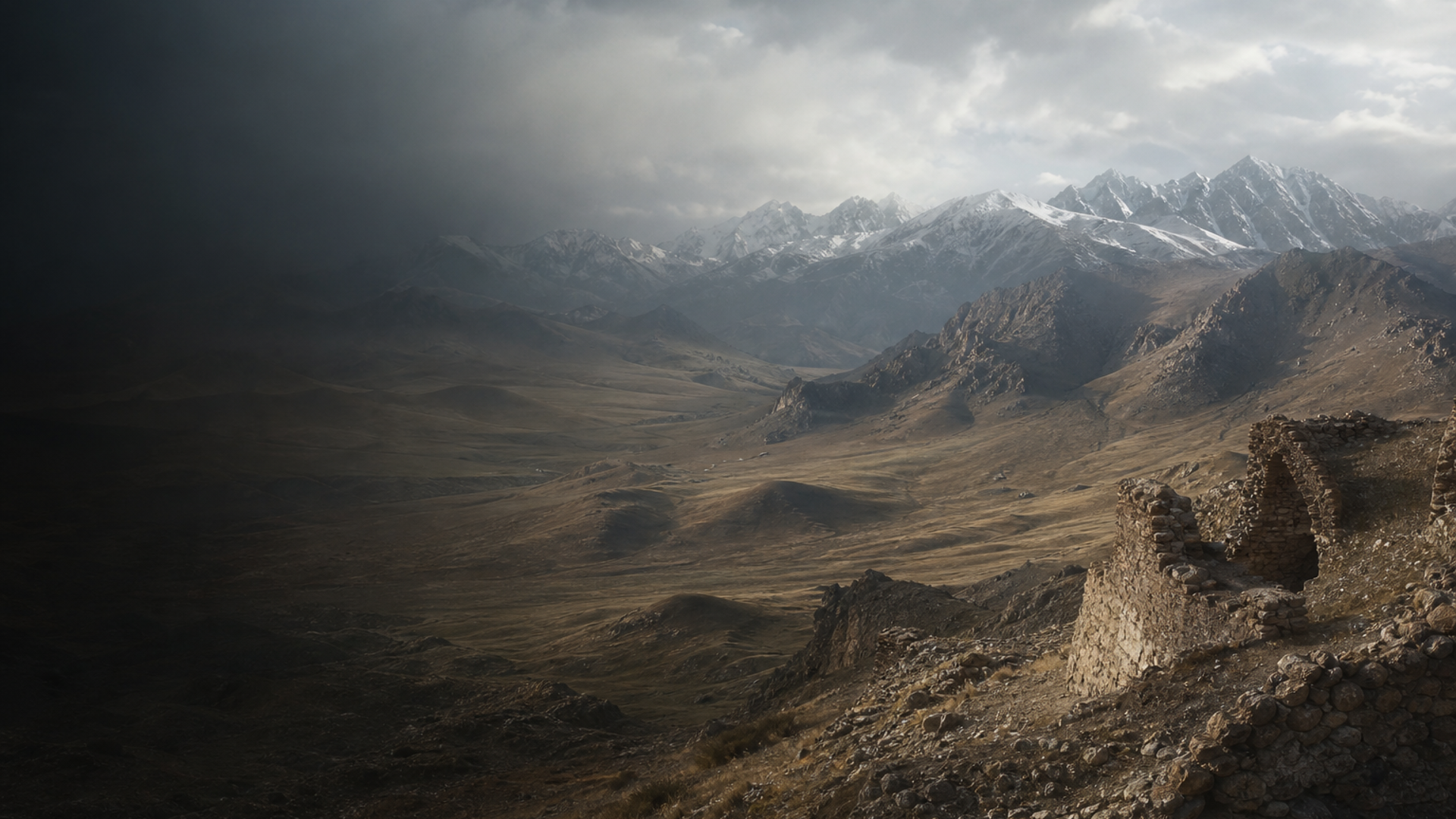
The Karakhanid period (roughly 9th–12th centuries CE) unfolds across the high grasses and jagged ridges of the Tian Shan and the wider Central Steppe. Archaeological data from burial sites and settlement traces in Kazakhstan — including the Butakty locality — place the Kazakhstan_Karakhanid samples within a landscape of mobile pastoralists, fortified market towns, and Silk Road corridors. Material culture of the era shows a tapestry of influences: Turkic nomadic lifeways layered with Islamic religious practices and trade goods that moved along transcontinental routes.

Limited evidence suggests that communities in and around the Tian Shan were nodes where east–west contacts concentrated. The Karakhanid dynasty, emerging in Central Asia in the 9th century CE, fostered urban centres and caravan networks; archaeological finds regionally include ceramics, metalwork, and architectural fragments consistent with commercial and religious exchange. However, the Butakty record remains locally sparse: radiocarbon-calibrated dates associated with habitation and funerary contexts fall comfortably within 800–1100 CE, but small site samples limit our resolution.

Taken together, the archaeological picture is one of dynamic emergence: a cultural horizon shaped by mobility, trade, and the layering of Turkic, Persianate, and steppe traditions. Genetic data (below) provide an independent line of evidence that begins to illuminate how people moved and mixed across these routes, but current genomic sampling is preliminary.

  • Situated in the Tian Shan and Central Steppe during the Karakhanid era (800–1100 CE).
  • Archaeology indicates crossroads of nomadism, Islam, and Silk Road trade.
  • Butakty site provides the primary skeletal context, but local samples are limited.
Chapter IV

Daily Life & Society

Imagine the wind across the steppe: felt tents, stringed instruments, caravan traffic, and seasonal herds sweeping between high pastures and riverine lowlands. Archaeological traces from the Central Steppe suggest a mixed economy in the Karakhanid period, where pastoral herding—primarily sheep, horses, and goats—was complemented by localized agriculture in river valleys and trade-focused urban crafts in burgeoning market towns.

Funerary evidence in the region is varied. While some burials reflect nomadic practices with few grave goods, others show richer assemblages implying social differentiation and participation in long-distance exchange. Material remains associated with the Karakhanid sphere frequently include Islamic religious paraphernalia and imported goods, signifying both spiritual transformation and the practicalities of Silk Road commerce.

Social life would have been defined by mobile kin groups and the growing influence of urban institutions: caravanserais, marketplaces, and mosques in regional centers. Linguistic and textual evidence from the broader Karakhanid realm points to Turkic administrative and cultural forms taking shape alongside Persianate and Islamic learning. But the everyday rhythms of the steppe—seasonal movement, animal economies, and local craft—remained central to life at Butakty and neighboring sites.

  • Pastoralism dominated, with seasonal movement between summer and winter pastures.
  • Regional towns connected rural herders to Silk Road trade and Islamic cultural networks.
Chapter V

Genetic Profile

Three genomes recovered from human remains at Butakty (Tian Shan, Kazakhstan) dated to ca. 800–1100 CE provide an initial glimpse into Karakhanid-period ancestry. Among these limited samples, one Y-chromosome haplogroup J and one mitochondrial haplogroup A are observed. Haplogroup J is most commonly associated with West Eurasian and Near Eastern paternal lineages, while mtDNA A is typically found in East Eurasian maternal lineages. This juxtaposition hints at mixed ancestry along sex-specific lines—one plausible scenario is male-mediated input from westward populations combined with east Asian maternal ancestry—consistent with other medieval Central Asian contexts where east–west interactions were frequent.

Caveats are essential: with only three samples (below the n<10 threshold), patterns remain highly provisional. The observed haplogroups do not capture the full autosomal picture and could reflect local idiosyncrasies, recent mobility, or sampling bias. Archaeological associations (trade, migration, and the political reach of the Karakhanids) support scenarios of admixture, but broader claims about population structure or continuity require many more genomes from diverse sites and careful comparative analysis with contemporaneous samples across Central Asia and the Near East.

In short, the genetic signal from Butakty is evocative but preliminary: it points toward a tapestry of west–east connections that archaeological evidence also suggests, and it underscores the need for expanded sampling to move from suggestive patterns to robust conclusions.

  • Observed paternal haplogroup J suggests West Eurasian/Near Eastern male lineages in one individual.
  • Observed maternal haplogroup A indicates East Eurasian maternal ancestry in one individual; conclusions are preliminary given n=3.
Chapter VI

Legacy & Modern Connections

The Karakhanid era left linguistic, religious, and cultural echoes across Central Asia: Turkic languages expanded, and Islam became a formative force in regional identity. Genetic and archaeological lines of evidence together portray a long-term process of admixture and cultural synthesis that contributed to the genetic landscape of later Central Asian populations.

However, direct genetic continuity between the three Butakty individuals and modern Kazakh or regional populations cannot be assumed. Modern genomes are the product of many subsequent migrations and demographic shifts. The Butakty data provide an early medieval snapshot—one that complements archaeology by showing how individuals at a frontier of the Silk Road carried mixed ancestries. Future, larger-scale aDNA surveys across Kazakhstan and neighboring regions will be required to trace how Karakhanid-era populations fed into the genetic mosaic of modern Central Asia.

  • Karakhanid-era cultural shifts (Turkic expansion, Islam) played a major role in shaping regional identity.
  • Genetic links to modern populations are plausible but unproven; more sampling is needed for firm conclusions.
AI 电源

AI 助手

就 Echoes of the Karakhanid Steppe 文化提问

AI 助手 由DNAGENICS公司制作

解锁此特性
Ask questions about the Echoes of the Karakhanid Steppe culture. Our AI assistant can explain genetic findings, historical context, archaeological evidence, and modern connections.
AI 样本分析

Echoes of the Karakhanid Steppe 文化是人类历史中值得了解的一章……

遗传分析揭示了与早期种群的联系,同时显示了独特的适应和文化创新的证据。 古代DNA样本提供了对迁徙模式、社会结构以及古代种群之间的生物关系的深刻见解。

这是人工智能分析的预览。 解锁全AI 助手, 以探索关于:

  • 遗传组成和祖先
  • 移徙模式和起源
  • 日常生活和文化习俗
  • 现代遗传遗产

探索更古老的文化

揭开古代世界文明的故事

使用优惠码 可减免 35% • 11月12日 到期




