Echoes of the Nuragic Bronze

下载的 PDF 是图像副本。如需可选中文本及更好的辅助技术支持,请使用打印功能。

Echoes of the Nuragic Bronze

揭开一个失落的文明

正在加载考古记录……

正在收集古代记录

跳转到主内容
Echoes of the Nuragic Bronze
文明焦点

Echoes of the Nuragic Bronze

Sardinia's Bronze Age communities seen through archaeology and DNA (1532–922 BCE)

1532 CE - 922 BCE
Sardinia, Italy
滚动开始
Chapter I

剧情

了解 Echoes of the Nuragic Bronze 文化

Archaeological remains and genetic data from 16 Sardinian Bronze Age individuals illuminate the Nuragic world—its people, islands, and lasting genetic threads. Evidence indicates strong Neolithic farmer continuity with regional variation and modest external inputs.

Time Period

1532–922 BCE

Region

Sardinia, Italy

Common Y-DNA

R (5), J (3), G (2), I (1)

Common mtDNA

H1 (4), J (3), T (3), H (2), K (1)

Chapter II

时间线

这种文化历史上的关键时刻

2500 BCE

Megalithic traditions consolidate

Regional megalithic building and social networks on Sardinia set foundations that later develop into the Nuragic Bronze Age cultural landscape.

Chapter III

Origins & Emergence

The Nuragic Bronze Age of Sardinia unfolds like a landscape of stone and sea: circular towers (nuraghi), coastal harbors and rocky inland refuges persist in the archaeological record. Sites included in this dataset—S'Orcu 'e Tueri (Perdasdefogu, NUO), Riparo sotto roccia Su Asedazzu and Su Cannisoni (Seulo, CA), Ingurtosu Mannu (Donori, CA) and Is Arutas (Cabras, OR)—date between 1532 and 922 BCE and belong to the long arc of Sardinian Bronze Age culture.

Archaeological data indicate continuity from earlier Neolithic and Copper Age communities: megalithic building traditions and local pottery styles evolve into distinct Nuragic material culture. The island's insularity promoted regional distinctiveness while maritime contacts with the western Mediterranean introduced new metals, styles, and possibly small-scale population movements. Limited evidence suggests these external interactions were episodic rather than large-scale population replacements. The material record—nuraghi foundations, fortifications, and rock-shelter assemblages—documents a society reorganizing around communal and defensive architecture, pastoralism, and burgeoning metallurgy.

While the archaeological narrative is robust, linking specific cultural shifts to discrete migrations remains challenging: chronology is improving, but many questions about the pace and direction of contact remain open.

  • Nuragic centers built across Sardinia, visible in nuraghi and rock shelters
  • Sites in dataset span inland and coastal contexts, 1532–922 BCE
  • Archaeology shows continuity from Neolithic roots with episodic external contacts
Chapter IV

Daily Life & Society

Life in Bronze Age Nuragic Sardinia combined pastoral mobility, coastal fishing, and craft specialization. Excavations at riparo sotto roccia sites (e.g., Su Asedazzu, Su Cannisoni) reveal domestic debris—animal bones, grinding stones and pottery—suggesting households practiced mixed farming and herding. Coastal deposits at Is Arutas (Cabras) provide evidence for marine resources and salt-related activities.
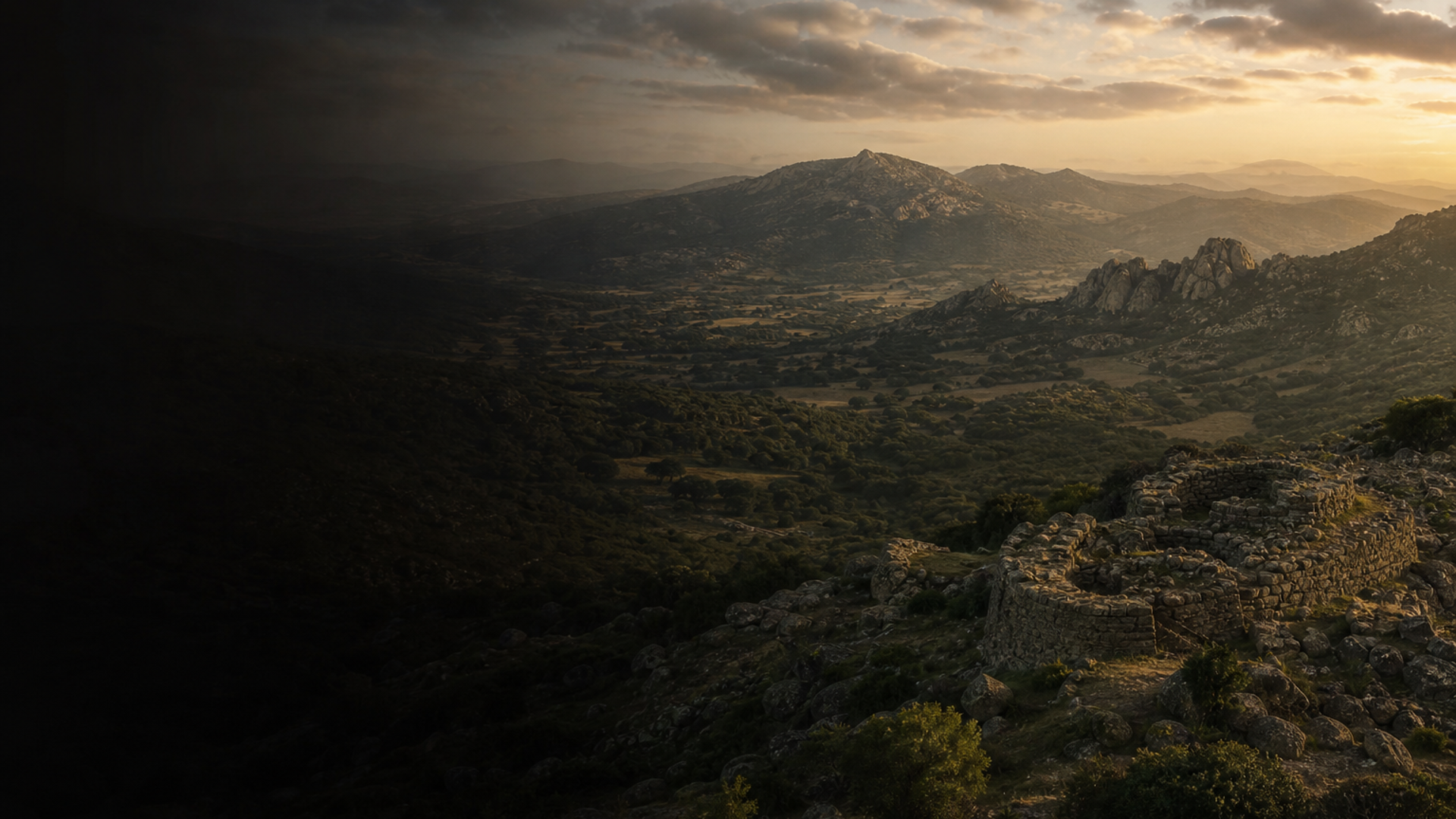

Material culture hints at social differentiation: larger nuraghi and fortified settlements likely hosted communal rituals and redistributed resources, while smaller domestic clusters managed subsistence production. Metallurgical finds and imported objects indicate access to Mediterranean exchange networks—bronze tools and ornaments imply both local workshop practice and connections to Corsica, the Italian mainland, and beyond. Burial practices vary across the island, from collective rock-cut tombs to individual interments, reflecting complex social identities and perhaps regional customs.

Archaeological interpretations must be cautious: taphonomic processes and uneven excavation coverage can bias our picture. Nonetheless, the combined record paints a cinematic world of island life punctuated by monumental stone, seasonal herds and seafaring exchange.

  • Mixed agro-pastoral economy with coastal resource exploitation
  • Material culture shows both local craft and long-distance exchange
Chapter V

Genetic Profile

Ancient DNA from 16 individuals (n=16) dated 1532–922 BCE provides a window into Nuragic population dynamics. Overall patterns align with strong continuity from Neolithic Anatolian-derived farmers—the dominant ancestry component in Sardinia through the Bronze Age—while showing modest and regionally variable influxes of other lineages.

Y-chromosome markers in this sample set are diverse: haplogroup R is the most frequent (5 individuals), followed by J (3), G (2) and I (1). This distribution suggests a mixture of long-standing island male lineages and incoming paternal inputs; precise subclade assignments would clarify whether R represents local branches or steppe-associated variants, but such detail is not available here. Mitochondrial DNA likewise reflects continuity with European farmer lineages: H1 (4), various H (2), J (3), T (3) and K (1) are common—haplogroups that are widespread in later European populations and in modern Sardinians.

Autosomal signals (broadly summarized) indicate predominant Neolithic farmer ancestry with limited steppe-related admixture compared with continental Bronze Age groups. This pattern is consistent with archaeological evidence for sustained island continuity and episodic external contacts. Because sample size (16) is modest and unevenly distributed across sites, conclusions about fine-scale demographic events should be considered preliminary. Further sampling and subclade resolution would refine models of migration, sex-biased mobility and regional structuring.

  • Predominant Neolithic-farmer ancestry with modest external admixture
  • Y-DNA dominated by R, with notable J and G presence; mtDNA shows farmer-lineage continuity
Chapter VI

Legacy & Modern Connections

The genetic and archaeological legacy of the Nuragic Bronze Age endures in Sardinia's landscapes and genomes. Modern Sardinians retain strong signals of Neolithic farmer ancestry and many elements of the island's Bronze Age genetic makeup, making Sardinia a key reference for studies of European prehistory. The persistence of haplogroups such as H1 and the continued presence of Y-lineages related to R and J suggest long-term continuity interwoven with episodic external influence.

Culturally, nuraghi remain iconic—massive stone towers that anchor modern identity and serve as tangible links to Bronze Age communities. However, scientists emphasize uncertainty: archaeological contexts are complex and current ancient DNA samples (n=16 for this series) provide a valuable but incomplete portrait. Expanded sampling across time, islands and social contexts will sharpen our picture of how people, goods and genes moved in the Bronze Age Mediterranean.

  • Modern Sardinians reflect substantial genetic continuity with Nuragic populations
  • Nuraghi and genetic signals together underscore long-term island persistence
AI 电源

AI 助手

就 Echoes of the Nuragic Bronze 文化提问

AI 助手 由DNAGENICS公司制作

解锁此特性
Ask questions about the Echoes of the Nuragic Bronze culture. Our AI assistant can explain genetic findings, historical context, archaeological evidence, and modern connections.
AI 样本分析

Echoes of the Nuragic Bronze 文化是人类历史中值得了解的一章……

遗传分析揭示了与早期种群的联系,同时显示了独特的适应和文化创新的证据。 古代DNA样本提供了对迁徙模式、社会结构以及古代种群之间的生物关系的深刻见解。

这是人工智能分析的预览。 解锁全AI 助手, 以探索关于:

  • 遗传组成和祖先
  • 移徙模式和起源
  • 日常生活和文化习俗
  • 现代遗传遗产

探索更古老的文化

揭开古代世界文明的故事

使用优惠码 可减免 35% • 11月12日 到期




