Guernsey: Middle Neolithic Voices

下载的 PDF 是图像副本。如需可选中文本及更好的辅助技术支持,请使用打印功能。

Guernsey: Middle Neolithic Voices

揭开一个失落的文明

正在加载考古记录……

正在收集古代记录

跳转到主内容
Guernsey: Middle Neolithic Voices
文明焦点

Guernsey: Middle Neolithic Voices

Le Déhus burials (4241–3968 BCE) reveal island lifeways and preliminary DNA links to continental groups

4241 CE - 3968 BCE
Channel Islands (Guernsey), United Kingdom
滚动开始
Chapter I

剧情

了解 Guernsey: Middle Neolithic Voices 文化

Three individuals from Le Déhus (Vale, Guernsey) dated 4241–3968 BCE provide a cautious window into Middle Neolithic island life. Archaeology and ancient DNA hint at hunter‑gatherer and farmer interactions; conclusions are preliminary due to small sample size.

Time Period

c. 4241–3968 BCE (Middle Neolithic)

Region

Channel Islands (Guernsey), United Kingdom

Common Y-DNA

I (observed in 2 of 3 males)

Common mtDNA

K, J, X (each observed among the 3 samples)

Chapter II

时间线

这种文化历史上的关键时刻

4241 BCE

Le Déhus burials dated

Human remains from Le Déhus (Vale, Guernsey) date to 4241–3968 BCE and produced the three ancient DNA samples discussed here.

Chapter III

Origins & Emergence

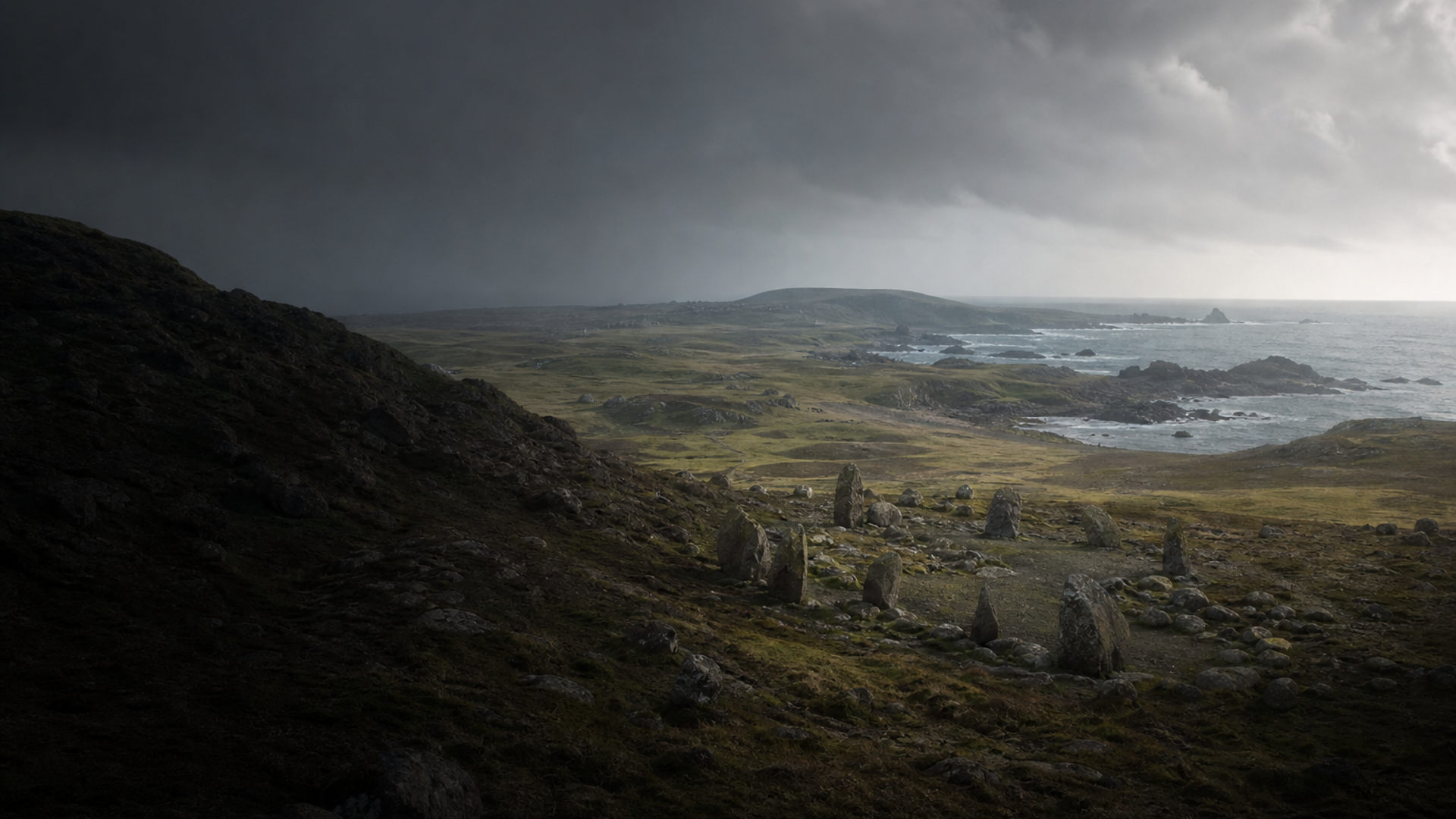
The Channel Islands during the Middle Neolithic appear as a liminal world at the edge of the Atlantic — rocky shores, sheltered bays, and the slow reworking of island communities after the arrival of farming in northwest Europe. Le Déhus, a well‑known chambered tomb in the parish of Vale on Guernsey, yielded human remains dated to 4241–3968 BCE. Archaeological data indicates deliberate burial practices and carved stone art at the site, linking it culturally to broader Atlantic and British Isles megalithic communities.

Maritime mobility and coastal resource use likely shaped settlement choices: limited arable land made mixed economies — small‑scale cultivation, domestic animals, and rich marine foraging — attractive strategies. Pottery styles and lithic technology from nearby mainland sites suggest ties with southern Britain and Brittany, but the island setting fostered local traditions in tomb construction and funerary ritual.

Genetic evidence from a small number of individuals (three samples) offers glimpses into population origins, but the sample count is too low for firm population‑level claims. Limited evidence suggests continuity with regional Neolithic networks rather than entirely isolated development. Archaeology therefore frames the Channel Islands as nodes of contact where maritime routes and local lifeways intersected in the fourth millennium BCE.

  • Le Déhus (Vale, Guernsey) — chambered tomb context dated 4241–3968 BCE
  • Island lifeways combined farming, pastoralism, and marine resources
  • Material ties to British and Atlantic Neolithic traditions
Chapter IV

Daily Life & Society

Daily life on the Middle Neolithic Channel Islands would have been shaped by rhythm of sea and soil. Archaeological remains from Guernsey and nearby islands indicate small, probably kin‑based communities exploiting a mosaic of habitats: patchy fields for cereals and pulses, grazing areas for sheep and cattle, and nearshore zones rich in shellfish and fish. Flint tools and domestic pottery fragments recovered in island contexts are similar to contemporaneous assemblages on the adjacent mainland, yet local forms of decoration and monument construction reflect island identities.

Funerary architecture such as Le Déhus served both as repository for the dead and as visible markers in the landscape. Grave deposits and carved stones suggest symbolic worlds where ancestry, place, and maritime horizons were woven together. Social structure is largely inferential: modest populations imply flexible social networks with emphasis on kin ties and reciprocal exchange. Seasonal mobility — trips to and from the mainland for trade or marriage — is plausible and would help explain cultural overlap across the Channel.

Archaeological data is fragmentary; absence of broad settlement excavations on the islands limits our picture of day‑to‑day social organization. Still, the material traces evoke resilient island communities adapting Neolithic lifeways to a narrow, maritime environment.

  • Mixed economy: small-scale farming, herding, and marine foraging
  • Monuments like Le Déhus acted as social and ritual focal points
Chapter V

Genetic Profile

Three ancient individuals from Le Déhus have yielded genome results dated to 4241–3968 BCE. Two male individuals carried Y‑DNA haplogroup I, a lineage observed in both Mesolithic hunter‑gatherers and some later European populations. Mitochondrial haplogroups recorded among the three samples are K, J, and X — maternal lineages that appear in Neolithic and pre‑Neolithic contexts across Europe.

Taken together, these genetic signals are compatible with mixed ancestry scenarios documented elsewhere in northwest Europe: incoming early farmers from Anatolian‑derived groups interacting and admixing with local hunter‑gatherer populations. However, with only three samples, any inference about population structure, admixture proportions, or sex‑biased migration remains highly tentative. The presence of haplogroup I in two males might hint at continuity of local paternal lines or recruitment from groups carrying this lineage, but small sample size prevents robust demographic conclusions.

Genetic data complements the archaeological picture of maritime connections: the mtDNA diversity (K, J, X) suggests links to broader Neolithic networks, while Y‑DNA I underscores the persistence or reintroduction of hunter‑gatherer–associated paternal markers. Future sampling across more burials and settlements on the islands and nearby coasts will be essential to test these preliminary patterns.

  • Small sample: only 3 individuals — conclusions are preliminary
  • Y‑DNA I (2 samples) and mtDNA K, J, X indicate mixed Neolithic/hunter‑gatherer signals
Chapter VI

Legacy & Modern Connections

The Middle Neolithic inhabitants of the Channel Islands left a tangible legacy in their monuments, carved stones, and the enduring presence of burial sites like Le Déhus. These tangible traces shape modern landscape memory and provide anchors for local identity in Guernsey. From a genetic perspective, ancient samples offer calibration points for ancestry platforms: they help distinguish deep, local hunter‑gatherer ancestry from incoming Neolithic farmer signals in modern DNA profiles.

Caution is essential: with only three ancient genomes, we cannot claim direct continuity between these individuals and present‑day islanders. Instead, the samples serve as early reference points showing that both hunter‑gatherer‑linked paternal markers and diverse maternal lineages were present on the islands in the fourth millennium BCE. As more genomes are added, these early results will be refined, allowing more nuanced narratives about migration, admixture, and cultural persistence across millennia.

  • Monuments and burials anchor long-term cultural memory on Guernsey
  • Ancient DNA provides reference points but more samples are needed for firm links to modern populations
AI 电源

AI 助手

就 Guernsey: Middle Neolithic Voices 文化提问

AI 助手 由DNAGENICS公司制作

解锁此特性
Ask questions about the Guernsey: Middle Neolithic Voices culture. Our AI assistant can explain genetic findings, historical context, archaeological evidence, and modern connections.
AI 样本分析

Guernsey: Middle Neolithic Voices 文化是人类历史中值得了解的一章……

遗传分析揭示了与早期种群的联系,同时显示了独特的适应和文化创新的证据。 古代DNA样本提供了对迁徙模式、社会结构以及古代种群之间的生物关系的深刻见解。

这是人工智能分析的预览。 解锁全AI 助手, 以探索关于:

  • 遗传组成和祖先
  • 移徙模式和起源
  • 日常生活和文化习俗
  • 现代遗传遗产

探索更古老的文化

揭开古代世界文明的故事

使用优惠码 可减免 35% • 11月12日 到期