Hasanlu Iron Age: Echoes of Western Iran

下载的 PDF 是图像副本。如需可选中文本及更好的辅助技术支持,请使用打印功能。

Hasanlu Iron Age: Echoes of Western Iran

揭开一个失落的文明

正在加载考古记录……

正在收集古代记录

跳转到主内容
Hasanlu Iron Age: Echoes of Western Iran
文明焦点

Hasanlu Iron Age: Echoes of Western Iran

Bones, pottery and DNA from Hasanlu Tepe reveal a crossroads of Near Eastern and West Eurasian lineages.

1425 CE - 479 BCE
Hasanlu, West Azerbaijan, northwest Iran
滚动开始
Chapter I

剧情

了解 Hasanlu Iron Age: Echoes of Western Iran 文化

Archaeogenetic portrait of Hasanlu (1425–479 BCE) links stratified Iron Age finds at Hasanlu Tepe, West Azerbaijan, Iran, with maternal haplogroups J, U, H, T and limited paternal R. Twenty samples offer a modest glimpse into population structure during Bronze–Iron Age transformations.

Time Period

1425–479 BCE

Region

Hasanlu, West Azerbaijan, northwest Iran

Common Y-DNA

R (1 sample; limited Y coverage)

Common mtDNA

J (4), U (4), H (3), T (2), HV (1)

Chapter II

时间线

这种文化历史上的关键时刻

1425 BCE

Earliest sampled occupations

Stratified contexts at Hasanlu date into the late Bronze Age, marking the start of the sampled sequence around 1425 BCE.

800 BCE

Major destruction horizon (Hasanlu IV)

A dramatic destruction layer preserves a sealed assemblage of artifacts and human remains, offering snapshots of life and death in the Iron Age.

479 BCE

Late sampled horizons

The sampled sequence extends into the early first millennium BCE, ending near 479 BCE and reflecting long-term occupation and change.

Chapter III

Origins & Emergence

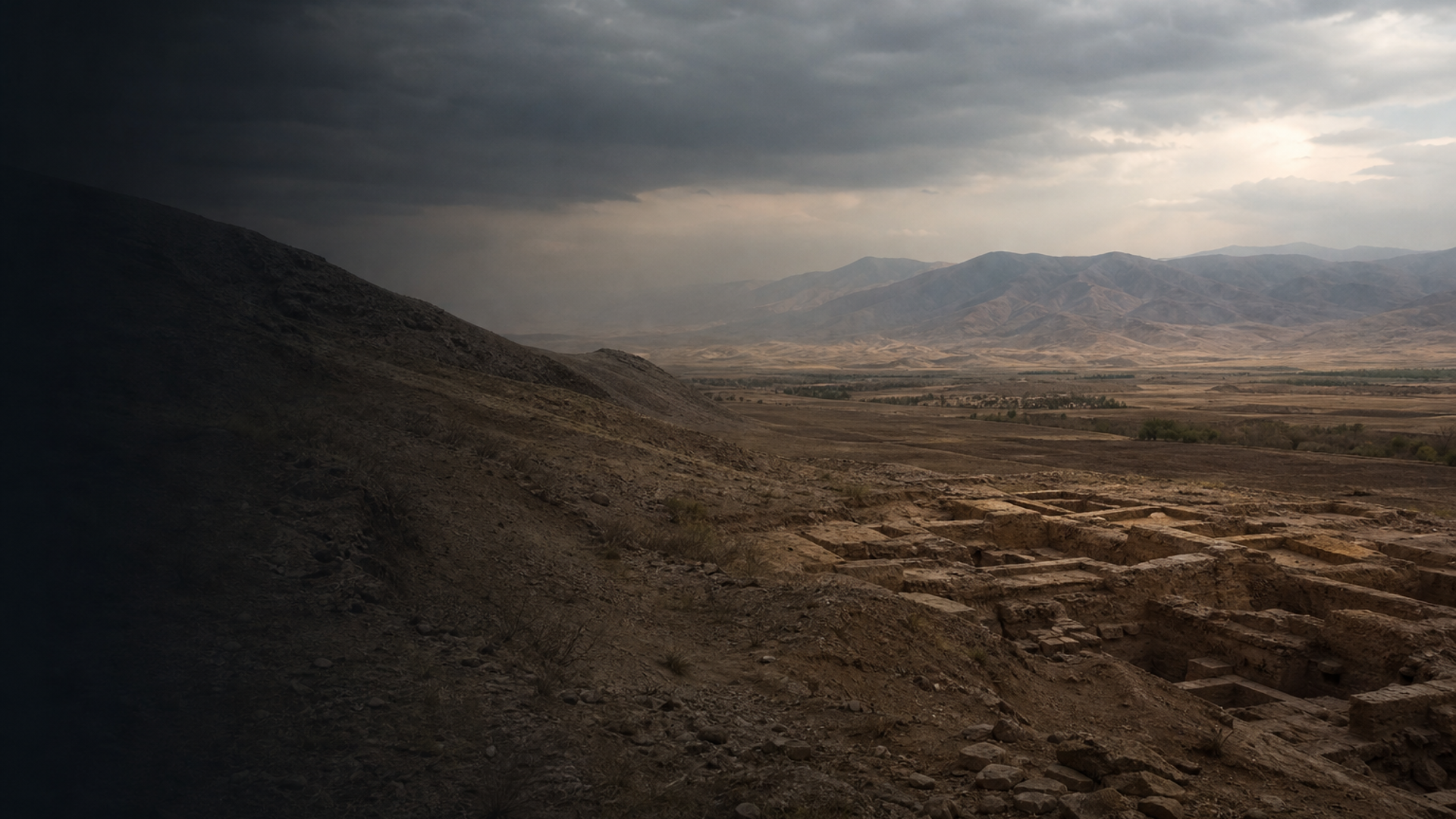
Rising from the salt-baked plain near Lake Urmia, Hasanlu Tepe records centuries of human presence that sweep from the late Bronze Age into the Iron Age. Archaeological stratigraphy at Hasanlu — notably the deep Iron Age horizons often referred to collectively as Hasanlu IV — preserves repeated cycles of occupation, craft production, and dramatic destruction events. Radiocarbon and typological dating place the sampled horizon range between roughly 1425 BCE and 479 BCE, a period when the town lay within a shifting tapestry of Near Eastern polities and trade networks.

Material culture — ceramics, metalwork, and architectural remains — speaks to sustained contact with neighbors to the north and west. Limited evidence suggests episodes of intensified exchange with northern highlands and Mesopotamian spheres, but local craft traditions remain pronounced. Archaeology indicates Hasanlu functioned as a regional center: a place of storage, skilled craft, and episodic violence that left sealed assemblages ideal for both osteological and genetic study.

Bullets

  • Hasanlu Tepe (West Azerbaijan, Iran) yields layered Iron Age contexts.
  • Stratigraphy and typology date sampled remains to 1425–479 BCE.
  • Archaeological evidence indicates local continuity with regional exchange networks.
  • Hasanlu Tepe in West Azerbaijan preserves deep Iron Age stratigraphy
  • Dates from 1425–479 BCE span late Bronze to Iron Age transitions
  • Material culture shows local traditions with regional contacts
Chapter IV

Daily Life & Society

Archaeological layers at Hasanlu unveil households, workshops, and ritual spaces that together sketch daily rhythms: weaving and metallurgy, communal storage, and curated deposits of personal ornaments. Excavations reveal multi-room mudbrick structures and courtyard complexes, where pottery styles and toolkits trace craft specializations. The dramatic destruction layers preserve momentary snapshots—kneeling figures, overturned vessels, and caches of objects — that allow us to reconstruct social practices in cinematic detail.

Dietary and mobility clues are more fragmentary. Faunal remains and plant impressions indicate mixed agropastoral strategies, while trade goods attest to long-distance connections. Funerary evidence at Hasanlu is variable: some burials are intrusive to habitation layers, while other human remains occur within destruction contexts. These patterns suggest a community shaped by household-based production, interregional exchange, and occasional episodes of violence or upheaval.

Bullets

  • Architecture: mudbrick houses with workshops and storage.
  • Economy: mixed farming, herding, and specialized metal- and textile-production.
  • Social life captured in destruction assemblages offering short-lived snapshots of activity.
  • Mudbrick architecture with workshop and storage areas
  • Mixed agropastoral economy with specialized craft production
Chapter V

Genetic Profile

Twenty individuals sampled from Hasanlu provide a moderate but informative window into maternal and paternal diversity across the site's Iron Age range. Maternal lineages are relatively diverse: mtDNA haplogroups include J (4 samples), U (4), H (3), T (2), and HV (1). These haplogroups are widespread across the Near East and into West Eurasia and often appear in both Bronze and Iron Age contexts across the region; their presence at Hasanlu is consistent with a population carrying a mixture of Near Eastern and broader West Eurasian maternal ancestries.

Paternal resolution is limited: only a single reported Y‑DNA assignment (R) is noted among the dataset. With one Y call, any inference about patrilineal structure or male-mediated migrations remains highly tentative. Autosomal ancestry (genome-wide) would be required to resolve admixture proportions and connections to neighboring polities or steppe-derived gene flows; if available, such data could test whether Hasanlu's people reflect continuity from local Chalcolithic/Bronze Age populations or admixture with northern/steppe groups.

Because the sample size is modest (n=20) and Y coverage is sparse, conclusions must remain cautious. Nevertheless, the mtDNA profile underscores continuity with broader Near Eastern maternal lineages and highlights the value of combining stratigraphic context with genetic data to read population dynamics over centuries.

Bullets

  • mtDNA diversity dominated by J, U, H, T, HV, suggesting Near Eastern and West Eurasian maternal ties.
  • Y-DNA limited to one R assignment: patrilineal patterns remain highly tentative.
  • mtDNA shows J, U, H, T, HV — maternal ties across the Near East and West Eurasia
  • Only one Y-DNA (R) reported: male-line inferences are provisional
Chapter VI

Legacy & Modern Connections

Hasanlu's ruins speak across millennia: pottery rims, metalwork, and human bones bridge the Iron Age and the present. Genetic signatures documented at the site — especially the mosaic of maternal haplogroups — echo patterns seen across modern Southwest Asia, underscoring long-term population interactions rather than abrupt replacement. However, continuity should not be assumed without broader genome-wide sampling: migrations, local admixture, and demographic shifts over 2,500 years can mask complex histories.

For present-day populations in northwest Iran and neighboring regions, Hasanlu provides an archaeological anchor point. Limited genetic overlap suggests that some maternal lineages have deep regional roots, but the modest sample size and sparse paternal data mean that robust claims of direct ancestry or cultural transmission are preliminary. Future studies integrating more ancient genomes, isotopes, and continued excavation will refine how Hasanlu's inhabitants contributed to the genetic landscape of the ancient Near East.

Bullets

  • Maternal haplogroups at Hasanlu reflect long-term regional ancestries.
  • Direct links to modern populations are suggestive but require broader genome-wide comparison.
  • mtDNA patterns point to long-term regional maternal ancestry
  • Direct modern-descendant claims require larger, genome-wide datasets
AI 电源

AI 助手

就 Hasanlu Iron Age: Echoes of Western Iran 文化提问

AI 助手 由DNAGENICS公司制作

解锁此特性
Ask questions about the Hasanlu Iron Age: Echoes of Western Iran culture. Our AI assistant can explain genetic findings, historical context, archaeological evidence, and modern connections.

AI 样本分析

Hasanlu Iron Age: Echoes of Western Iran 文化是人类历史中值得了解的一章……

遗传分析揭示了与早期种群的联系,同时显示了独特的适应和文化创新的证据。 古代DNA样本提供了对迁徙模式、社会结构以及古代种群之间的生物关系的深刻见解。

这是人工智能分析的预览。 解锁全AI 助手, 以探索关于:

  • 遗传组成和祖先
  • 移徙模式和起源
  • 日常生活和文化习俗
  • 现代遗传遗产

探索更古老的文化

揭开古代世界文明的故事

使用优惠码 可减免 35% • 11月12日 到期




