Highland Chimu at Chinchawas

下载的 PDF 是图像副本。如需可选中文本及更好的辅助技术支持,请使用打印功能。

Highland Chimu at Chinchawas

揭开一个失落的文明

正在加载考古记录……

正在收集古代记录

跳转到主内容
Highland Chimu at Chinchawas
文明焦点

Highland Chimu at Chinchawas

Late Intermediate Period highland community showing Chimu influence and early DNA signals

1100 CE - 1400 CE
Chinchawas, Peruvian Highlands, Peru
滚动开始
Chapter I

剧情

了解 Highland Chimu at Chinchawas 文化

Archaeological and genetic glimpses from Chinchawas, Peru (1100–1400 CE) reveal a highland expression of Chimu-era networks. Limited samples (n=3) show mtDNA D1 and Y-DNA Q, suggesting Native American maternal continuity and a typical paternal lineage; conclusions remain preliminary.

Time Period

1100–1400 CE (Late Intermediate Period)

Region

Chinchawas, Peruvian Highlands, Peru

Common Y-DNA

Q (observed in 1 sample)

Common mtDNA

D1 (observed in 3 samples)

Chapter II

时间线

这种文化历史上的关键时刻

1100 CE

Local emergence at Chinchawas

Initial archaeological horizons and radiocarbon dates indicate occupation and material exchanges beginning around 1100 CE.

1400 CE

Late Intermediate transformations

By c. 1400 CE Chinchawas shows signs of shifting material culture and interaction patterns before the later regional realignments.

Chapter III

Origins & Emergence

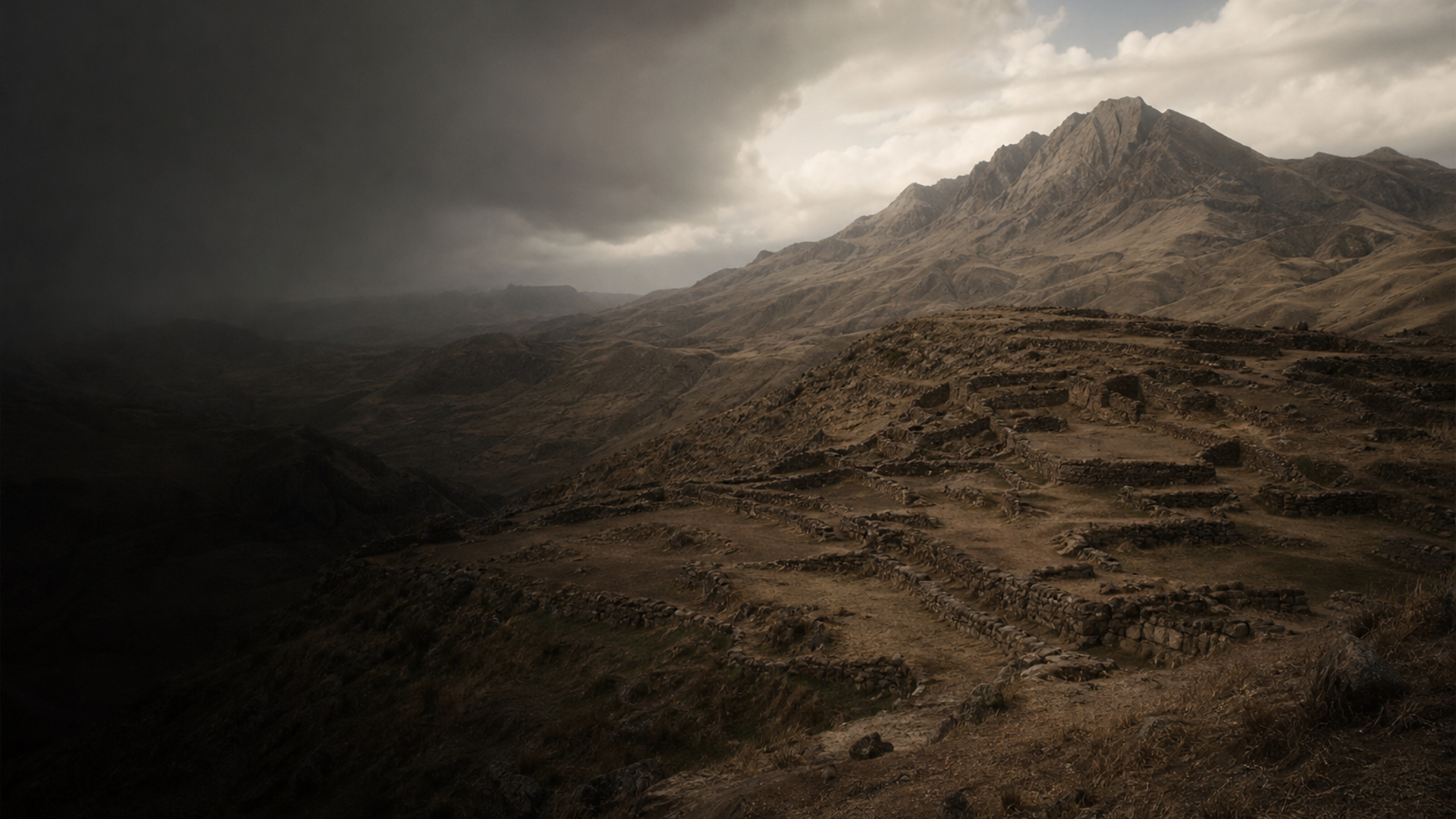
In the thin air of the Peruvian highlands, stone terraces and village mounds at Chinchawas whisper of a community shaped between c. 1100 and 1400 CE. Archaeological data indicates this interval falls within the Late Intermediate Period, when coastal polities like the Chimú exerted economic and stylistic influence inland. Limited evidence from ceramics, textile fragments, and settlement patterns suggests that Chinchawas participated in regional exchange networks rather than representing a wholesale transplant of coastal society: pottery motifs show echoes of Chimú forms layered onto local highland traditions. Radiocarbon dates from organic deposits associated with habitations and burials anchor human activity in this window, but small sample sizes limit broad generalizations. Environmental archaeology points to cultivation of highland crops (tubers and grains) and management of camelids, which would have sustained communities and enabled trade caravans to traverse the vertical ecological zones. In cinematic contrast — wind-swept terraces meeting shimmering textile fragments — the site embodies a frontier of cultural interaction. However, archaeologists emphasize that the pattern remains tentative: more stratified excavations and larger assemblages are needed to resolve whether Chinchawas represents a localized Chimu enclave, a hybrid highland polity, or a trade node linking coast and sierra.

  • Occupation dated c. 1100–1400 CE (Late Intermediate Period)
  • Material culture shows coastal Chimú traits blended with highland traditions
  • Current evidence is limited and interpretations remain provisional
Chapter IV

Daily Life & Society

Archaeological remains evoke everyday rhythms: terraces sheared into slopes for tuber cultivation, corrals for camelids, and compact house compounds where families mended textiles and prepared stews. Excavations at Chinchawas have uncovered domestic floors and fragmented textiles that indicate skilled weaving traditions; textile styles may carry motifs or techniques traceable to coastal exchange, suggesting craftsmen and goods moved along Andean corridors. Zooarchaeological and botanical remains (where preserved) point to mixed farming economies adapted to altitude — quinoa, potatoes, and herded llamas and alpacas — providing caloric and transport resources. Burial contexts, although few, offer intimate glimpses: interments appear to contain personal ornaments and clothing fragments that reflect identity markers, craft specialization, and possibly social differentiation. Archaeological data indicates that seasonal mobility and long-distance exchange were important: highland communities accessed marine products and exotic metals through intermediary networks, while sending camelid fiber and highland crops to lowland partners. Yet, because excavated contexts and recovered materials are limited, reconstructions of household size, political organization, and labor systems at Chinchawas remain cautious hypotheses awaiting larger datasets and collaborative study with descendant communities.

  • Mixed highland agriculture and camelid herding sustained daily life
  • Textiles and portable goods suggest craft specialization and exchange
Chapter V

Genetic Profile

Ancient DNA recovered from three individuals at Chinchawas provides a slender but valuable genetic window. All three mitochondrial genomes are assigned to haplogroup D1, a lineage widespread among Native American populations and commonly seen in Andean contexts; the single Y-chromosome result is haplogroup Q, likewise frequent among Indigenous peoples of the Americas. These uniparental markers are consistent with continuity of core Native American maternal and paternal lineages in the highlands during the Late Intermediate Period. However, with only three samples the statistical power is very limited: small-n datasets can reflect local founder effects or preservation biases rather than population-wide patterns. Archaeological data indicates the possibility of coastal–highland interaction at Chinchawas; genetically, that could manifest as subtle admixture detectable in autosomal genomes, but autosomal sequence coverage and larger sample sizes are required to test admixture models robustly. In practice, uniparental markers are best read as complementary signals — useful for tracing maternal and paternal lineages over time but insufficient alone to resolve population structure, migration rates, or sex-biased gene flow. Ongoing work aims to recover more genomes and integrate isotopic data to link movement of people with dietary and provenance signals.

  • mtDNA D1 in all three sampled individuals suggests maternal continuity
  • Y-DNA Q observed in one individual aligns with common Native American paternal lineage; conclusions are preliminary
Chapter VI

Legacy & Modern Connections

The genetic lineages seen at Chinchawas — particularly mtDNA D1 and Y-DNA Q — persist in many present-day Andean populations, offering a thread of biological continuity across centuries. Culturally, elements of textile tradition, crop choices, and highland ecological knowledge survive among descendant communities, and these living practices provide context for archaeological interpretation. Scientific narratives must be presented with humility: the small number of ancient samples from Chinchawas constrains claims about population replacement or major migrations. Equally important is collaboration with local and Indigenous stakeholders to ensure research respects cultural heritage and yields insights meaningful to communities today. In cinematic terms: stones and strands of fiber at Chinchawas join DNA sequences to form a patchwork story, one still being stitched as new data arrives.

  • Uniparental markers observed at Chinchawas continue in modern Andean populations
  • Research stresses respectful collaboration and emphasizes preliminary nature of findings
AI 电源

AI 助手

就 Highland Chimu at Chinchawas 文化提问

AI 助手 由DNAGENICS公司制作

解锁此特性
Ask questions about the Highland Chimu at Chinchawas culture. Our AI assistant can explain genetic findings, historical context, archaeological evidence, and modern connections.
AI 样本分析

Highland Chimu at Chinchawas 文化是人类历史中值得了解的一章……

遗传分析揭示了与早期种群的联系,同时显示了独特的适应和文化创新的证据。 古代DNA样本提供了对迁徙模式、社会结构以及古代种群之间的生物关系的深刻见解。

这是人工智能分析的预览。 解锁全AI 助手, 以探索关于:

  • 遗传组成和祖先
  • 移徙模式和起源
  • 日常生活和文化习俗
  • 现代遗传遗产

探索更古老的文化

揭开古代世界文明的故事

使用优惠码 可减免 35% • 11月12日 到期





