Huaqiao Caves — Ming Guangxi

下载的 PDF 是图像副本。如需可选中文本及更好的辅助技术支持,请使用打印功能。

Huaqiao Caves — Ming Guangxi

揭开一个失落的文明

正在加载考古记录……

正在收集古代记录

跳转到主内容
Huaqiao Caves — Ming Guangxi
文明焦点

Huaqiao Caves — Ming Guangxi

A single Ming‑era individual from Baitai Mountain offers a whisper of maternal ancestry in southern China.

1437 CE - 1625 CE
Guangxi, China — Hechi City, Nandan County
滚动开始
Chapter I

剧情

了解 Huaqiao Caves — Ming Guangxi 文化

Archaeological remains from Huaqiao Caves (Nandan, Hechi, Guangxi) date to 1437–1625 CE. One ancient DNA sample carries mtDNA G1. Limited evidence links this individual to broader East Asian maternal lineages; interpretations remain highly preliminary pending more samples.

Time Period

1437–1625 CE (Ming Dynasty)

Region

Guangxi, China — Hechi City, Nandan County

Common Y-DNA

Not reported (no Y data)

Common mtDNA

G1 (n=1)

Chapter II

时间线

这种文化历史上的关键时刻

1500 CE

Occupation date (sample)

Approximate midpoint date for the Huaqiao individual (1437–1625 CE), reflecting Ming‑era context.

Chapter III

Origins & Emergence

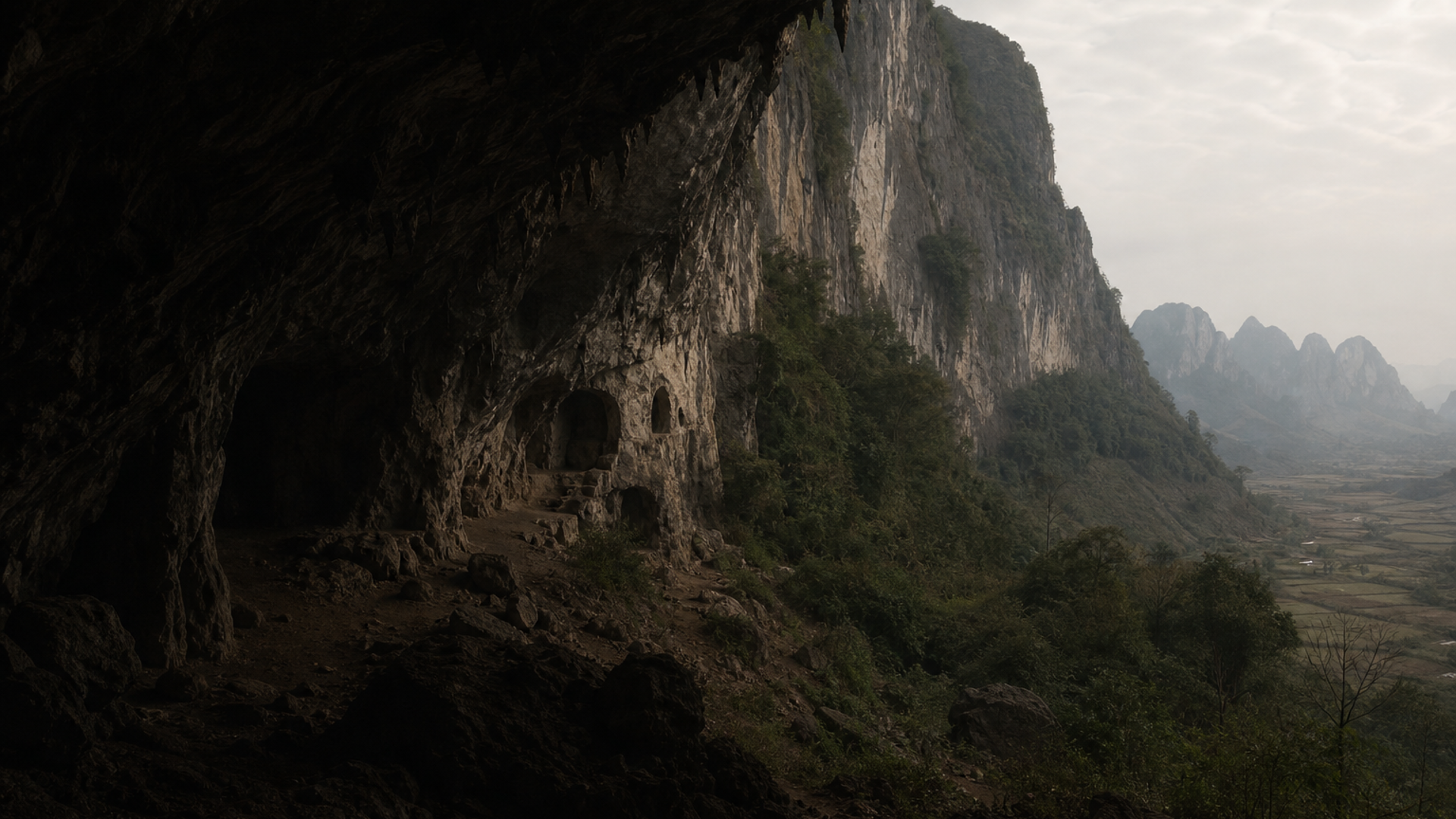
Perched within the karst slopes of Baitai Mountain, Huaqiao Village preserves human traces that archaeologists assign to the Ming dynasty horizon (1437–1625 CE). Archaeological data indicates the Huaqiao Caves were used by local mountain communities — perhaps seasonally or for burial — during a period of intensifying state presence and regional exchange in southern China. The recovered human material for this project is limited to a single individual sampled from a stratigraphic context attributed to the fifteenth–seventeenth centuries.

Limited evidence suggests that this individual's presence reflects local subsistence and settlement patterns common to Guangxi's uplands: dispersed hamlets, terraced or valley agriculture, and mobility tied to upland resources. The caves’ geography — steep limestone slopes and sheltered recesses — made them convenient for short‑term occupation and for the deposition of human remains where preservation conditions can be favorable. While the broader Ming landscape included expanding trade networks and administrative consolidation, the human story at Huaqiao remains focused and intimate: one excavated person whose bones and DNA offer a momentary window into the lives of Ming‑era mountain dwellers.

Because the dataset is a single sample, origins narratives must remain cautious. Archaeological patterns provide cultural context, but genetic conclusions require a larger comparative framework to move from individual biography to population‑level history.

  • Site: Huaqiao Caves, Baitai Mountain, Huaqiao Village, Lihu Yaozu Town
  • Chronology: Ming dynasty context, 1437–1625 CE
  • Evidence: Single human individual sampled; cave contexts often reflect short‑term use or burial
Chapter IV

Daily Life & Society

Archaeological data from Guangxi’s uplands suggests lifeways shaped by steep terrain, river valleys, and a mix of dry‑field and wet‑rice cultivation in lower elevations. Material culture in neighboring sites of the region points to local ceramic use, simple metal tools, and textile practice suited to mountain villages, though direct artifact associations at Huaqiao are sparse. In the cinematic hush of limestone caverns, the skeletal remains recall daily rhythms rather than courtly spectacle: food gathering, animal husbandry on marginal slopes, and craft activities suited to household production.

Ethnographic continuity in Guangxi is complex. Indigenous and migrant groups, including communities historically identified as Yao and Zhuang, have occupied the region's hills for centuries. Archaeological indicators — such as plant macroremains, hearth features, and tool types in comparative sites — point to adaptable subsistence strategies and occasional long‑distance contacts along riverine routes. Still, for Huaqiao the archaeological picture is fragmentary: limited excavation data and a single individual mean reconstructions of social structure, burial practice, or daily economy must be presented as hypotheses rather than firm conclusions.

  • Mountain village lifeways inferred from regional archaeology
  • Evidence for mixed subsistence and household crafts; specific Huaqiao artifacts limited
Chapter V

Genetic Profile

Ancient DNA extracted from the Huaqiao individual reveals mitochondrial haplogroup G1. Haplogroup G1 is part of a maternal lineage found in East Eurasia; its broader modern and ancient geographic distribution includes pockets in Northeast and East Asia and, at lower frequencies, parts of northern and eastern China. The presence of G1 in a Ming‑era individual from Guangxi suggests continuity of broadly East Asian maternal lineages into southern China, but the signal must be read with caution.

Crucially, only one individual was sequenced (sample count = 1). When sample sizes fall below ten, population‑level inferences are preliminary: a single mtDNA result can reflect personal ancestry, maternal lineage movement, or rare lineage survival rather than a dominant regional pattern. No Y‑chromosome data are reported for this sample, so paternal lineages and sex‑biased migration remain unknown. Genetic affinities inferred from mtDNA alone cannot resolve complex admixture or demographic events; genome‑wide data from additional individuals across Guangxi and neighboring provinces would be required to test hypotheses about continuity with modern Zhuang, Yao, Han, or other groups.

Archaeology and genetics together provide the richest narrative: the cave context situates the individual in Ming‑era Guangxi, while the mtDNA assignment offers a maternal thread connecting this person to wider East Asian genetic landscapes. Yet the tapestry remains incomplete until more threads are sampled.

  • mtDNA: G1 identified in the single sequenced individual
  • Interpretation limited by sample size; no Y‑DNA reported
Chapter VI

Legacy & Modern Connections

Huaqiao's lone genetic voice hints at continuity and complexity in Guangxi’s human story. Modern populations in the region — including Zhuang and Yao communities — carry diverse genetic ancestries shaped by millennia of local survival and occasional long‑distance interaction. Archaeological continuity of settlement, combined with isolated maternal lineages like G1, is consistent with pockets of genetic persistence alongside waves of mobility.

However, linking a single Ming‑era individual directly to contemporary groups would be speculative. The responsible path forward pairs targeted archaeological excavation with systematic ancient DNA sampling across multiple sites and time slices. That combined approach can trace whether the maternal lineage observed at Huaqiao represents a persistent local lineage, an incoming family, or an otherwise rare maternal haplotype preserved by chance. For museums and public audiences, the evocative image is clear: one person’s mitochondrial genome becomes a thread connecting deep human movement, local landscape, and the still‑unfolding genetic history of southern China.

  • Modern parallels plausible with Guangxi upland populations, but direct links are speculative
  • More samples and genome‑wide data needed to test continuity versus migration scenarios
AI 电源

AI 助手

就 Huaqiao Caves — Ming Guangxi 文化提问

AI 助手 由DNAGENICS公司制作

解锁此特性
Ask questions about the Huaqiao Caves — Ming Guangxi culture. Our AI assistant can explain genetic findings, historical context, archaeological evidence, and modern connections.
AI 样本分析

Huaqiao Caves — Ming Guangxi 文化是人类历史中值得了解的一章……

遗传分析揭示了与早期种群的联系,同时显示了独特的适应和文化创新的证据。 古代DNA样本提供了对迁徙模式、社会结构以及古代种群之间的生物关系的深刻见解。

这是人工智能分析的预览。 解锁全AI 助手, 以探索关于:

  • 遗传组成和祖先
  • 移徙模式和起源
  • 日常生活和文化习俗
  • 现代遗传遗产

探索更古老的文化

揭开古代世界文明的故事

使用优惠码 可减免 35% • 11月12日 到期