Ireland's Megalithic Voices

下载的 PDF 是图像副本。如需可选中文本及更好的辅助技术支持,请使用打印功能。

Ireland's Megalithic Voices

揭开一个失落的文明

正在加载考古记录……

正在收集古代记录

跳转到主内容
Ireland's Megalithic Voices
文明焦点

Ireland's Megalithic Voices

Millennia-old passage tomb communities revealed by bones and genomes

3785 CE - 3359 BCE
Ireland (Primrose Grange, Carrowmore)
滚动开始
Chapter I

剧情

了解 Ireland's Megalithic Voices 文化

Neolithic passage-tomb communities in Ireland (3785–3359 BCE) left rich stone rituals and a modest DNA signal. Eleven ancient genomes from Primrose Grange and Carrowmore show a maternal profile dominated by haplogroup K, offering a window into farmer-era kinship and ritual in Atlantic Europe.

Time Period

3785–3359 BCE

Region

Ireland (Primrose Grange, Carrowmore)

Common Y-DNA

Limited/undetermined in this sample set

Common mtDNA

K (5), T (2), H (1), U (1), W1 (1)

Chapter II

时间线

这种文化历史上的关键时刻

3700 BCE

Intensive use of Carrowmore and Primrose Grange

Archaeological layers and radiocarbon dates indicate concentrated burial activity in passage tombs at Carrowmore and Primrose Grange around this period.

Chapter III

Origins & Emergence

Beneath the low Irish horizon, between 3785 and 3359 BCE, communities raised stone chambers whose silhouettes still command the landscape. Archaeological data indicates these people are part of the wider Atlantic European megalithic phenomenon: networks of passage tombs and cairns that link the west coasts of Ireland, Britain and Brittany. Carrowmore, a dense cemetery of megalithic tombs near Sligo, and Primrose Grange, a local tomb complex, preserve layered burials, carved stones and placed grave goods that speak to long-term ritual investment.

Material culture—grooved pottery forms, worked bone and stone tools, and organized burial architecture—aligns with the Neolithic farming tradition introduced to Ireland several centuries earlier. Paleobotanical and isotopic evidence from related Irish sites indicates mixed agriculture and animal husbandry, seasonal movement, and concentrated ritual use of particular landscapes.

Genetic evidence from the eleven sampled individuals complements this archaeological picture: their mitochondrial lineages are characteristic of farmer-associated populations in Neolithic Europe, while the absence of a strong, consistent Y-DNA signature in this dataset limits firm conclusions about male-line continuity. Limited evidence suggests these communities were not isolated: megalithic architecture, long-distance exchange of stone and other materials, and shared burial customs imply cultural connections across Atlantic seaways.

Bullets:

  • Emerged during late Irish Neolithic ritual intensification
  • Associated with passage tomb construction at Carrowmore, Primrose Grange
  • Archaeology points to farming economies with strong communal burial rites

  • Emerged during late Irish Neolithic ritual intensification
  • Associated with passage tomb construction at Carrowmore, Primrose Grange
  • Archaeology points to farming economies with strong communal burial rites
Chapter IV

Daily Life & Society

The cinematic sweep of stone chambers obscures quotidian rhythms: sowing, herding, repair of wooden fences, and seasonal gatherings. Zooarchaeological remains from contemporaneous Irish sites suggest cattle and sheep were central to subsistence and social display, while cereal grains contributed to a mixed agricultural diet. Lithic scatters and polished stone tools recovered around megalithic complexes indicate craft production and landscape management.

Burial practice is a defining social stage. Passage tombs at Carrowmore contain multiple, accumulated interments—evidence of long-lived familial or communal tomb use. The arrangement of remains, occasional grave offerings, and the repeated reopening of tombs suggest active memory and ancestor veneration. Funerary behavior likely structured social ties: control over burial spaces could reflect lineage importance, ritual specialists, or seasonal gatherings that reinforced alliances.

Yet many aspects remain opaque. Preservation bias, limited excavation of some cairns, and a small genetic sample set (11 individuals) constrain fine-grained reconstructions of kinship systems and social hierarchy. Osteological indicators sometimes show a mix of childhood stress and adult robustness, hinting at fluctuating resource access.

Bullets:

  • Mixed farming economy with cattle and cereals
  • Passage tombs used repeatedly, indicating communal ancestor rites
  • Mixed farming economy with cattle and cereals
  • Passage tombs used repeatedly, indicating communal ancestor rites
Chapter V

Genetic Profile

The genetic snapshot from eleven individuals dated 3785–3359 BCE provides a focused yet tentative view of maternal ancestry in megalithic Ireland. Mitochondrial DNA is dominated by haplogroup K (5 of 11), with representatives of T (2), H (1), U (1) and W1 (1). This composition aligns with broader Neolithic patterns in western and central Europe where mtDNA K and T are frequently associated with early farming populations derived largely from Anatolian migrants.

Archaeogenetic context suggests these megalith builders carried substantial Neolithic farmer ancestry, likely mixed to varying degrees with local Western Hunter-Gatherer input, as seen in contemporaneous European datasets. Because Y-chromosome data in this set are limited or inconsistent, we cannot robustly reconstruct paternal lineages for this community; absence of clear Y-DNA signals may reflect sampling bias, preservation, or genuine demographic complexity.

Importantly, these samples predate the major Steppe-related influx into Britain and Ireland (~2500 BCE) that later reshaped Y-DNA landscapes. Thus, the Ireland_Megalithic genomes likely represent pre-steppe farmer-derived genetic structure in the Atlantic zone. Given the modest sample size (11), conclusions about population structure, kinship patterns inside tombs, or sex-biased mobility remain preliminary and should be tested with additional genomes and isotopic analyses.

Bullets:

  • mtDNA dominated by K, consistent with Neolithic farmer ancestry
  • Pre-steppe genetic profile; Y-DNA largely unresolved in this dataset
  • mtDNA dominated by K, consistent with Neolithic farmer ancestry
  • Pre-steppe genetic profile; Y-DNA largely unresolved in this dataset
Chapter VI

Legacy & Modern Connections

The passage tombs of Carrowmore and Primrose Grange stand as visceral anchors to a Neolithic social imagination: long-term sites of burial, memory and social performance. Stones arranged to frame light and shadow, the reuse of tomb chambers, and the maternal genetic signal captured in mtDNA all speak to a cultural continuity that shaped later Irish ritual landscapes.
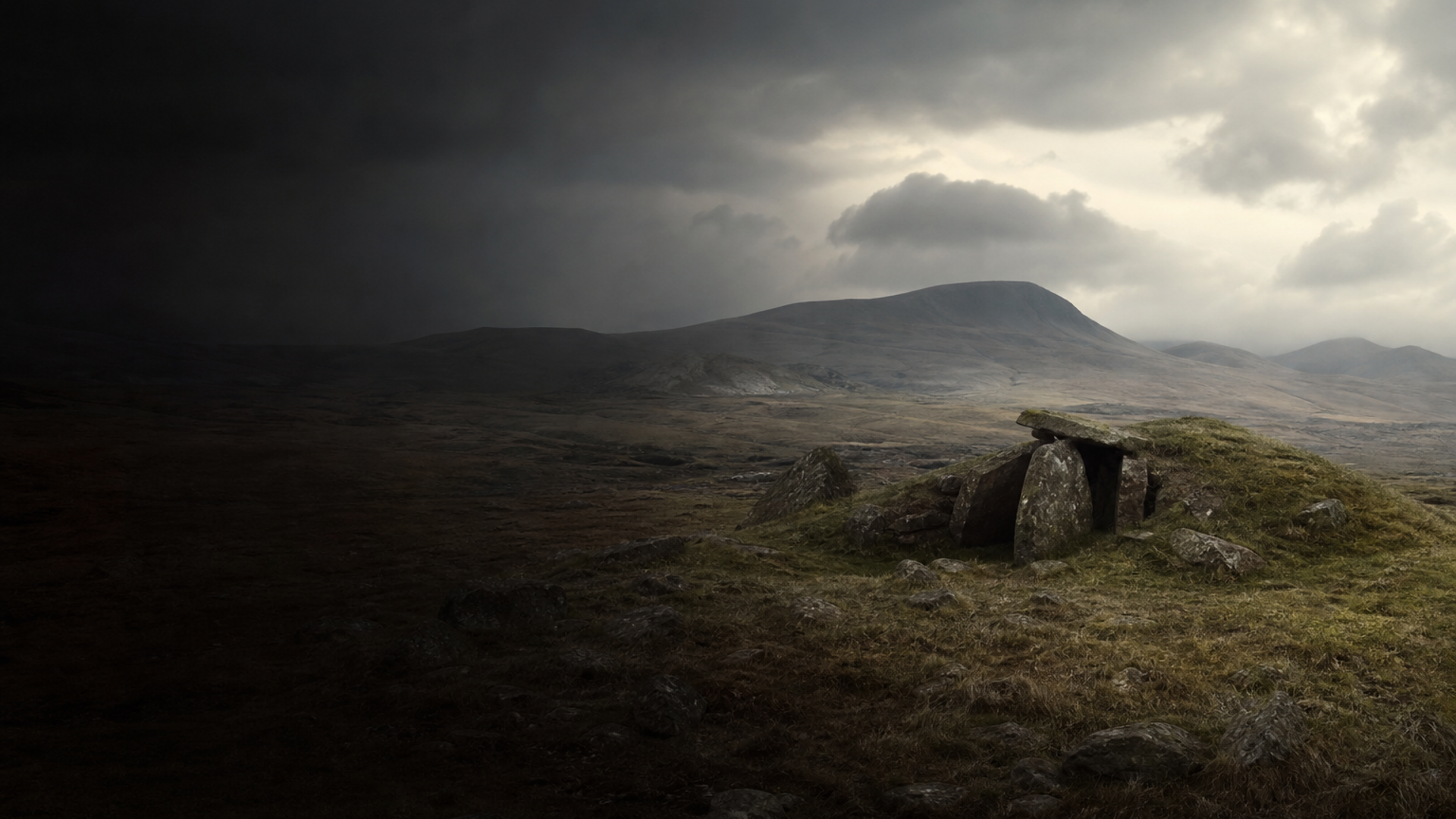
Genetically, the prevalence of haplogroup K among these individuals connects them to the broader tapestry of early European farmers. While modern Irish populations are genetically layered by later migrations, elements of the Neolithic maternal legacy persist in regional haplogroup frequencies. Archaeology and aDNA together allow us to trace how ritual places and maternal lineages contributed to deep-rooted regional identities, even as subsequent Bronze Age movements altered the genomic and cultural picture.

Bullets:

  • Maternal lineages link these communities to broader Neolithic Europe
  • Megalithic tombs remain cultural landmarks and research priorities
  • Maternal lineages link these communities to broader Neolithic Europe
  • Megalithic tombs remain cultural landmarks and research priorities
AI 电源

AI 助手

就 Ireland's Megalithic Voices 文化提问

AI 助手 由DNAGENICS公司制作

解锁此特性
Ask questions about the Ireland's Megalithic Voices culture. Our AI assistant can explain genetic findings, historical context, archaeological evidence, and modern connections.
AI 样本分析

Ireland's Megalithic Voices 文化是人类历史中值得了解的一章……

遗传分析揭示了与早期种群的联系,同时显示了独特的适应和文化创新的证据。 古代DNA样本提供了对迁徙模式、社会结构以及古代种群之间的生物关系的深刻见解。

这是人工智能分析的预览。 解锁全AI 助手, 以探索关于:

  • 遗传组成和祖先
  • 移徙模式和起源
  • 日常生活和文化习俗
  • 现代遗传遗产

探索更古老的文化

揭开古代世界文明的故事

使用优惠码 可减免 35% • 11月12日 到期




