Karakhanid Steppe Voices

下载的 PDF 是图像副本。如需可选中文本及更好的辅助技术支持,请使用打印功能。

Karakhanid Steppe Voices

揭开一个失落的文明

正在加载考古记录……

正在收集古代记录

跳转到主内容
Karakhanid Steppe Voices
文明焦点

Karakhanid Steppe Voices

Bones and genomes from the Tian Shan reveal a medieval frontier of movement and mixture

800 CE - 1100 CE
Tian Shan & Central Kazakh Steppe, Kazakhstan
滚动开始
Chapter I

剧情

了解 Karakhanid Steppe Voices 文化

Archaeogenetic and archaeological evidence from 800–1100 CE Karakhanid-era burials in the Tian Shan (Butakty, Central Steppe, Kazakhstan) hint at a mixed Steppe population shaped by Silk Road networks. Limited sampling (n=3) makes conclusions preliminary.

Time Period

800–1100 CE (Karakhanid Period)

Region

Tian Shan & Central Kazakh Steppe, Kazakhstan

Common Y-DNA

J (n=1; low sample)

Common mtDNA

A (n=1; low sample)

Chapter II

时间线

这种文化历史上的关键时刻

840 CE

Formation of Karakhanid polities

Early Karakhanid polities consolidate power across parts of Transoxiana and the Central Steppe, creating a political framework for Silk Road trade and steppe networks.

960 CE

Islamic conversion accelerates

By the 10th century, influential Karakhanid leaders adopt Islam, a shift reflected in ritual practices and material culture across many Central Asian communities.

Chapter III

Origins & Emergence

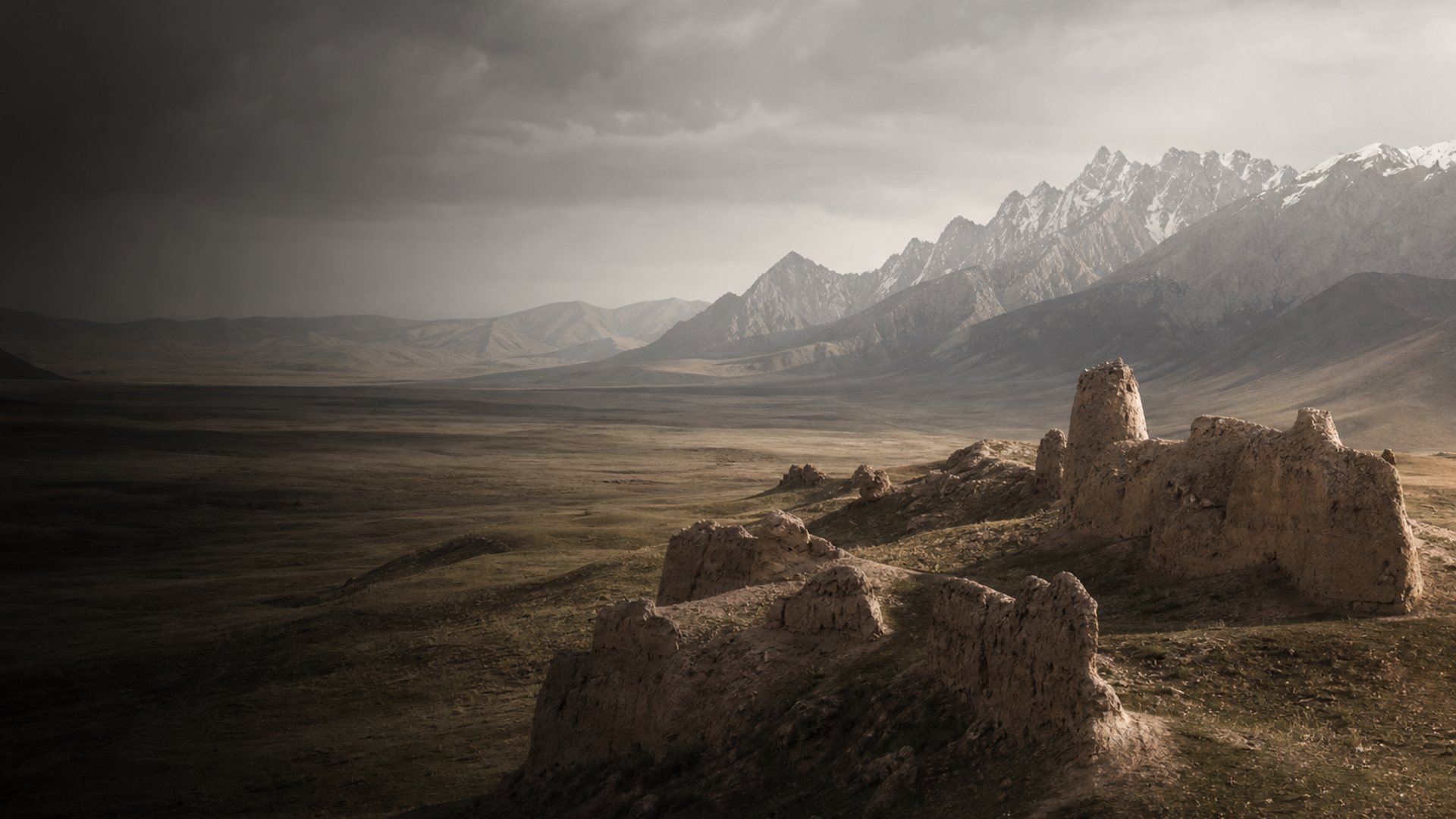
The Karakhanid period (roughly the 9th–11th centuries CE) unfolded across a vast, wind-swept arena where mountain shadows of the Tian Shan meet endless steppe. Archaeological data from cemeteries and settlement traces in the Central Steppe — including samples recovered near Butakty — indicate active interaction zones rather than isolated populations. Material culture across Karakhanid contexts shows the imprint of steppe pastoralism, Turkic political structures, and Silk Road exchange.

Limited skeletal and burial evidence suggests local communities were mobile, with seasonal herding and ties to caravan routes that threaded through the Tian Shan corridors. Historical sources place Karakhanid polities as Turkic-speaking and increasingly Islamic by the 10th–11th centuries; archaeological traces complement this, showing trade goods and imported luxury items in some burial assemblages. Importantly, the genetic evidence currently available from three individuals is a slender window into this complexity: it hints at biological mixing consistent with the cultural crossroads of medieval Central Asia, but the small sample size makes any population-level statements provisional.

Key archaeological sites: Butakty (Central Steppe, Kazakhstan), broader Tian Shan burial clusters. Dating: directly associated contexts fall within ~800–1100 CE, aligning with Karakhanid political expansion and intensified Silk Road connectivity.

  • Karakhanid era: 9th–11th centuries CE
  • Samples from Butakty and Tian Shan reflect mobile steppe lifeways
  • Evidence indicates cultural and material exchange along Silk Road routes
Chapter IV

Daily Life & Society

Life on the Karakhanid-era steppe is best imagined as motion and encounter: herds moving between pastures beneath glacier-lit peaks; merchants and envoys threading pack routes; village and funerary sites receiving objects and ideas from far-flung markets. Archaeological data indicates a pastoral economy dominated by horse and sheep husbandry, with occasional sedentary pockets tied to caravan nodes. Graves in the Central Steppe region often preserve traces of quotidian life — bone wear, toolkit fragments, and occasional metal fittings associated with equestrian gear — that speak to a horse-focused material culture.

Society in this frontier landscape was negotiated across kinship, tribal affiliation, and emerging Karakhanid political structures. Craft production and trade brought textiles, metalwork, and ceramics into steppe contexts, and the adoption of Islam in many Karakhanid elites by the 10th century reshaped ritual and identity in some communities. At the local level near Butakty, burial practices show variability consistent with mixed subsistence strategies and social differentiation; however, preservation and sampling remain uneven. Osteological indicators suggest a life of mobility and workloads linked to riding and herding, but more systematic excavation and bioarchaeological study are required to refine these reconstructions.

  • Pastoral, horse-centered economy with Silk Road interactions
  • Burial variability reflects mixed subsistence and social roles
Chapter V

Genetic Profile

The genetic window into Kazakhstan_Karakhanid is very small: three individuals dated to ca. 800–1100 CE from the Tian Shan/Central Steppe (including material from Butakty). Among these samples, researchers identified one Y-chromosome haplogroup J (n=1) and one mitochondrial haplogroup A (n=1). These markers offer snapshots rather than full portraits.

Haplogroup J on the paternal line is most commonly observed in West Asia and parts of South Asia and is also present in many Central Asian populations — its presence here may reflect male-mediated connections along west–east trade and migration routes, or local retention of West Eurasian paternal ancestry. Haplogroup A on the maternal line is an East Eurasian lineage found across Siberia and northern Eurasia; its detection suggests eastern maternal input into the local gene pool. Together, these uniparental markers are consistent with a mixed west–east ancestry mosaic, which aligns with the historical role of the Tian Shan as a contact zone. However, uniparental markers track single ancestral lines and can be shaped by drift, social selection, or small sample biases.

Given n=3 (below the n<10 threshold), conclusions must remain tentative: archaeological context indicates mobility and exchange, and the genetic hints are compatible with that picture, but broader sampling — especially autosomal data — is essential to test hypotheses about population structure, admixture proportions, and continuity with later populations such as modern Kazakhs.

  • Small sample (n=3) — conclusions are preliminary
  • Y-J suggests West/West Asian-linked paternal input; mtDNA A indicates East Eurasian maternal ancestry
Chapter VI

Legacy & Modern Connections

The Karakhanid epoch helped shape the linguistic, religious, and political contours of medieval Central Asia. Archaeologically and historically, Karakhanid polities contributed to the Islamization of Turkic communities and to the intensification of long-distance exchange across the Silk Road. Genetically, the fragmentary data from the Tian Shan implies a living mosaic — a population formed at the crossroads of east and west.

For modern populations, this suggests that some genetic threads present in medieval steppe communities persist in the region’s diverse contemporary gene pool, but direct continuity cannot be assumed from three samples. Further archaeogenetic sampling across multiple cemeteries, combined with autosomal analyses and careful chronological control, will clarify how Karakhanid-era mixtures contributed to the genetic landscape of later Central Asian peoples. Until then, the existing evidence invites a cinematic image of a multilingual, multiethnic frontier where genes, goods, and ideas flowed together across mountain passes.

  • Karakhanid era contributed to Turkic-Islamic cultural transformations
  • Preliminary DNA hints at east–west admixture; larger datasets needed to assess continuity
AI 电源

AI 助手

就 Karakhanid Steppe Voices 文化提问

AI 助手 由DNAGENICS公司制作

解锁此特性
Ask questions about the Karakhanid Steppe Voices culture. Our AI assistant can explain genetic findings, historical context, archaeological evidence, and modern connections.
AI 样本分析

Karakhanid Steppe Voices 文化是人类历史中值得了解的一章……

遗传分析揭示了与早期种群的联系,同时显示了独特的适应和文化创新的证据。 古代DNA样本提供了对迁徙模式、社会结构以及古代种群之间的生物关系的深刻见解。

这是人工智能分析的预览。 解锁全AI 助手, 以探索关于:

  • 遗传组成和祖先
  • 移徙模式和起源
  • 日常生活和文化习俗
  • 现代遗传遗产

探索更古老的文化

揭开古代世界文明的故事

使用优惠码 可减免 35% • 11月12日 到期




