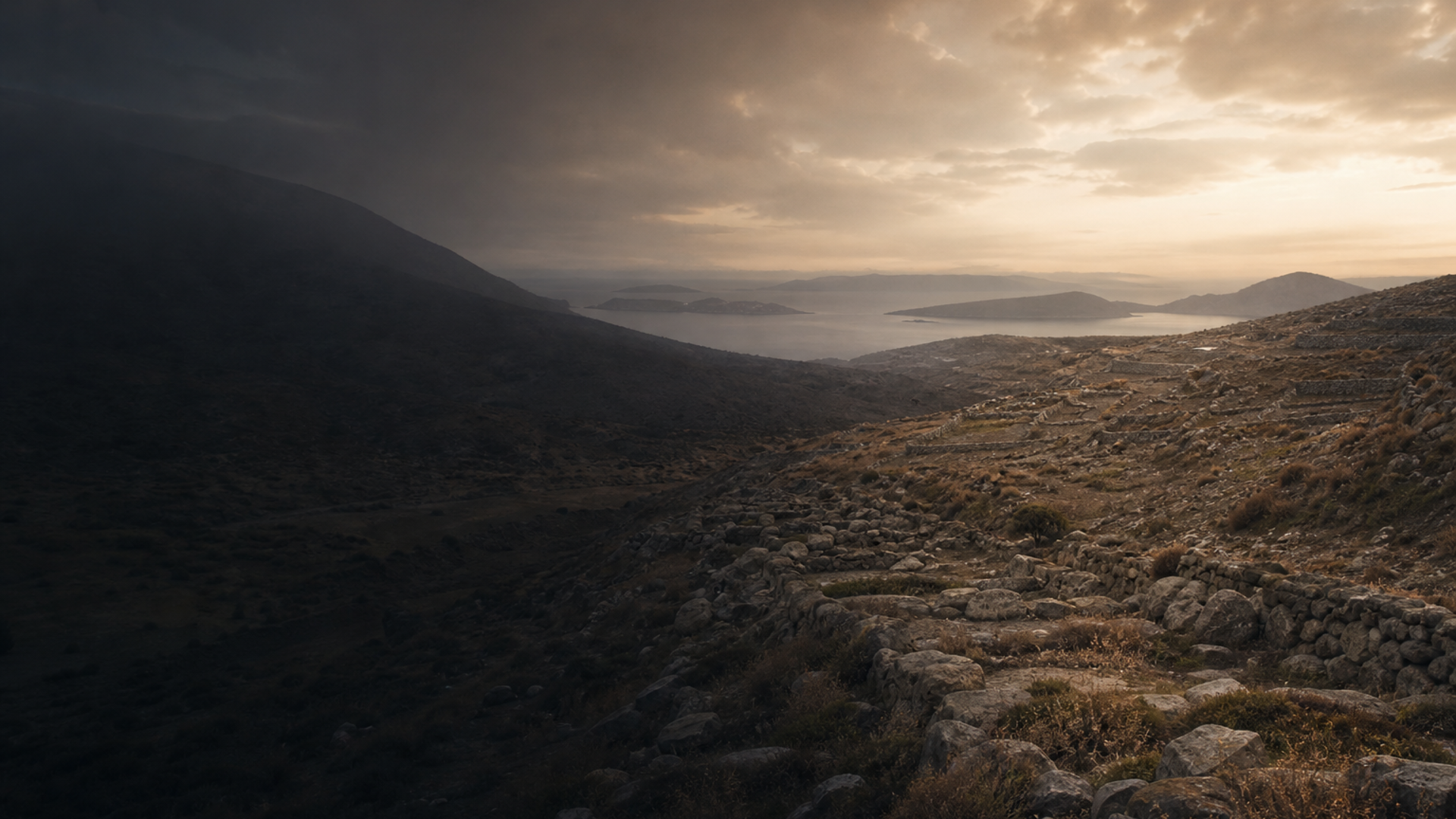
Koukounaries (Paros) — Late Bronze Age Echoes

下载的 PDF 是图像副本。如需可选中文本及更好的辅助技术支持,请使用打印功能。

Koukounaries (Paros) — Late Bronze Age Echoes

揭开一个失落的文明

正在加载考古记录……

正在收集古代记录

跳转到主内容
Koukounaries (Paros) — Late Bronze Age Echoes
文明焦点

Koukounaries (Paros) — Late Bronze Age Echoes

Four genomes from Koukounaries (1175–1150 BCE) tie Cycladic lifeways to wider Aegean threads

1175 CE - 1150 BCE
Cyclades, Greece (Paros)
滚动开始
Chapter I

剧情

了解 Koukounaries (Paros) — Late Bronze Age Echoes 文化

Archaeogenetic and archaeological traces from Koukounaries on Paros (1175–1150 BCE) reveal a small Late Bronze Age community. Limited samples hint at Mediterranean/Anatolian affinities and local continuity. Conclusions are preliminary: only four individuals inform this portrait.

Time Period

1175–1150 BCE (Late Bronze Age)

Region

Cyclades, Greece (Paros)

Common Y-DNA

J (observed in 1/4 samples)

Common mtDNA

H, U, J (each present among 4 samples)

Chapter II

时间线

这种文化历史上的关键时刻

1175 BCE

Koukounaries occupation horizon (dated)

Archaeological deposits and radiocarbon contexts at Koukounaries on Paros are dated to c. 1175–1150 BCE, representing Late Bronze Age activity amid wider Aegean transitions.

Chapter III

Origins & Emergence

The people represented by the Koukounaries assemblage lived on Paros during the closing decades of the Late Bronze Age (c. 1175–1150 BCE), a time when the Aegean world was reshaping itself. Archaeological data indicates human presence in the Koukounaries area through settlement debris and funerary deposits that suggest continuity of Cycladic maritime lifeways. Cinematically, imagine a wind-sculpted shore where fishing skiffs and trading craft threaded between islands by starlight.

Genetically, the tiny Koukounaries sample (n = 4) offers only a tentative glimpse: one observed male lineage belongs to haplogroup J — a paternal marker found broadly across the eastern Mediterranean and Anatolia — while maternal lineages include H, U and J, haplogroups commonly detected across Europe and the Near East. Limited evidence suggests these genomes reflect a community embedded in long-distance seafaring networks, rather than an isolated island gene pool.

Archaeological parallels in the Cyclades and mainland Aegean show shared ceramic styles and trade goods at this time, indicating cultural exchange. However, given the very small sample size, any narrative of migration or demographic turnover must remain provisional. Further excavation and additional ancient DNA from Paros and neighboring islands are required to turn these evocative hints into a robust origin story.

  • Occupational horizon dated to 1175–1150 BCE on Paros
  • Material culture indicates Cycladic maritime connections
  • Genetic signals are preliminary due to small sample count
Chapter IV

Daily Life & Society

The archaeological imagination of Koukounaries is shaped by sea, stone and trade. Local architecture in the Cyclades of the Late Bronze Age tended toward compact settlements with storage spaces for olive oil, dried fish, and ceramic amphorae — goods that fueled island economies. Archaeological finds across the Cyclades often include imported pottery sherds, metalwork fragments and simple personal ornaments, suggesting household economies integrated with regional exchange.

At Koukounaries, everyday life likely combined agricultural production (olives, cereals), pastoralism, fishing, and specialized craftwork tied to maritime commerce. The island setting encouraged mobility: sailors, merchants and perhaps seasonal laborers moved between islands and the mainland. Funerary practices visible in Cycladic contexts range from simple inhumations to more elaborate tombs elsewhere in the Aegean; the limited number of burials at Koukounaries constrains firm statements about social hierarchy.

Archaeological data indicates resilience and adaptability: communities on Paros negotiated shifting trade routes and political landscapes as palatial power ebbed on the mainland. The cinematic image is human-scale — hands shaping amphorae, seawater on sunburned decks, and conversation in shared harbor shadows — but the precise social structures at Koukounaries remain only faintly illuminated by the surviving material record.

  • Economy blended agriculture, pastoralism, fishing, and craft
  • Island life tied to regional seafaring and exchange
Chapter V

Genetic Profile

Only four genomes from Koukounaries have been reported, so genetic inferences must be cautious. Among these individuals, one Y-chromosome is assigned to haplogroup J. Mitochondrial haplogroups observed include H, U and J. These markers are not unusual in the broader Mediterranean and Aegean: haplogroup J is found in Anatolia, the Levant and parts of the Mediterranean, while H and U are common maternal lineages across Europe and the Near East.

Archaeogenetic comparisons across the Bronze Age Aegean indicate a tapestry of ancestries — Neolithic farmer-descended populations, long-standing island lineages, and gene flow tied to interregional contacts. The Koukounaries individuals are consistent with this complex picture but do not by themselves define it. If integrated with larger regional datasets, these genomes could help track whether Paros experienced continuity from earlier Neolithic/Cycladic populations or received additional input during Late Bronze Age movements.

Because the sample count is low (n < 10), statements about population structure, migration, or sex-biased admixture are provisional. Limited evidence suggests affinities with Mediterranean-Anatolian genetic pools, but future samples from Paros and neighboring islands are essential to confirm patterns. Archaeological context — burial treatment, associated artifacts, and stratigraphy — will be critical to interpret any genetic signals responsibly.

  • Small dataset: 4 genomes — conclusions are preliminary
  • Y: J (1); mtDNA: H, U, J — consistent with wider Aegean variation
Chapter VI

Legacy & Modern Connections

The human echoes from Koukounaries resonate into the present as part of the long human story of the Cyclades. Archaeological continuity in material culture suggests durable island traditions, while genetic traces hint at enduring Mediterranean connections. Modern populations of the Aegean retain composite ancestries shaped by millennia of seafaring, trade and mobility; Koukounaries contributes a small but meaningful fragment to that mosaic.

It is important to frame these connections conservatively: with only four ancient genomes, we cannot draw direct lines from Koukounaries individuals to specific modern groups. Instead, these remains illuminate the processes — exchange, adaptation, and connectivity — that helped shape Aegean genetic landscapes. Each new sample holds the potential to transform provisional impressions into detailed narratives about who moved, who stayed, and how island communities navigated the ebb and flow of the Late Bronze Age.

  • Contributes to the mosaic of Aegean genetic and cultural continuity
  • Modern connections are plausible but remain provisional given sample size
AI 电源

AI 助手

就 Koukounaries (Paros) — Late Bronze Age Echoes 文化提问

AI 助手 由DNAGENICS公司制作

解锁此特性
Ask questions about the Koukounaries (Paros) — Late Bronze Age Echoes culture. Our AI assistant can explain genetic findings, historical context, archaeological evidence, and modern connections.
AI 样本分析

Koukounaries (Paros) — Late Bronze Age Echoes 文化是人类历史中值得了解的一章……

遗传分析揭示了与早期种群的联系,同时显示了独特的适应和文化创新的证据。 古代DNA样本提供了对迁徙模式、社会结构以及古代种群之间的生物关系的深刻见解。

这是人工智能分析的预览。 解锁全AI 助手, 以探索关于:

  • 遗传组成和祖先
  • 移徙模式和起源
  • 日常生活和文化习俗
  • 现代遗传遗产

探索更古老的文化

揭开古代世界文明的故事

使用优惠码 可减免 35% • 11月12日 到期