Kumsay Early Bronze Echoes

下载的 PDF 是图像副本。如需可选中文本及更好的辅助技术支持,请使用打印功能。

Kumsay Early Bronze Echoes

揭开一个失落的文明

正在加载考古记录……

正在收集古代记录

跳转到主内容
Kumsay Early Bronze Echoes
文明焦点

Kumsay Early Bronze Echoes

Human remains from Kyirik Oba reveal a fragile window into early Bronze Age Kazakhstan

3345 CE - 2908 BCE
Kumsay, Kyirik Oba, Kazakhstan
滚动开始
Chapter I

剧情

了解 Kumsay Early Bronze Echoes 文化

Archaeological and genetic data from four individuals at Kumsay (Kyirik Oba), Kazakhstan, dated 3345–2908 BCE, suggest a mixed steppe and Siberian ancestry. Limited sample size makes conclusions preliminary; evidence connects burial contexts to wider Bronze Age steppe dynamics.

Time Period

3345–2908 BCE

Region

Kumsay, Kyirik Oba, Kazakhstan

Common Y-DNA

Q (1)

Common mtDNA

C (2), H6a (1), U4a (1)

Chapter II

时间线

这种文化历史上的关键时刻

3345 BCE

Earliest Kumsay burials

Radiocarbon dating places human remains at Kumsay (Kyirik Oba) beginning around 3345 BCE, marking the start of the site's Early Bronze Kumsay horizon.

Chapter III

Origins & Emergence

The Kumsay assemblage—recovered from burial contexts at Kyirik Oba in central Kazakhstan and dated by radiocarbon to between 3345 and 2908 BCE—captures an early chapter of Bronze Age transformation on the Eurasian steppe. Archaeological data indicates these interments belong to what researchers classify as the Early Bronze Kumsay horizon, a local expression within broader steppe networks.

Limited evidence suggests that Kumsay communities were positioned at an ecological and cultural crossroads: to the north and east lay taiga and forest-steppe zones with connections to Siberian groups; to the west and south extended the open grasslands that later hosted expansive pastoral spheres. Material traces from the site are fragmentary in the published record, so reconstructions rely heavily on mortuary placement, stratigraphy, and now genomics.

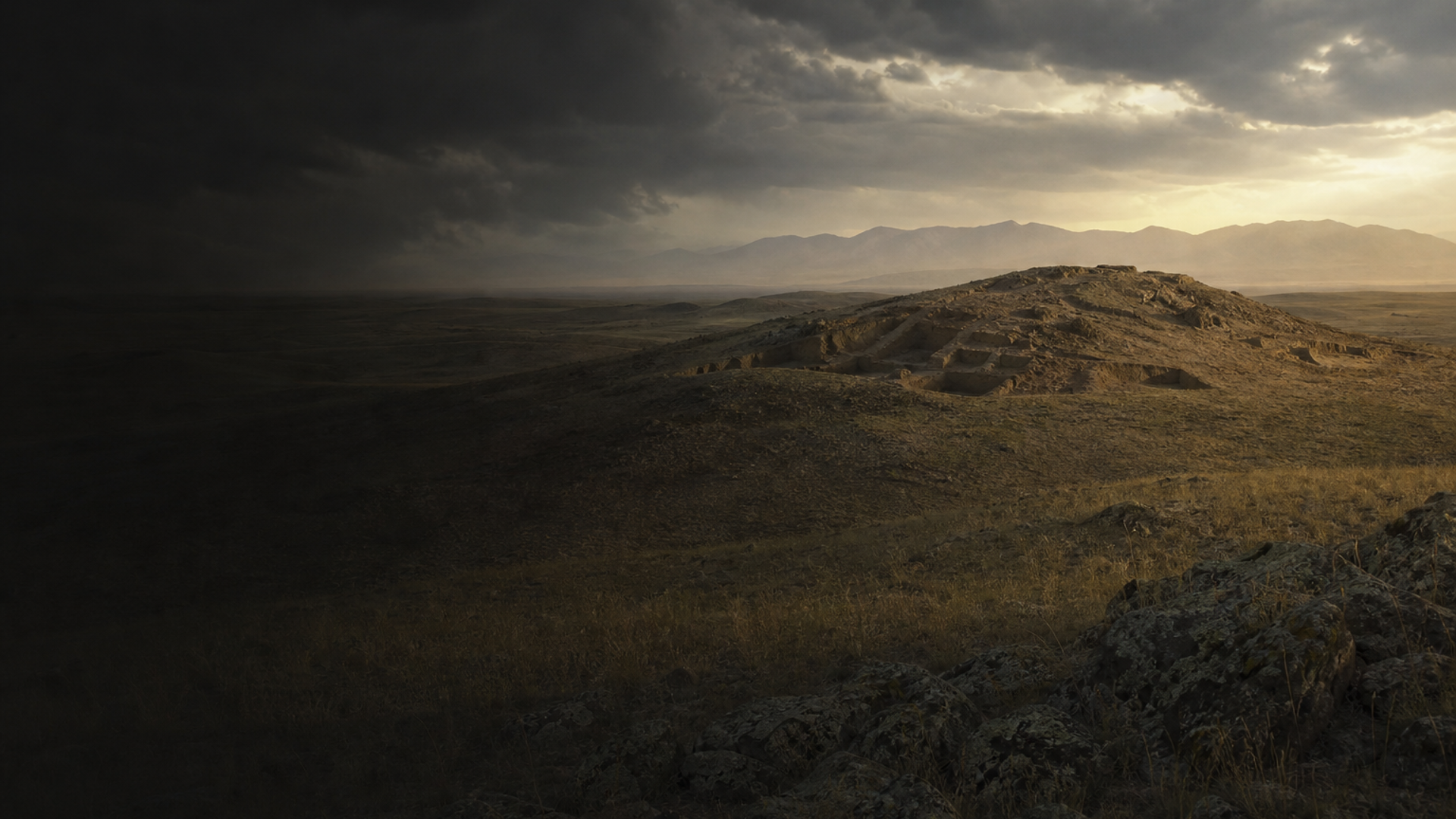
The cinematic sweep of this landscape—wintry plains, distant mountain ranges, and seasonal pastures—frames a society in motion. People at Kumsay likely engaged in mobile lifeways adapted to steppe ecologies, while maintaining local identities expressed in burial practice. Because only four human genomes are available from Kumsay, any narrative about population movements or cultural origins must remain cautious and provisional.

  • Burial site: Kumsay (Kyirik Oba), central Kazakhstan
  • Radiocarbon dates span 3345–2908 BCE (Early Bronze Kumsay)
  • Interpretation limited by small sample size and fragmentary archaeological record
Chapter IV

Daily Life & Society

Archaeological data from Kumsay provide only a partial silhouette of everyday life, yet the material and environmental context allows informed inference. The Early Bronze Age steppe was a mosaic of seasonal pastures and riverine corridors; communities here balanced mobility with localized use of burial grounds like Kyirik Oba. Funerary deposits suggest attention to the dead and social distinctions encoded in burial placement, though grave goods and architectural detail are sparsely documented for this site.

Subsistence strategies in contemporaneous steppe groups combined herding of domesticated animals with hunting and gathering resources across variable terrain. High winds, cold winters, and shifting grassland productivity would have shaped seasonal rounds—camp relocation, aggregation at strategic waterpoints, and exchange networks for raw materials. Social life likely centered on kin groups with flexible alliances; craft production and long-distance exchange (obsidian, copper, ornaments) are known from other Bronze Age steppe sites and could have parallels at Kumsay.

The human remains themselves, now analyzed genetically, are among the most direct witnesses to daily life: they carry traces of diet, mobility, and biological ancestry. Isotopic and aDNA studies, when available alongside careful excavation records, transform bones into narratives of migration, marriage, and adaptation.

  • Likely pastoral and mobile lifeways adapted to steppe ecology
  • Funerary contexts indicate social attention but archaeological detail is limited
Chapter V

Genetic Profile

The genetic data from Kumsay are scarce but evocative. Four individuals yielded mitochondrial and Y-chromosome haplogroups that hint at admixture between eastern and western Eurasian lineages. Maternal lineages include mtDNA C (found in two samples), H6a (one), and U4a (one). Haplogroup C is commonly associated with Siberian and East Eurasian populations; H6a and U4a are typically considered West Eurasian or steppe-associated maternal branches.

On the paternal side, one sampled male carried Y-haplogroup Q. Q is a lineage with deep ties to northern Eurasia and is observed in Siberian and some early Holocene steppe populations; it is distinct from the R1 lineages often emphasized in later Bronze Age steppe narratives. The coexistence of mtDNA C with H and U maternal signals suggests a biological tapestry in which individuals or maternal ancestors trace to both eastern and western gene pools.

Important caveats govern these interpretations: with only four genomes, patterns of ancestry, sex-biased admixture, and population structure remain preliminary. Archaeological context must be integrated with larger aDNA datasets from Kazakhstan and adjacent regions to clarify whether Kumsay reflects localized admixture events, long-standing mixed ancestry, or episodic migration. Nonetheless, these genomes provide a cinematic snapshot of a time when the steppe was a zone of encounter, carrying signatures of diverse ancestries.

  • mtDNA: C (2), H6a (1), U4a (1) — suggests East and West Eurasian maternal inputs
  • Y-DNA: Q in one male — indicative of northern/Inner Eurasian paternal ties
Chapter VI

Legacy & Modern Connections

Kumsay’s genetic echoes contribute to a broader story of how populations across the Eurasian steppe blended and moved during the Bronze Age. The presence of both Siberian-associated and West Eurasian maternal lines alongside a Q paternal lineage points toward demographic complexity that likely fed into later steppe cultures and modern Central Asian diversity.

However, because the Kumsay dataset includes only four individuals, any direct links to modern populations must be framed as tentative. What these genomes do reliably demonstrate is that by the early Bronze Age the Kazakh steppe was not monolithic: it was a palimpsest of ancestries, networks, and lifeways that would shape subsequent cultural and genetic landscapes across Central Asia.

  • Contributes evidence of mixed East–West ancestry in early Bronze Age Kazakhstan
  • Direct connections to modern groups are plausible but preliminary given sample size
AI 电源

AI 助手

就 Kumsay Early Bronze Echoes 文化提问

AI 助手 由DNAGENICS公司制作

解锁此特性
Ask questions about the Kumsay Early Bronze Echoes culture. Our AI assistant can explain genetic findings, historical context, archaeological evidence, and modern connections.
AI 样本分析

Kumsay Early Bronze Echoes 文化是人类历史中值得了解的一章……

遗传分析揭示了与早期种群的联系,同时显示了独特的适应和文化创新的证据。 古代DNA样本提供了对迁徙模式、社会结构以及古代种群之间的生物关系的深刻见解。

这是人工智能分析的预览。 解锁全AI 助手, 以探索关于:

  • 遗传组成和祖先
  • 移徙模式和起源
  • 日常生活和文化习俗
  • 现代遗传遗产

探索更古老的文化

揭开古代世界文明的故事

使用优惠码 可减免 35% • 11月12日 到期