Late Mesolithic Sicily – Grotta dell'Uzzo

下载的 PDF 是图像副本。如需可选中文本及更好的辅助技术支持,请使用打印功能。

Late Mesolithic Sicily – Grotta dell'Uzzo

揭开一个失落的文明

正在加载考古记录……

正在收集古代记录

跳转到主内容
Late Mesolithic Sicily – Grotta dell'Uzzo
文明焦点

Late Mesolithic Sicily – Grotta dell'Uzzo

Cave communities on Sicily's rugged shorelines whose maternal lines trace Mesolithic Europe

8798 CE - 5844 BCE
Sicily, Italy — Grotta dell'Uzzo
滚动开始
Chapter I

剧情

了解 Late Mesolithic Sicily – Grotta dell'Uzzo 文化

Archaeological and genetic glimpses from three individuals (8798–5844 BCE) at Grotta dell'Uzzo reveal coastal hunter-gatherer lifeways in Late Mesolithic Sicily. mtDNA U appears in all samples; Y-chromosome data are not reported. Interpretations are preliminary given small sample size.

Time Period

8798–5844 BCE (Late Mesolithic)

Region

Sicily, Italy — Grotta dell'Uzzo

Common Y-DNA

Not reported / unknown (no Y data from 3 samples)

Common mtDNA

U (3 samples)

Chapter II

时间线

这种文化历史上的关键时刻

8798 BCE

Earliest dated individuals at Grotta dell'Uzzo

Radiocarbon dates place sequenced individuals at Grotta dell'Uzzo beginning around 8798 BCE, marking early Holocene coastal occupation in northwest Sicily.

Chapter III

Origins & Emergence

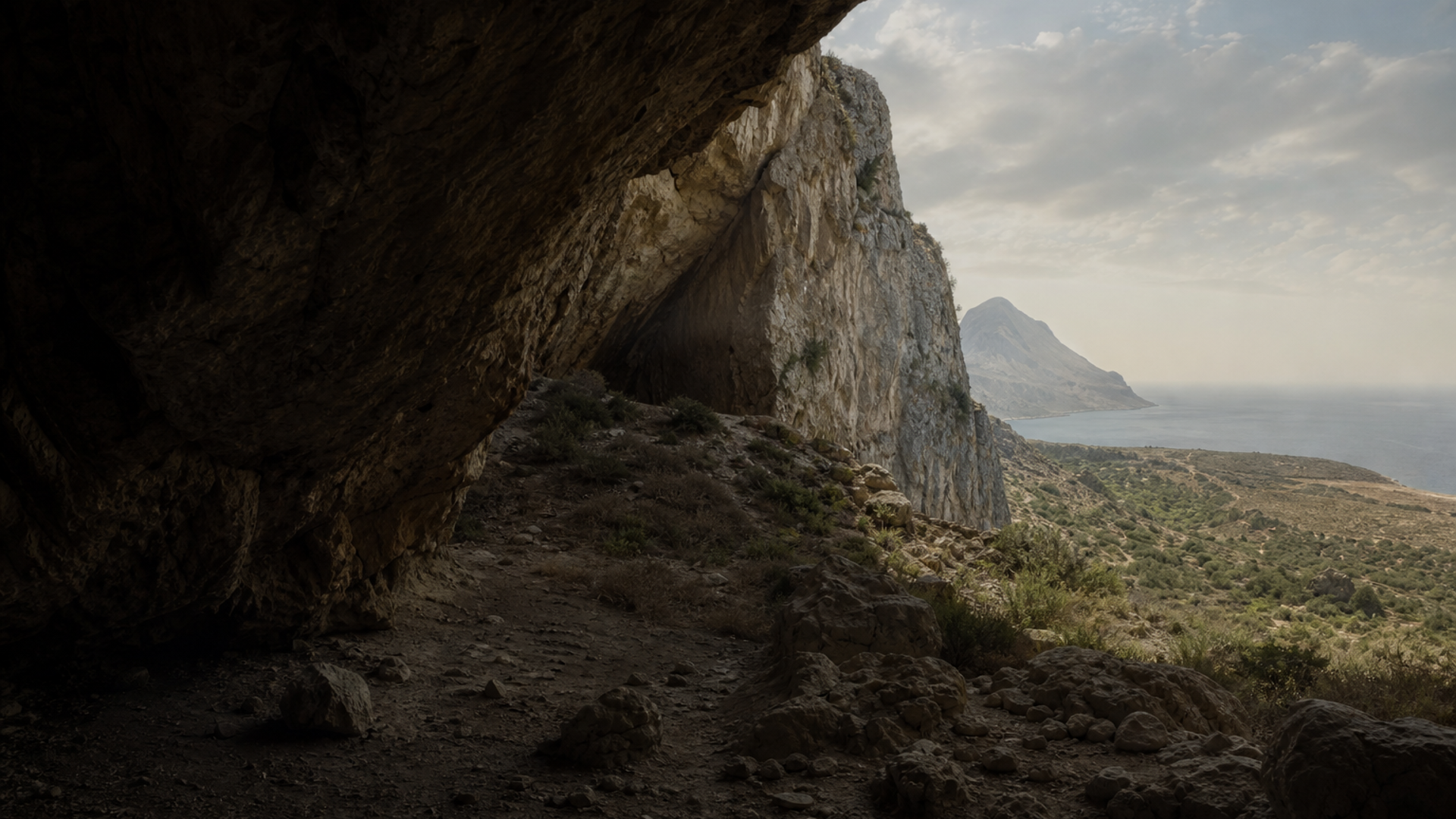
The Late Mesolithic occupation of Grotta dell'Uzzo on north-western Sicily reads like a coastal chronicle. Archaeological data indicate repeated human use of the cave from the early Holocene into the Neolithic transition; radiocarbon dates associated with the sequenced individuals fall between 8798 and 5844 BCE. Grotta dell'Uzzo sits above a rugged coastline where the sea and land met in a rich ecological margin, attracting small, mobile groups who exploited fish, shellfish, birds and terrestrial game. Lithic assemblages from the site show a continuity of microlithic technologies adapted to both marine and terrestrial resource extraction, and faunal remains and shell middens reflect a diet closely tied to the nearshore environment.

Cinematically, one can imagine small bands moving along the shoreline at dusk, fires flickering near cave entrances while nets, traps and bone tools are readied for the night. Archaeologically, this setting places Sicily within the broader tapestry of Mediterranean Late Mesolithic adaptations characterized by seasonal mobility, specialized coastal foraging, and a flexible toolkit. Limited evidence suggests interaction with nearby islands and mainland Italy, but the details remain thin: pebble tools and raw material sourcing hint at networks without yet providing a clear map of exchange. Given the small number of sequenced individuals from the cave, conclusions about population origins must remain cautious; the genetic signals available so far are best interpreted as preliminary notes in a larger prehistoric symphony.

  • Occupations dated between 8798 and 5844 BCE at Grotta dell'Uzzo
  • Coastal-foraging adaptation with microlithic toolkits and shell middens
  • Evidence of regional connections, but limited by current data
Chapter IV

Daily Life & Society

Material culture from Grotta dell'Uzzo paints a vivid picture of daily life along the Late Mesolithic Sicilian coast. Excavations reveal hearths, worked bone, fishing gear impressions, and dense shell deposits that attest to repeated seasonal camps focused on marine resources. Archaeological strata show specialized activity areas: loci of fish processing, bone tool manufacture, and refuse deposits. Small-scale hunting parties likely targeted red deer and wild boar inland, while coastal groups gathered shellfish, seabirds and migratory fish using nets and traps.

Social organization was likely flexible and kin-based, structured around seasonal rounds rather than permanent settlements. Burials in nearby contexts and mortuary treatment—although only sparingly preserved—suggest social recognitions that may have included selected burials within cave environments. Ornamentation and personal items are rare but present, hinting at identity markers and perhaps long-distance exchange of decorative materials. Environmental reconstructions show a warmer Holocene coastline with rich littoral resources that sustained modest population densities.

Interpretations must emphasize the fragmentary nature of the record: taphonomic processes, episodic excavation, and small sample sizes constrain firm conclusions. Yet the archaeological picture coheres around an image of maritime-skilled, mobile communities whose lives were choreographed by tides, seasons and the rugged contours of Sicily's shores.

  • Shell middens and hearths indicate intensive coastal resource use
  • Evidence for seasonal mobility and specialized activity areas
Chapter V

Genetic Profile

DNA recovered from three individuals at Grotta dell'Uzzo provides a tantalizing, if preliminary, genetic window into Late Mesolithic Sicily. All three sequenced mitochondrial genomes belong to haplogroup U, a lineage commonly found among European hunter-gatherers across the Mesolithic. This maternal signal aligns with archaeological expectations for indigenous hunter-gatherer ancestry in the region and resonates with broader patterns observed in Western Hunter-Gatherer (WHG) populations.

No consistent Y-DNA haplogroup is reported for these three samples in the provided data, so paternal affinities remain unresolved. The small sample count (n=3) necessitates caution: while maternal continuity with European Mesolithic groups is suggested, it would be premature to generalize about population structure, sex-biased mobility, or admixture dynamics. Future sampling could reveal incoming Neolithic farmer admixture, macromesolithic variability, or island-specific substructure that current data cannot detect.

Genetically, these individuals likely occupied a place within the mosaic of postglacial European hunter-gatherers—connected by maternal lineages shared across the continent, but also shaped by local island ecology and mobility patterns. Archaeogeneticists emphasize that with fewer than ten samples, signals are fragile: patterns seen here should be treated as hypotheses to test as more Sicilian Mesolithic genomes are sequenced and integrated with isotope, lithic and faunal datasets.

  • All three samples carry mtDNA haplogroup U, typical of Mesolithic Europe
  • Y-chromosome data are not reported; paternal affinities remain unknown
Chapter VI

Legacy & Modern Connections

The genetic echoes from Grotta dell'Uzzo resonate into modern discussions about Mediterranean prehistory. Maternal haplogroup U ties these Sicilian hunter-gatherers to a broader European Mesolithic genetic heritage, suggesting that elements of early Holocene maternal ancestry persisted in island populations before later Neolithic changes. Archaeological continuity in coastal subsistence also informs modern understandings of human resilience in maritime environments.
However, any claim of direct ancestry to present-day Sicilians must be cautious: millennia of migrations, demographic turnovers, and admixture—particularly during the Neolithic, Bronze Age and historical periods—greatly reshaped the genetic landscape. Limited sample size and uneven temporal coverage mean that Grotta dell'Uzzo offers an evocative snapshot rather than a full portrait. It remains an essential site where archaeology and ancient DNA together illuminate how island life and maternal lineages intertwined in the deep past.

  • mtDNA U links these individuals to pan-European Mesolithic maternal lineages
  • Later migrations likely altered genetic continuity; direct links to modern populations are tentative
AI 电源

AI 助手

就 Late Mesolithic Sicily – Grotta dell'Uzzo 文化提问

AI 助手 由DNAGENICS公司制作

解锁此特性
Ask questions about the Late Mesolithic Sicily – Grotta dell'Uzzo culture. Our AI assistant can explain genetic findings, historical context, archaeological evidence, and modern connections.
AI 样本分析

Late Mesolithic Sicily – Grotta dell'Uzzo 文化是人类历史中值得了解的一章……

遗传分析揭示了与早期种群的联系,同时显示了独特的适应和文化创新的证据。 古代DNA样本提供了对迁徙模式、社会结构以及古代种群之间的生物关系的深刻见解。

这是人工智能分析的预览。 解锁全AI 助手, 以探索关于:

  • 遗传组成和祖先
  • 移徙模式和起源
  • 日常生活和文化习俗
  • 现代遗传遗产

探索更古老的文化

揭开古代世界文明的故事

使用优惠码 可减免 35% • 11月12日 到期




