Roopkund: Lake of Snow and Strangers

下载的 PDF 是图像副本。如需可选中文本及更好的辅助技术支持,请使用打印功能。

Roopkund: Lake of Snow and Strangers

揭开一个失落的文明

正在加载考古记录……

正在收集古代记录

跳转到主内容
Roopkund: Lake of Snow and Strangers
文明焦点

Roopkund: Lake of Snow and Strangers

High‑altitude skeletons (1650–1950 CE) linking Himalayan archaeology with mixed DNA ancestries

1650 CE - 1950 CE
Uttarakhand, Himalaya, India
滚动开始
Chapter I

剧情

了解 Roopkund: Lake of Snow and Strangers 文化

Roopkund B represents 14 individuals from Roopkund Lake, Uttarakhand (c.1650–1950 CE). Archaeology and DNA reveal a surprising mixture of West Eurasian Y and mtDNA lineages at a Himalayan pilgrimage site; interpretations remain cautious given the localized sample.

Time Period

c.1650–1950 CE

Region

Uttarakhand, Himalaya, India

Common Y-DNA

J (3), R (2), G (1), T (1), E (1)

Common mtDNA

H (3), H1 (2), J1b, X2d, H12

Chapter II

时间线

这种文化历史上的关键时刻

1942 CE

First modern discovery of the Roopkund skeletal cluster

Local and colonial observers reported large numbers of human bones at Roopkund Lake; the site entered scientific attention as a high‑altitude death assemblage.

Chapter III

Origins & Emergence

Roopkund’s skeletal clusters lie on a high glacial shelf above 5,000 m, a place where snow and ice reveal bones like a frozen ledger. Archaeological survey of the lake basin and surrounding moraines documents scattered human remains, fragmented bone, and occasional artifacts indicating episodic deposition rather than continuous occupation. Radiocarbon and stratigraphic work constrain the assemblage discussed here to the late premodern period (c.1650–1950 CE).

The concentration of remains at such altitude suggests episodic travel through a dangerous route — pilgrim columns, traders, or small parties who crossed high passes. Limited archaeological evidence preserves little in the way of dress or grave goods, complicating cultural attribution. Environmental taphonomy (freeze‑thaw cycles, slope processes) has rearranged bones and removed context in places.

Interpreting origins therefore relies on integrating skeletal data with material traces and, crucially, genetic results. The presence of multiple West Eurasian haplogroups among these individuals indicates that the group interred at Roopkund B was not a homogeneous local population. However, the sample is geographically concentrated at one site, and social identity (pilgrims, merchants, or small traveling parties) remains uncertain. Further excavation and comparative regional sampling are needed to refine origin hypotheses.

  • Remains concentrated on a high‑altitude lake shelf (Roopkund, Uttarakhand).
  • Radiocarbon and context place these individuals between c.1650–1950 CE.
  • Material evidence is sparse; interpretation uses aDNA and taphonomy.
Chapter IV

Daily Life & Society

Skeletal biology and the archaeological setting offer fragmentary glimpses of the lives behind the bones. Stable isotopes from bone collagen (when available) can indicate diets rich in C3 or C4 plants and relative marine vs. terrestrial protein, but for this assemblage such data are limited. Pathologies on preserved bones — healed fractures, dental wear, and markers of physical stress — hint at physically demanding lifestyles consistent with long‑distance travel or heavy labor.
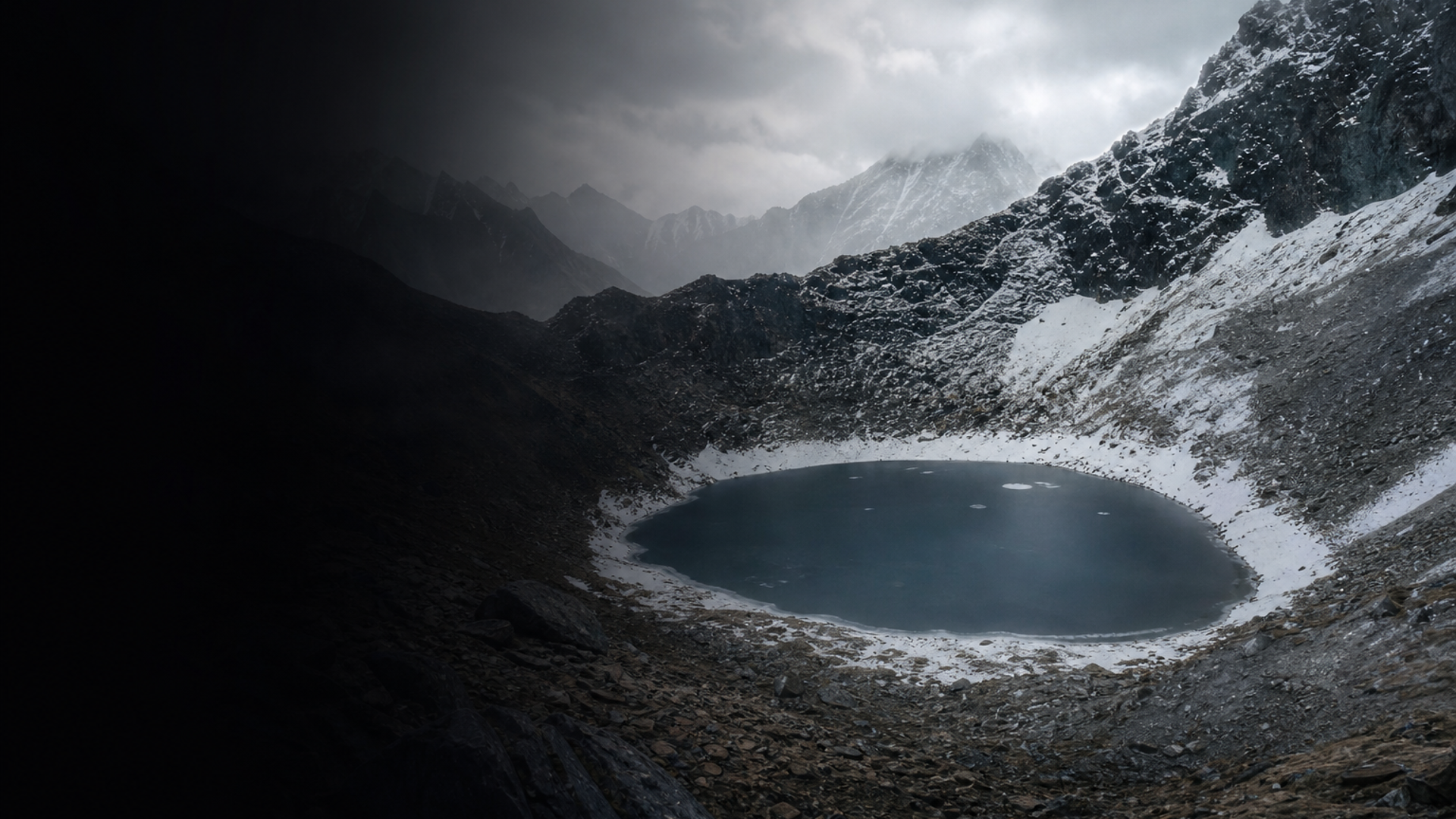

Climatic hardship at 5,000 m implies that those who reached Roopkund were adapted to episodic high‑altitude exposure or were undertaking an extraordinary journey. Clothing, footwear, and temporary shelters leave poor preservation, so daily practice is best reconstructed by analogy with ethnographic and historical accounts of Himalayan pilgrims and traders. Seasonal pilgrimage circuits and trans‑Himalayan trade routes were active in the premodern period; a small party of outsiders could have been vulnerable to sudden storms or avalanches, producing the concentrated death assemblage at the lake.

Archaeological data indicate a single mortuary context rather than an organized cemetery: bones are often dispersed and intermixed, consistent with a catastrophic event or multiple events at the same natural trap.

  • Skeletal markers suggest physically strenuous lives and travel-related stress.
  • Sparse material culture; context typical of catastrophic high‑altitude death.
Chapter V

Genetic Profile

Genomic screening of 14 individuals from the Roopkund B assemblage reveals a notable presence of West Eurasian paternal and maternal lineages alongside diversity within those clades. The Y‑DNA spectrum includes haplogroups J (n=3), R (n=2), G (n=1), T (n=1) and E (n=1). These haplogroups are broadly distributed across West Asia, the Mediterranean and parts of Europe and North Africa, and their presence at Roopkund suggests that at least some individuals had recent paternal ancestry from outside the highlands of South Asia.

Mitochondrial data show multiple H‑lineage mitotypes (H, H1, H12) alongside J1b and X2d. Haplogroup H is very common in West Eurasia and relatively rare in many parts of South Asia, so its frequency here stands out. MtDNA diversity implies mixed maternal ancestries among the sampled individuals rather than a single matrilineal community.

Interpreting these genetic signals requires caution: 14 individuals offer a meaningful but localized snapshot. The mix of haplogroups could reflect a traveling group of mixed origin, repeated depositions of outsiders over centuries, or small elite groups moving along long‑range routes. Archaeogenetic data therefore complements archaeology by identifying unexpected ancestries, but cannot alone specify social identity, route of origin, or cause of death without broader comparative sampling.

  • Y‑DNA dominated by West Eurasian clades (J, R, G, T, E).
  • MtDNA shows multiple H variants and other West Eurasian maternal lineages.
Chapter VI

Legacy & Modern Connections

Roopkund B complicates simple narratives of local homogeneity in the Himalayan past. The genomic signal of West Eurasian lineages among a cluster of high‑altitude deaths reminds us that long‑distance movement — whether pilgrimage, trade, or other causes — has a deep history. For modern populations, the site provides a touchstone for studying past connectivity across the mountains and the ways mobile groups left genetic traces in unexpected places.

However, legacy claims must be tempered: the sample is from a single site and window (c.1650–1950 CE), so it cannot speak to broader population dynamics across the subcontinent. Ongoing sampling across regions and time periods is required to contextualize Roopkund B within wider patterns of mobility and admixture. For museum audiences, Roopkund serves as a powerful, cinematic case where bones, snow, and DNA together illuminate the complex tapestry of human movement.

  • Demonstrates historical long‑distance mobility into the high Himalaya.
  • Highlights need for wider regional sampling to place local DNA signals into context.
AI 电源

AI 助手

就 Roopkund: Lake of Snow and Strangers 文化提问

AI 助手 由DNAGENICS公司制作

解锁此特性
Ask questions about the Roopkund: Lake of Snow and Strangers culture. Our AI assistant can explain genetic findings, historical context, archaeological evidence, and modern connections.
AI 样本分析

Roopkund: Lake of Snow and Strangers 文化是人类历史中值得了解的一章……

遗传分析揭示了与早期种群的联系,同时显示了独特的适应和文化创新的证据。 古代DNA样本提供了对迁徙模式、社会结构以及古代种群之间的生物关系的深刻见解。

这是人工智能分析的预览。 解锁全AI 助手, 以探索关于:

  • 遗传组成和祖先
  • 移徙模式和起源
  • 日常生活和文化习俗
  • 现代遗传遗产

探索更古老的文化

揭开古代世界文明的故事

使用优惠码 可减免 35% • 11月12日 到期




