Samdzong (Mustang): Middle Kingdoms

下载的 PDF 是图像副本。如需可选中文本及更好的辅助技术支持,请使用打印功能。

Samdzong (Mustang): Middle Kingdoms

揭开一个失落的文明

正在加载考古记录……

正在收集古代记录

跳转到主内容
Samdzong (Mustang): Middle Kingdoms
文明焦点

Samdzong (Mustang): Middle Kingdoms

High‑altitude lives on Himalayan margins revealed by archaeology and ancient DNA

350 CE - 1000 CE
Mustang, Nepal (Samdzong)
滚动开始
Chapter I

剧情

了解 Samdzong (Mustang): Middle Kingdoms 文化

Archaeological remains from Samdzong in Mustang (350–1000 CE) reveal a high‑altitude community at the crossroads of Tibetan and South Asian networks. Ancient DNA from nine individuals suggests mixed East‑ and South‑Asian ancestry, though conclusions remain preliminary.

Time Period

350–1000 CE

Region

Mustang, Nepal (Samdzong)

Common Y-DNA

O (observed)

Common mtDNA

M, D4i, F, F1g (observed)

Chapter II

时间线

这种文化历史上的关键时刻

350 CE

Earliest dated occupation

Archaeological layers and radiocarbon dates place human activity at Samdzong beginning around 350 CE.

800 CE

Peak of Middle Kingdoms activity

Material culture and trade indicators suggest intensified exchange across Himalayan routes circa 8th–9th centuries CE.

1000 CE

Later occupation phase

Archaeological evidence continues to 1000 CE, after which regional dynamics shift; genetic samples derive from this broader span.

Chapter III

Origins & Emergence

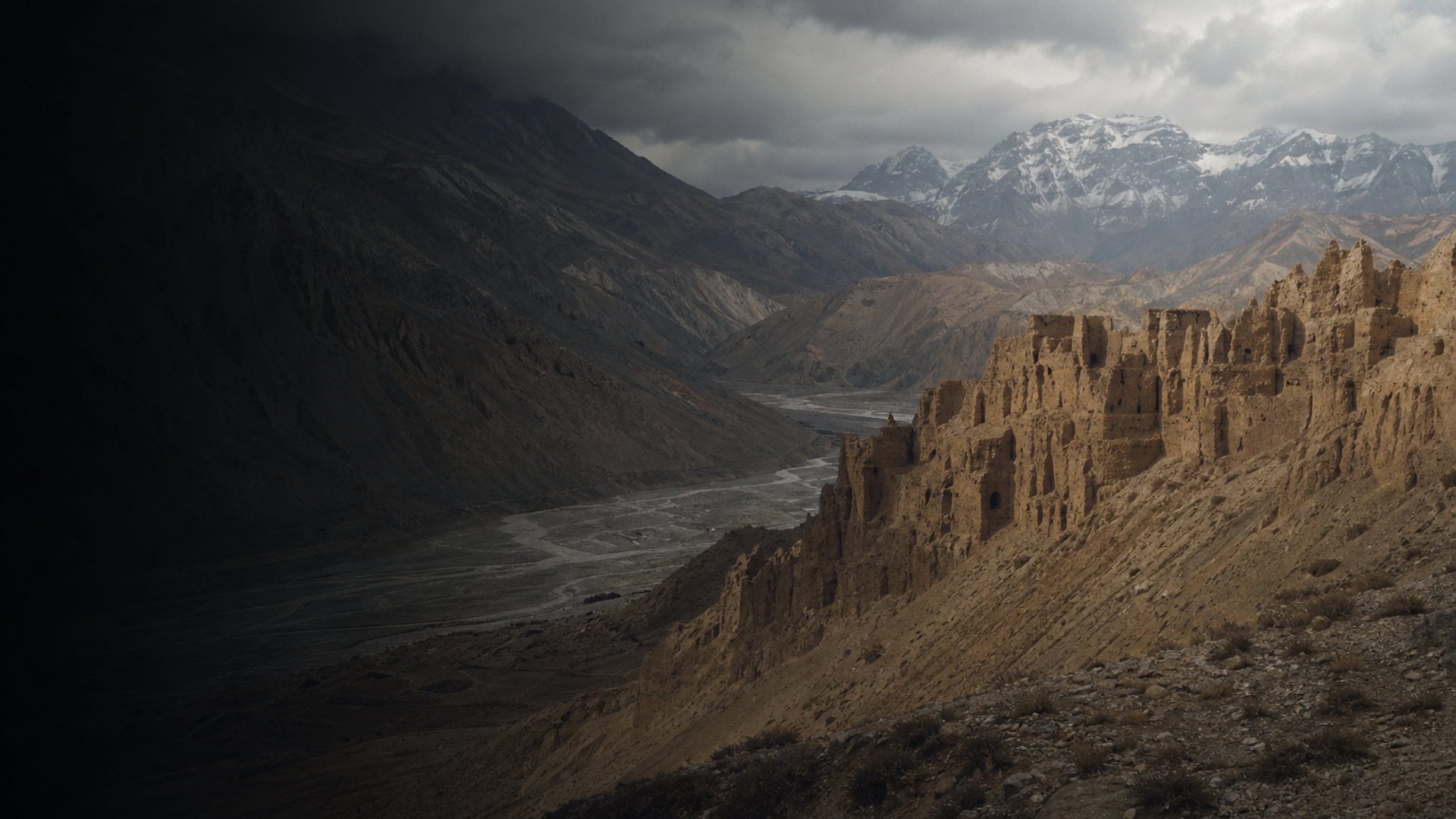
Perched on a remote Himalayan shelf, Samdzong yielded burials and habitations dated between roughly 350 and 1000 CE that speak of a community negotiating altitude, trade and cultural exchange. Archaeological data indicates small settlement clusters, stone-built dwellings, ritual spaces and mortuary deposits with grave goods that suggest connections to both the Tibetan Plateau and trans‑Himalayan routes. The material culture—ceramics, metalwork fragments and textile impressions—evokes a tapestry of local traditions woven with influences carried by merchants, pilgrims and pastoralists.

Genetically, the site offers a tantalizing glimpse into the population dynamics of the Middle Kingdoms period in Mustang. With just nine sampled individuals, caution is essential: the small sample size limits broad historical claims. Nevertheless, preliminary ancient DNA shows male lineages dominated by haplogroup O and diverse maternal lineages including haplogroup M and East Asian types such as D4i and F. This pattern is consistent with archaeological indicators of east‑west contact and suggests that Samdzong sat at a biological as well as cultural crossroads.

Limited evidence suggests that population continuity may have been punctuated by episodic migration or elite mobility tied to trade and religious networks. Future, larger datasets will be needed to resolve whether Samdzong was a stable local population or a hub of continual exchange.

  • Site dates: ca. 350–1000 CE; Mustang, Samdzong excavations
  • Material culture shows Tibetan‑plateau and trans‑Himalayan connections
  • Small aDNA sample (n=9) limits broad demographic conclusions
Chapter IV

Daily Life & Society

Life at Samdzong unfolded against stark landscapes: terraced fields clung to slopes, yak and sheep grazed the high pastures, and stone houses gathered into small hamlets. Archaeological evidence—floor hearths, grinding stones, and bone assemblages—indicates a mixed subsistence economy of pastoralism, high‑altitude agriculture (barley and perhaps millet) and hunting. Ritual practice appears visible in small shrines, curated offerings and specially furnished interments.

Social organization likely balanced household autonomy with wider networks of exchange. Objects of nonlocal origin—bronze fragments, distinctive beads, and textile motifs—signal participation in long‑distance commerce along mountain corridors. These corridors connected Mustang to the Tibetan Plateau, to inner Himalayan valleys and to southward routes into central Nepal and northern India. The interplay of mobility and local rootedness would have shaped identity: families tied to pastures and fields, and lineages linked by marriage, pilgrimage and trade.

Archaeobotanical and zooarchaeological evidence is limited but points to resilient lifeways adapted to seasonal mobility and resource scarcity. In the cinematic dusk of the high valleys, communities managed risk through social alliances and material exchange.

  • Economy: pastoralism, high‑altitude agriculture, and hunting
  • Material culture indicates participation in long‑distance mountain trade
Chapter V

Genetic Profile

Ancient DNA from nine individuals at Samdzong provides an initial genetic snapshot of this Middle Kingdoms community. Y‑chromosome data show a prevalence of haplogroup O (reported in 4 male samples), a lineage today common across East and Southeast Asia and among many Tibeto‑Burman speaking populations. Mitochondrial diversity is notable: haplogroup M appears in multiple individuals (M types in 3 samples), with additional maternal lineages including D4i, F and F1g. D4 subclades are often associated with northern/East Asian maternal ancestries, while F and F1g have broad distributions across East and Southeast Asia.

Together, these markers suggest that the Samdzong population carried a mixture of East Asian–linked paternal and maternal lineages alongside broader South/Central Himalayan mitochondrial diversity. Archaeogenetic patterns are concordant with archaeological indicators of mobility and interaction across the Tibetan Plateau and Himalayan margins. However, because the dataset comprises fewer than ten individuals, these patterns must be treated as preliminary. Statistical power is low for detecting population structure, sex‑biased migration, or fine‑scale ancestry components.

Future sampling—higher genome coverage, isotope analyses, and expanded temporal sampling—will be critical to test hypotheses about migration pulses, marriage networks, and the degree of continuity between ancient and modern high‑altitude communities.

  • Y-DNA dominance of haplogroup O suggests East Asian/Tibeto‑linked paternal input
  • mtDNA variety (M, D4i, F, F1g) indicates mixed maternal ancestries; conclusions are preliminary (n=9)
Chapter VI

Legacy & Modern Connections

Samdzong’s archaeological and genetic traces form a bridge to contemporary Himalayan communities. Material continuities—house forms, pastoral strategies and ritual practices—mirror traditions still visible among Mustang and trans‑Himalayan populations. The genetic signal, while limited, aligns with modern patterns of East and South Asian lineages on the Plateau, suggesting that some ancestral threads may persist in regional gene pools.

Yet, the archaeological record also records flux: trade, pilgrimage and political realignments across centuries that could have reshaped local ancestry. Given the small number of ancient genomes available, assertions about direct ancestry to present-day groups remain cautious. What emerges most clearly is a portrait of Samdzong as a liminal community—adapted to altitude, engaged in exchange, and genetically interconnected with the broader Himalayan world. As more samples and comparative datasets appear, Samdzong will offer sharper insights into how mountain societies negotiated history and heredity.

  • Material and genetic patterns suggest continuity with Himalayan populations, cautiously interpreted
  • Further sampling needed to link ancient Samdzong directly to modern communities
AI 电源

AI 助手

就 Samdzong (Mustang): Middle Kingdoms 文化提问

AI 助手 由DNAGENICS公司制作

解锁此特性
Ask questions about the Samdzong (Mustang): Middle Kingdoms culture. Our AI assistant can explain genetic findings, historical context, archaeological evidence, and modern connections.
AI 样本分析

Samdzong (Mustang): Middle Kingdoms 文化是人类历史中值得了解的一章……

遗传分析揭示了与早期种群的联系,同时显示了独特的适应和文化创新的证据。 古代DNA样本提供了对迁徙模式、社会结构以及古代种群之间的生物关系的深刻见解。

这是人工智能分析的预览。 解锁全AI 助手, 以探索关于:

  • 遗传组成和祖先
  • 移徙模式和起源
  • 日常生活和文化习俗
  • 现代遗传遗产

探索更古老的文化

揭开古代世界文明的故事

使用优惠码 可减免 35% • 11月12日 到期




