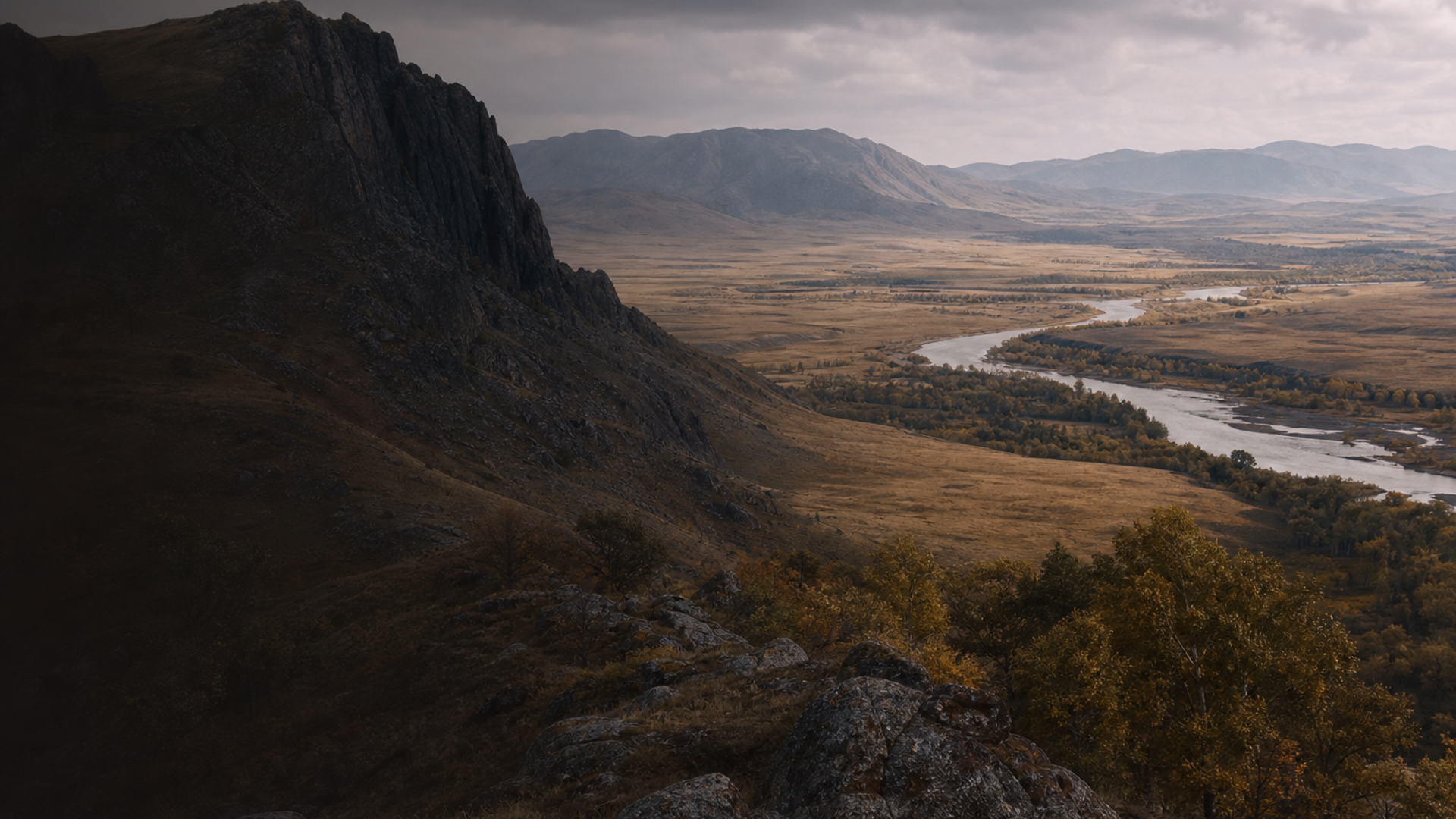
Tagar: Echoes of the Siberian Steppe

下载的 PDF 是图像副本。如需可选中文本及更好的辅助技术支持,请使用打印功能。

跳转到主内容
文明焦点

Tagar: Echoes of the Siberian Steppe

A cinematic glimpse of 1st-millennium BCE communities in the Minusinsk Basin through archaeology and DNA.

1000 CE - 800 BCE
Siberia; Tungus & Eastern Steppe (Russia), Minusinsk Basin

剧情

Archaeological and genetic snapshots from eight individuals (1000–800 BCE) illuminate the Tagar horizon in southern Siberia. Material culture and mixed maternal/paternal lineages point to a frontier of steppe and forest-steppe contact. Conclusions are preliminary given the small sample size.

Time Period

1000–800 BCE

Region

Siberia; Tungus & Eastern Steppe (Russia), Minusinsk Basin

Common Y-DNA

R (3), Q (1) — small sample

Common mtDNA

U (2), N (2), F (1), H (1), A (1) — diverse maternal pool

时间线

2500 BCE

Earlier Bronze Age antecedents

Bronze Age cultures in southern Siberia set the stage for later Tagar developments — metallurgy and long-distance exchange networks that shaped the 1st-millennium BCE horizon.

Origins & Emergence

The Tagar horizon in southern Siberia emerges in the wake of Late Bronze Age transformations along the Upper Yenisei and in the Minusinsk Basin. Archaeological data indicates a landscape of kurgan cemeteries, timber-lined graves and richly worked bronze and iron objects dated here to roughly 1000–800 BCE. Material forms — ornamented horse gear, metal tumuli, and textile impressions — reveal a tapestry of influences from both steppe nomadic traditions and forest-steppe communities.

Limited evidence suggests that Tagar communities sat at a cultural crossroads: trade and movement along east–west corridors brought steppe metallurgical styles into contact with local southern Siberian craft. The funerary architecture, often monumental and visible on the plain, functioned as both social statement and anchor for territorial claims. While the archaeological record yields durable images — bronze razors, decorated harness fittings, and burial mounds — it leaves open questions about language, exact social organization, and the pace of population change. Genetic snapshots from small sample sets now allow archaeologists to begin linking these visible cultural practices with invisible patterns of ancestry and mobility, but the picture remains provisional.

  • Located in the Minusinsk Basin and Upper Yenisei (Siberia) 1000–800 BCE
  • Archaeology shows kurgan cemeteries, bronze and iron craftsmanship
  • A frontier culture blending steppe and forest-steppe influences

Daily Life & Society

Daily life across the Tagar horizon likely combined seasonal pastoralism with local foraging and small-scale cultivation where soils allowed. Archaeological assemblages reveal domestic pottery, bone tools, and traces of animal husbandry — cattle, sheep/goat, and horses — consistent with mixed agropastoral economies. Horse gear and riding paraphernalia suggest mounted mobility played an important role in transport, status and perhaps warfare.

Burials provide the most dramatic windows onto social life: graves often contain personal ornaments, weaponry and finely worked metal — gestures of identity and rank. Wooden chambers and stone markers organized the landscape into visible loci of memory. Artistic motifs carved into bone and metal show shared visual languages across the steppe, while local variations in grave construction underline regional identities. However, preservation biases and limited excavated contexts mean many quotidian practices remain conjectural; large parts of domestic architecture and seasonal camps are poorly sampled in the archaeological record.

  • Mixed pastoralism with horses central to mobility and status
  • Rich burials indicate social differentiation and widespread craft specialization

Genetic Profile

Genetic sampling for the Russia_Tagar set comprises eight individuals dated to ~1000–800 BCE. With only eight samples, conclusions must be framed as preliminary. Y-chromosome lineages are recorded as R in three individuals and Q in one. The R signal is notable because broad R lineages are frequent across Eurasian steppe populations and are often associated with male-mediated steppe expansions in other regions; however, the available data do not resolve subclades (R1a vs R1b), so precise historical inferences are limited. The presence of Y Q points to a contribution from northeastern Eurasian or Siberian paternal lineages.

Maternal haplogroups show a mixed palette: U (2) and H (1) are common west-Eurasian lineages, while N (2), F (1), and A (1) are more typical of eastern Eurasian or Siberian maternal ancestries. This mixture suggests that Tagar communities were genetically heterogeneous, reflecting contacts across an east–west gradient. Such a pattern is compatible with scenarios of admixture between incoming steppe-associated male lineages and local or eastern maternal pools, but with eight samples we cannot robustly test sex-biased admixture or demographic models. Autosomal genome-wide data, dense sampling across sites, and direct radiocarbon dates are needed to clarify timing, magnitude and directionality of gene flow.

  • Eight samples — preliminary: Y-DNA R (3), Q (1); mtDNA includes U, N, F, H, A
  • Signals point to mixed west–east ancestry; further genome-wide data needed

Legacy & Modern Connections

The Tagar horizon contributed to the evolving mosaic of Iron Age cultures across the Eurasian steppe. Its material world—kurgans, metalwork and horse culture—resonates with later Saka and Scythian horizons, suggesting cultural continuities in art and social display. Genetically, the mixture of western and eastern lineages seen in the small Russia_Tagar sample mirrors patterns documented in later Iron Age populations across Siberia and Central Asia, hinting that Tagar communities formed part of a long-standing corridor of human movement.

Caution is essential: with only eight individuals, we cannot assert direct ancestry lines to modern groups. Instead, these DNA results provide evocative glimpses of the genetic tapestry of the Minusinsk Basin and underscore the need for broader sampling to trace how Tagar-era populations contributed to the genetic landscape of later Siberian and Central Asian peoples.

  • Cultural echoes visible in later steppe art and funerary traditions
  • Genetic mix suggests contribution to later Siberian/Central Asian population structure, but evidence is preliminary

AI 助手

AI 助手 由DNAGENICS公司制作

解锁此特性
Ask questions about the Tagar: Echoes of the Siberian Steppe culture. Our AI assistant can explain genetic findings, historical context, archaeological evidence, and modern connections.
AI 样本分析

Tagar: Echoes of the Siberian Steppe 文化是人类历史中值得了解的一章……

遗传分析揭示了与早期种群的联系,同时显示了独特的适应和文化创新的证据。 古代DNA样本提供了对迁徙模式、社会结构以及古代种群之间的生物关系的深刻见解。

这是人工智能分析的预览。 解锁全AI 助手, 以探索关于:

  • 遗传组成和祖先
  • 移徙模式和起源
  • 日常生活和文化习俗
  • 现代遗传遗产
使用优惠码 可减免 30% • 11月14日 到期