Tarquinian Echoes

下载的 PDF 是图像副本。如需可选中文本及更好的辅助技术支持,请使用打印功能。

Tarquinian Echoes

揭开一个失落的文明

正在加载考古记录……

正在收集古代记录

跳转到主内容
Tarquinian Echoes
文明焦点

Tarquinian Echoes

Etruscan burials from Tarquinia illuminate late Iron Age life through archaeology and mtDNA

400 BCE - 1 BCE
Lazio (Viterbo), Tarquinia, Italy
滚动开始
Chapter I

剧情

了解 Tarquinian Echoes 文化

Genomic and archaeological data from 17 individuals (400–1 BCE) at Tarquinia, Viterbo, reveal maternal lineages dominated by haplogroup H and T2e, consistent with long-standing European maternal ancestry amid Mediterranean contacts.

Time Period

400 BCE – 1 BCE

Region

Lazio (Viterbo), Tarquinia, Italy

Common Y-DNA

Not reported / undetermined in this dataset

Common mtDNA

H (5), T2e (3), U (2), HV (1), H5 (1)

Chapter II

时间线

这种文化历史上的关键时刻

2500 BCE

Bronze Age foundations

Late Bronze Age communities in central Italy lay demographic and cultural foundations that later evolve into Villanovan and then Etruscan societies.

Chapter III

Origins & Emergence

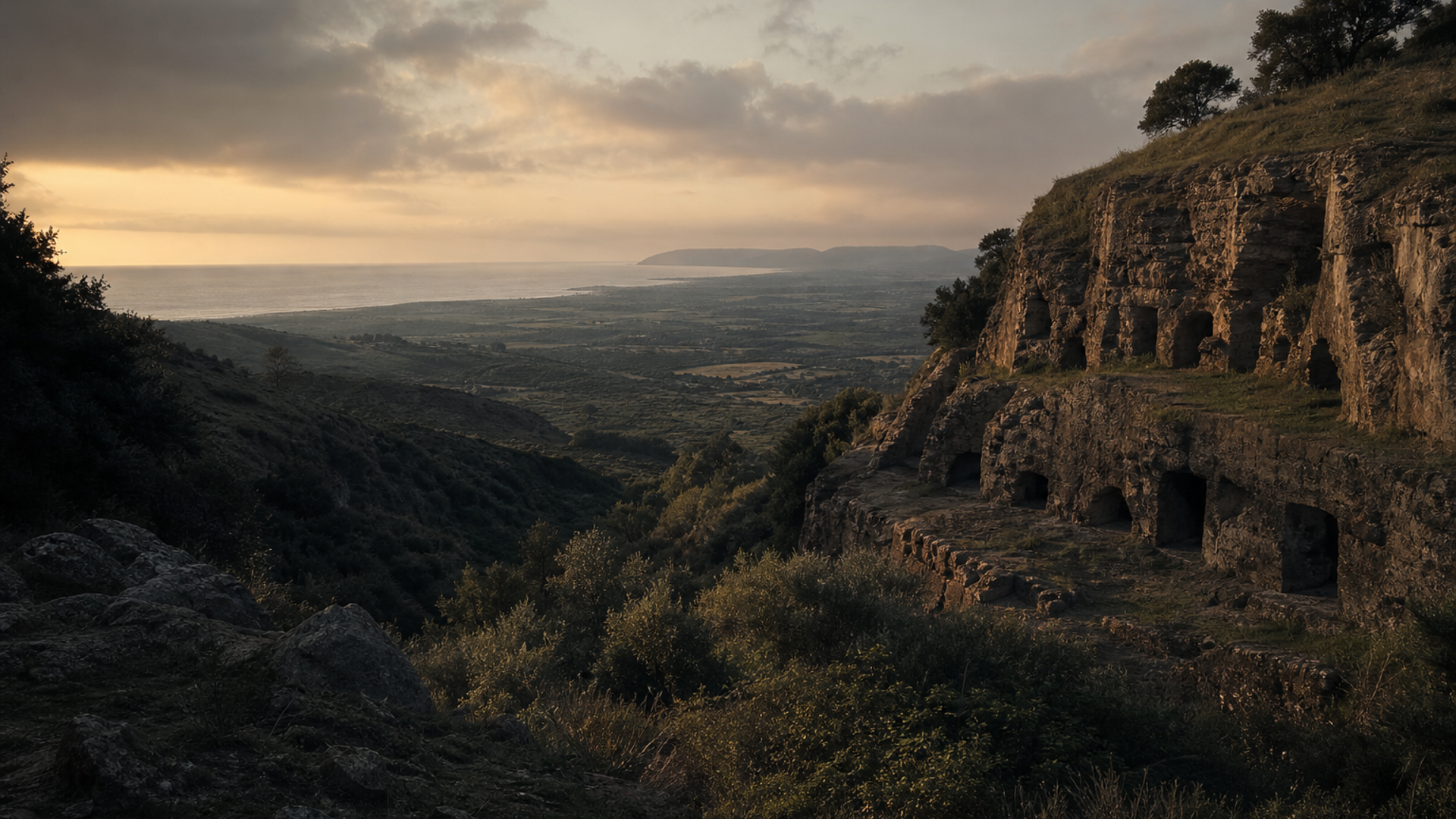
Tarquinia sits like a stage set on the Tyrrhenian edge of central Italy. Archaeology at the Monterozzi necropolis and surrounding cemeteries (Tarquinia, Viterbo, Lazio) paints a dramatic arc: from Villanovan cremation practices in the late Bronze Age to the painted chamber tombs and urban elites of Classical Etruria.

Material culture — bucchero pottery, elaborate ironwork, and polychrome tomb paintings — signals sustained regional development and intense maritime exchange with the wider Mediterranean world (Greece, Phoenicia). Linguistically, Etruscan is a non‑Indo‑European language, and historical sources debated external origins. Archaeological data indicates strong local cultural continuity from Bronze Age Italy into the Etruscan period, while also showing influxes of foreign goods and artistic motifs.

Genetic sampling targeted burials from Tarquinia (dated ca. 400–1 BCE) offers an additional thread. Limited ancient DNA evidence from this late Etruscan horizon suggests maternal lineages largely align with broader European and Mediterranean profiles rather than pointing to a single exotic origin. However, the dataset is temporally constrained and geographically focused; it is therefore most informative about Late Etruscan populations of southern Etruria and less conclusive about earlier processes that created the Etruscan identity.

  • Tarquinia (Monterozzi necropolis) is a principal Etruscan burial landscape
  • Material culture shows local continuity with Bronze Age antecedents and Mediterranean trade
  • Genetic signal from late-period burials suggests European/Mediterranean maternal affinities
Chapter IV

Daily Life & Society

Walking through a painted tomb is like stepping into a city of the dead that preserves everyday gestures: banqueters reclining beneath frescoes, horsemen poised in procession, and scenes of ritual and craft. Tarquinia's tomb art captures elite identities and public performance — the visual language of family memory.

Archaeological deposits show a mixed economy: agriculture (cereals, pulses), pastoralism, specialized metalworking, and seafaring trade. Coastal access made Tarquinia a hub for exchange in the Iron Age, importing luxury items while exporting ceramics and metalwork. Burial assemblages reveal clear social differentiation: richly furnished chamber tombs for aristocratic households versus simpler interments for more modest individuals.

Settlements around Viterbo and Tarquinia indicate urbanizing tendencies: planned necropoleis, monumental tumuli, and elaborate grave architecture. Craft specialization — bucchero pottery kilns, bronze workshops — signals artisanal communities integrated into wider economic networks. While archaeology offers vivid snapshots of elite life, skeletal and genetic data from burials help expand the view to ordinary people, migrants, and household composition, although surviving molecular data remain limited in scope and number.

  • Tomb paintings at Monterozzi preserve elite ritual and social scenes
  • Economy combined agriculture, metallurgy, and maritime trade with clear social stratification
Chapter V

Genetic Profile

Seventeen individuals from Tarquinia (Viterbo, Lazio) dated to 400–1 BCE were analyzed for ancient DNA. The maternal haplogroup distribution in the available data includes H (5), T2e (3), U (2), HV (1), and H5 (1). These mitochondrial lineages are broadly consistent with long‑standing European maternal profiles found across Neolithic, Bronze Age, and Iron Age contexts in the Mediterranean and continental Europe.

This pattern suggests substantial local continuity of maternal ancestry in southern Etruria during the late Etruscan period, with haplogroups such as H and T2 commonly associated with post‑Neolithic European populations. The presence of U lineages is compatible with deeper Mesolithic or Bronze Age ancestry components that persist in Italy. Because Y‑chromosome haplogroups were not uniformly reported for these samples, conclusions about male‑mediated migration or patrilineal structure remain unresolved in this dataset.

Important caveats apply: the dataset covers a narrow time window (centuries immediately before and during the Roman expansion) and a single necropolis, so it reflects Late Etruscan demography rather than the full spectrum of Etruscan origins. Additionally, 17 individuals, while useful, are a modest sample size for making population‑scale inferences. Future analyses combining genome‑wide data, more sites across Etruria, and Y‑DNA will be necessary to untangle local continuity from episodic gene flow and to test competing models (local development vs. substantial external migration).

  • 17 samples (400–1 BCE) show mtDNA dominated by H and T2e, indicating European/Mediterranean maternal affinities
  • Y-DNA data not reported here, so male-line mobility and patrilineal patterns remain uncertain
Chapter VI

Legacy & Modern Connections

The Etruscans left an outsized cultural legacy: urban planning, religious practice, funerary art, and technical crafts shaped early Rome and the wider Italian peninsula. Tarquinia's visual vocabulary—processions, feasts, and funerary architecture—echoes in Roman ceremonial life.

Genetically, modern populations of central Italy show a mosaic heritage shaped by millennia of continuity and movement. Broader ancient DNA studies across Italy indicate substantial preservation of maternal lineages over long timescales, punctuated by later admixture events during the Roman Imperial era and beyond. The Tarquinia mtDNA profile reinforces a picture of local continuity in southern Etruria, but it also underlines the complexity of heritage: culture, language, and genes do not always move in lockstep. Continued sampling across time, more genome‑wide data, and comparison to modern genomes will clarify how the Etruscan genetic signal contributed to the ancestry of present‑day Italians.

  • Tarquinia influenced Roman culture; its art and rituals shaped later Mediterranean practices
  • Genetic data suggest local maternal continuity in Lazio, tempered by centuries of subsequent admixture
AI 电源

AI 助手

就 Tarquinian Echoes 文化提问

AI 助手 由DNAGENICS公司制作

解锁此特性
Ask questions about the Tarquinian Echoes culture. Our AI assistant can explain genetic findings, historical context, archaeological evidence, and modern connections.
AI 样本分析

Tarquinian Echoes 文化是人类历史中值得了解的一章……

遗传分析揭示了与早期种群的联系,同时显示了独特的适应和文化创新的证据。 古代DNA样本提供了对迁徙模式、社会结构以及古代种群之间的生物关系的深刻见解。

这是人工智能分析的预览。 解锁全AI 助手, 以探索关于:

  • 遗传组成和祖先
  • 移徙模式和起源
  • 日常生活和文化习俗
  • 现代遗传遗产

探索更古老的文化

揭开古代世界文明的故事

使用优惠码 可减免 35% • 11月12日 到期