Tepe Anau Chalcolithic Horizon

下载的 PDF 是图像副本。如需可选中文本及更好的辅助技术支持,请使用打印功能。

Tepe Anau Chalcolithic Horizon

揭开一个失落的文明

正在加载考古记录……

正在收集古代记录

跳转到主内容
Tepe Anau Chalcolithic Horizon
文明焦点

Tepe Anau Chalcolithic Horizon

Sparse DNA from a Turkmen plain linking local life to wider Eurasian currents

4000 CE - 3000 BCE
Turkmenistan (Tepe Anau, Turkestan)
滚动开始
Chapter I

剧情

了解 Tepe Anau Chalcolithic Horizon 文化

Chalcolithic occupations at Tepe Anau (Turkestan, Turkmenistan) c. 4000–3000 BCE yield three genome samples. Preliminary genetic signals (Y-R; mt H, U, W) hint at western Eurasian and possible steppe connections, but small sample size makes conclusions tentative.

Time Period

4000–3000 BCE

Region

Turkmenistan (Tepe Anau, Turkestan)

Common Y-DNA

R (2 of 3 sampled)

Common mtDNA

H, U, W (each 1 of 3)

Chapter II

时间线

这种文化历史上的关键时刻

2500 BCE

Chalcolithic occupation at Tepe Anau

Settlement and material culture at Tepe Anau date to the mid-3rd millennium BCE, reflecting local farming communities with wider regional contacts.

Chapter III

Origins & Emergence

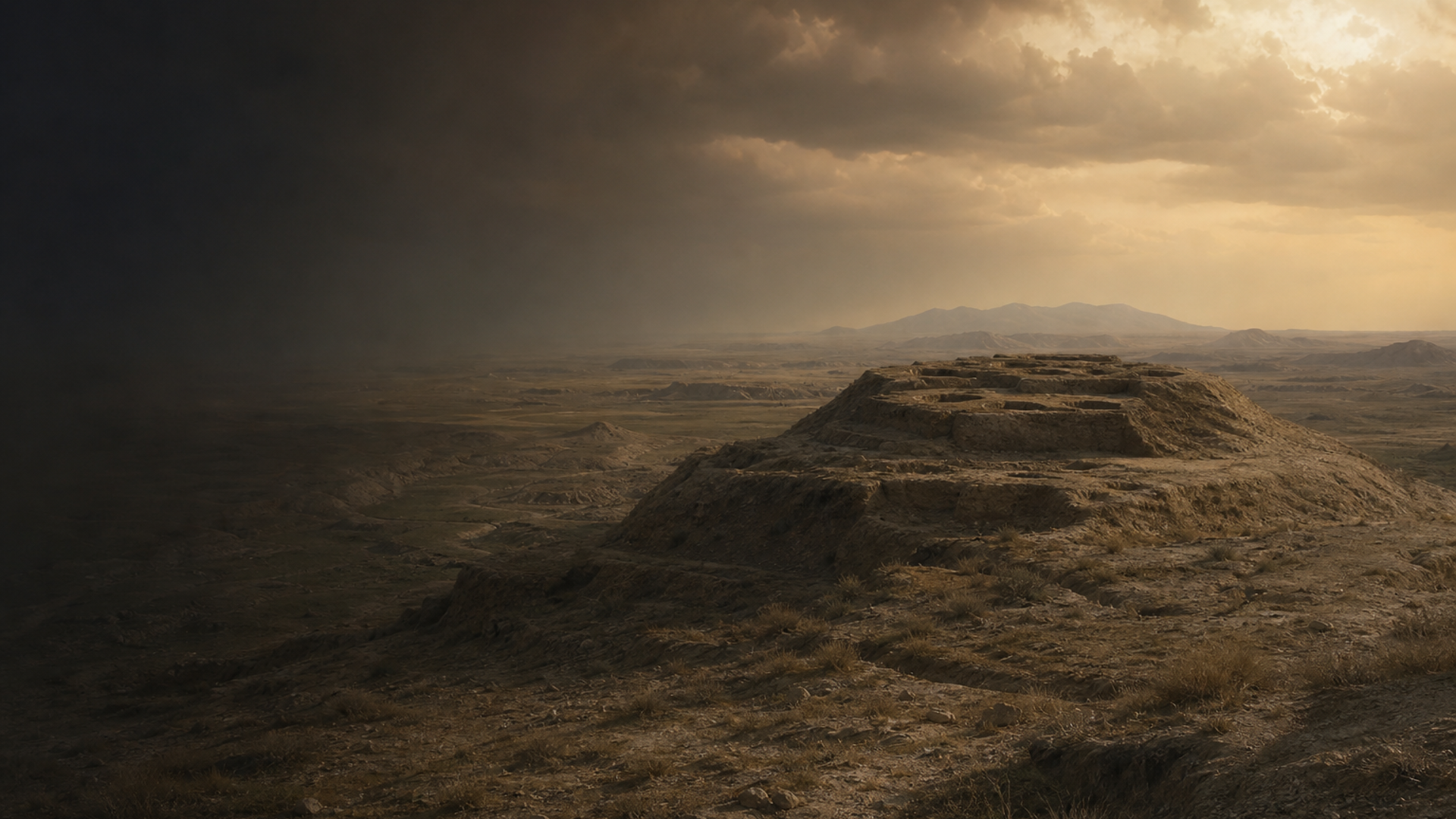
Tepe Anau sits on the flat, sun-bleached plains of Turkestan in modern Turkmenistan. Archaeological stratigraphy places a Chalcolithic occupation here between roughly 4000 and 3000 BCE — a time when local riverine communities were in dynamic contact with neighboring highlands and steppe margins. Excavations at Tepe Anau have identified settlement layers and material culture broadly consistent with regional Chalcolithic traditions; ceramic styles and architectural traces suggest a settled farming community with long-distance contacts.

The cinematic sweep of the horizon — wind across open steppe, seasonal herds, and low mounded settlements — frames a place of exchange. Limited evidence indicates Tepe Anau lay along networks that would later connect to Bronze Age polities in Central Asia. Archaeological data indicates interaction rather than isolation: raw materials and stylistic parallels hint at ties to both irrigated river valleys and more mobile pastoral economies.

However, the picture is fragmentary. Chronological control is improving but remains uneven, and direct links between material culture and population movements are inferred rather than proven. In this early phase, Tepe Anau appears as a local node in a broader mosaic of Chalcolithic life across Central Asia, part of the slow transformation that precedes the larger demographic shifts of the 3rd millennium BCE.

  • Occupation dated c. 4000–3000 BCE, Chalcolithic layers at Tepe Anau
  • Material culture indicates local farming with external contacts
  • Site likely part of wider Central Asian exchange networks
Chapter IV

Daily Life & Society

Archaeological traces at Tepe Anau conjure intimate scenes: the rhythm of sowing and harvest, hearth-smoke in earthen houses, and the repair of pottery by lamplight. Domestic features recovered from Chalcolithic layers suggest households engaged in mixed subsistence — agriculture on irrigable plots combined with animal husbandry. Tools, grinding stones, and pottery sherds indicate daily crafts and food processing, while occasional exotic materials point to trade or exchange.

Social life was probably organized around kin groups and household units rather than large hierarchical polities. Burial evidence from the region is sporadic, and at Tepe Anau the funerary record is limited, making it difficult to reconstruct social ranking or ritual complexity with confidence. Where burials exist, they can illuminate diet, health, and mobility, but current samples remain few.

Everyday life at Tepe Anau must be read as the interplay of local practice and external influence: craft styles and raw materials traveled across landscapes, and people adapted to climatic variability, creating resilient lifeways. Archaeological data indicates a community at the threshold between long-standing local traditions and new social trajectories that shaped later Bronze Age societies.

  • Mixed farming and animal husbandry inferred from domestic remains
  • Limited funerary evidence constrains reconstruction of social hierarchy
Chapter V

Genetic Profile

Three genome samples from Tepe Anau provide a slender but evocative genetic window into Chalcolithic Central Asia. Two of the three male individuals carry Y-chromosome lineage labeled broadly as R; mitochondrial lineages observed among the three individuals include H, U, and W. These haplogroups are widely distributed across western Eurasia and are commonly seen in ancient and modern populations of Europe and parts of western Asia.

The presence of Y-R in two individuals is suggestive, because R-lineages (in specific subclades) are frequently associated with populations expanding across the Eurasian steppe during the 4th–3rd millennia BCE. However, without higher-resolution subclade assignment it is not possible to link these R chromosomes decisively to a particular migration or cultural group. Similarly, mtDNA types H, U, and W point to western Eurasian maternal ancestry but cannot alone resolve mobility, admixture, or local continuity.

Crucially, these genetic signals must be read with caution. The sample count is only three — below the threshold commonly used to make robust population-level inferences — so conclusions are preliminary. Nevertheless, the combination of archaeological context and these genetic markers aligns with broader regional patterns in which local communities show varying degrees of western Eurasian and steppe-related ancestry during the late Neolithic–Chalcolithic transition. Additional samples, genome-wide analyses, and precise datings are required to move from suggestive patterns to firm narratives.

  • Two of three males carry Y-lineage R — potentially indicative of steppe-linked ancestry
  • mtDNA H, U, W signal western Eurasian maternal ties; small sample size makes conclusions tentative
Chapter VI

Legacy & Modern Connections

Tepe Anau's legacy is not a single lineage but a palimpsest of human choices preserved in earth and bone. The limited DNA recovered connects this small sample to broader western Eurasian genetic landscapes, suggesting that the peoples of this Turkmen plain participated in long-distance networks that shaped Central Asia's genetic and cultural tapestry. For modern ancestry seekers, the data offers a cautious glimpse: some genetic threads at Tepe Anau are shared with later populations across Eurasia, but continuity is neither uniform nor guaranteed.

For scientific and public audiences alike, the chief lesson is humility. Sparse samples can illuminate possibilities — pathways of contact, admixture, and mobility — but they cannot alone rewrite population histories. Future excavations and a larger, well-dated genetic catalogue from Tepe Anau and neighboring sites will be essential to trace which elements of Chalcolithic identity persisted, changed, or vanished in the millennia that followed.

  • Preliminary genetic links to broader western Eurasian ancestries, not proof of direct continuity
  • More samples and finer genomic resolution needed to clarify connections to modern populations
AI 电源

AI 助手

就 Tepe Anau Chalcolithic Horizon 文化提问

AI 助手 由DNAGENICS公司制作

解锁此特性
Ask questions about the Tepe Anau Chalcolithic Horizon culture. Our AI assistant can explain genetic findings, historical context, archaeological evidence, and modern connections.
AI 样本分析

Tepe Anau Chalcolithic Horizon 文化是人类历史中值得了解的一章……

遗传分析揭示了与早期种群的联系,同时显示了独特的适应和文化创新的证据。 古代DNA样本提供了对迁徙模式、社会结构以及古代种群之间的生物关系的深刻见解。

这是人工智能分析的预览。 解锁全AI 助手, 以探索关于:

  • 遗传组成和祖先
  • 移徙模式和起源
  • 日常生活和文化习俗
  • 现代遗传遗产

探索更古老的文化

揭开古代世界文明的故事

使用优惠码 可减免 35% • 11月12日 到期





