Tian Shan Saka: Steppe Voices

下载的 PDF 是图像副本。如需可选中文本及更好的辅助技术支持,请使用打印功能。

Tian Shan Saka: Steppe Voices

揭开一个失落的文明

正在加载考古记录……

正在收集古代记录

跳转到主内容
Tian Shan Saka: Steppe Voices
文明焦点

Tian Shan Saka: Steppe Voices

Iron Age horsemen of the Kyrgyz Tian Shan—where graves and genomes meet

650 BCE - 100 CE
Tian Shan, Central Steppe, Kyrgyzstan
滚动开始
Chapter I

剧情

了解 Tian Shan Saka: Steppe Voices 文化

Archaeological and genetic evidence from 11 individuals (650 BCE–100 CE) illuminates the Saka presence in Kyrgyzstan's Tian Shan: kurgan burials, mobile pastoral lifeways, and a mixed Steppe–West–East genetic signature suggesting interaction across Eurasia.

Time Period

650 BCE – 100 CE

Region

Tian Shan, Central Steppe, Kyrgyzstan

Common Y-DNA

R (5), J (3), Q (1)

Common mtDNA

HV6 (2), U (2), D (2), C4 (1), W1c (1)

Chapter II

时间线

这种文化历史上的关键时刻

650 BCE

Early Saka Presence in Tian Shan

Kurgan burials and Saka-associated artifacts appear in the Tian Shan foothills, marking the emergence of mobile pastoral groups in the region.

300 BCE

Peak Iron Age Mobility

Material links across the Central Steppe suggest intensified exchange of people and goods along transhumant routes.

100 CE

Late Sample Horizon

Genetic samples from the Tian Shan reach into the early centuries CE, capturing continued population admixture at the mountain frontier.

Chapter III

Origins & Emergence

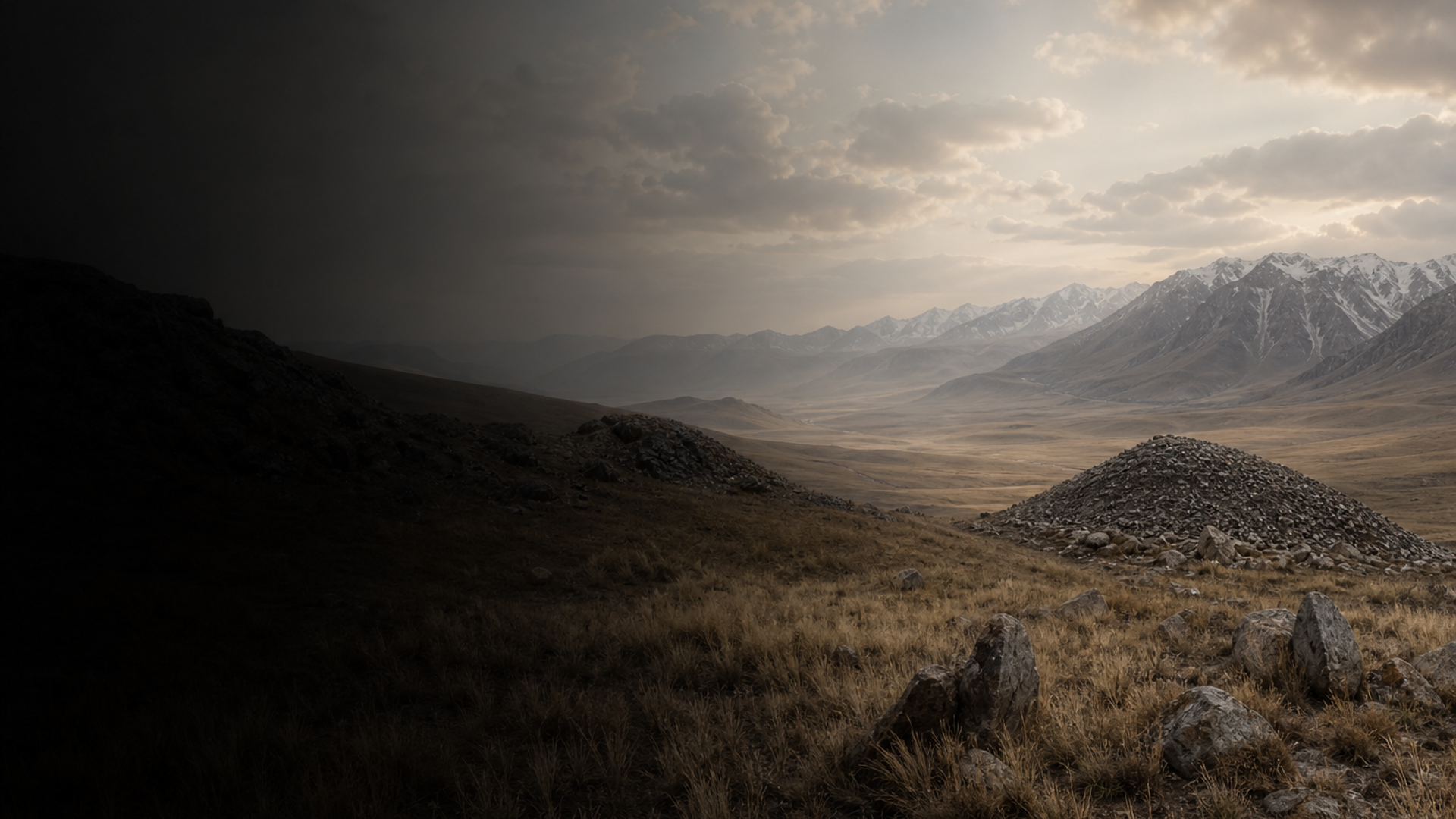
Across the cragged ridges and grassy foothills of the Tian Shan, mortuary mounds and scattered grave goods tell a story of mobility and frontier contact. Archaeological data indicates that populations identified with Saka cultural markers—characteristic weapons, horse gear, and kurgan burials—were present in what is now Kyrgyzstan from at least the 7th century BCE. These communities occupied the high-steppe ecotone, exploiting seasonal pastures and controlling transhumant corridors between the western Central Steppe and the inner Asian ranges.

Material culture shows affinities with the wider Saka horizon of the Eurasian steppe: slender composite bows, distinctive iron and bronze adornments, and richly furnished graves. Limited evidence suggests local adaptation to mountain-edge landscapes, with some burials displaying imported styles alongside regional variants.

Genetically, the small set of 11 sampled individuals spans 650 BCE to 100 CE and affords a preliminary window into origins: a predominance of Y-haplogroup R alongside J and Q hints at a mixed male ancestry reflecting steppe pastoralist roots and contacts with western and southern networks. Archaeological context combined with these genetic signatures supports a scenario of cultural continuity blended with episodic migration and long-distance exchange across Eurasia. Given the modest sample size, these inferences remain provisional and invite broader sampling in the Tian Shan and adjacent regions.

  • Saka cultural markers in Tian Shan from c. 650 BCE
  • Kurgan burials and horse gear indicate mobile pastoral lifeways
  • Preliminary genetic signals point to mixed Steppe and West/East inputs
Chapter IV

Daily Life & Society

The lived world of the Tian Shan Saka would have been one of seasonal movement: herds driven between alpine pastures and lower valleys, temporary camps punctuating long-distance routes. Archaeological assemblages—bone tools, bits of textile, horse harness fittings, and occasional ceramics—evoke a society organized around mounted pastoralism, hunting, and exchange rather than dense agricultural settlement.

Grave architecture and funerary accoutrements offer social clues. Kurgan burials range from modest single interments to more elaborate mound burials with weapons and personal ornaments, suggesting differences in status, age, or role. The presence of both male and female burials with high-value items implies household-level wealth and gendered roles tied to pastoral economies and craft exchange.

Material traces of metalworking and the circulation of exotic goods reveal connections to wider networks: trade routes that crossed the steppe linked the Tian Shan margins to the Iranian Plateau, the Altai, and eventually to southern Siberia. Archaeological evidence indicates a flexible social order resilient to climatic and political fluctuations of the Iron Age steppe.

While graves provide dramatic snapshots, they capture only part of daily life; organic materials rarely preserve, and so reconstructions combine artifact patterns, landscape context, and the newly emerging genetic evidence to render a fuller picture.

  • Seasonal transhumance between alpine and valley pastures
  • Kurgan burials show social differentiation and craft exchange
Chapter V

Genetic Profile

The genetic dataset for Kyrgyzstan_TianShan_Saka comprises 11 individuals dated between 650 BCE and 100 CE. This modest sample reveals a mosaic ancestry: Y-chromosome haplogroups are dominated by R (5/11), with notable presence of J (3/11) and a single Q (1/11). On the maternal side, mtDNA lineages include HV6 (2), U (2), D (2), C4 (1), and W1c (1), indicating both West Eurasian and East Eurasian maternal contributions.

Interpreting these patterns archaeogenetically, Y-haplogroup R is commonly associated with Steppe pastoralist networks across Eurasia and is consistent with male-mediated expansions or continuity of steppe lineages into the Tian Shan. The presence of J suggests gene flow from west or south (regions where J is more frequent), reflecting contacts or migrations linking the Central Steppe to Near Eastern corridors. The Q haplogroup and the presence of East Eurasian mtDNA lineages such as D and C4 testify to connections with Siberian and Inner Asian populations, particularly on the maternal side.

These mixed signals align with archaeological evidence of the Tian Shan as a crossroads: mobility, intermarriage, and exchange likely produced the observed genetic admixture. However, with only 11 samples, conclusions are preliminary; patterns may shift as more genomes—especially from contemporaneous neighboring sites—become available. Future sampling across different burial contexts, sexes, and time slices is essential to resolve chronology, sex-biased admixture, and the extent of population turnover versus continuity.

  • Predominant Y-haplogroup R alongside J and Q suggests mixed male ancestry
  • Maternal mtDNA shows West and East Eurasian contributions (D, C4, HV6, U, W1c)
Chapter VI

Legacy & Modern Connections

The genetic and archaeological traces of the Tian Shan Saka form threads in the long tapestry of Central Asian history. Modern populations in Kyrgyzstan and neighboring regions carry a complex admixture that likely reflects millennia of steppe mobility, and some genetic lineages observed in these Iron Age samples persist—though in shifted frequencies—among present-day Central Asian groups.

Archaeologically, Saka cultural expressions contributed motifs and technologies—horsemanship, metalwork styles, and funerary practices—that influenced later steppe polities. Genetically, the mixed West–East signature seen in the Tian Shan samples exemplifies how the steppe acted as a conduit rather than a barrier: people, genes, and ideas flowed across vast distances. Given the limited sample set, any direct ancestral claims to specific modern groups should be made cautiously; rather, these individuals illustrate ancestral components that contributed to the genomic landscape of the region through complex, multi-century processes.

  • Elements of the genetic signature persist regionally but frequencies have changed
  • Saka material culture influenced later steppe societies and networks
AI 电源

AI 助手

就 Tian Shan Saka: Steppe Voices 文化提问

AI 助手 由DNAGENICS公司制作

解锁此特性
Ask questions about the Tian Shan Saka: Steppe Voices culture. Our AI assistant can explain genetic findings, historical context, archaeological evidence, and modern connections.

AI 样本分析

Tian Shan Saka: Steppe Voices 文化是人类历史中值得了解的一章……

遗传分析揭示了与早期种群的联系,同时显示了独特的适应和文化创新的证据。 古代DNA样本提供了对迁徙模式、社会结构以及古代种群之间的生物关系的深刻见解。

这是人工智能分析的预览。 解锁全AI 助手, 以探索关于:

  • 遗传组成和祖先
  • 移徙模式和起源
  • 日常生活和文化习俗
  • 现代遗传遗产

探索更古老的文化

揭开古代世界文明的故事

使用优惠码 可减免 35% • 11月12日 到期