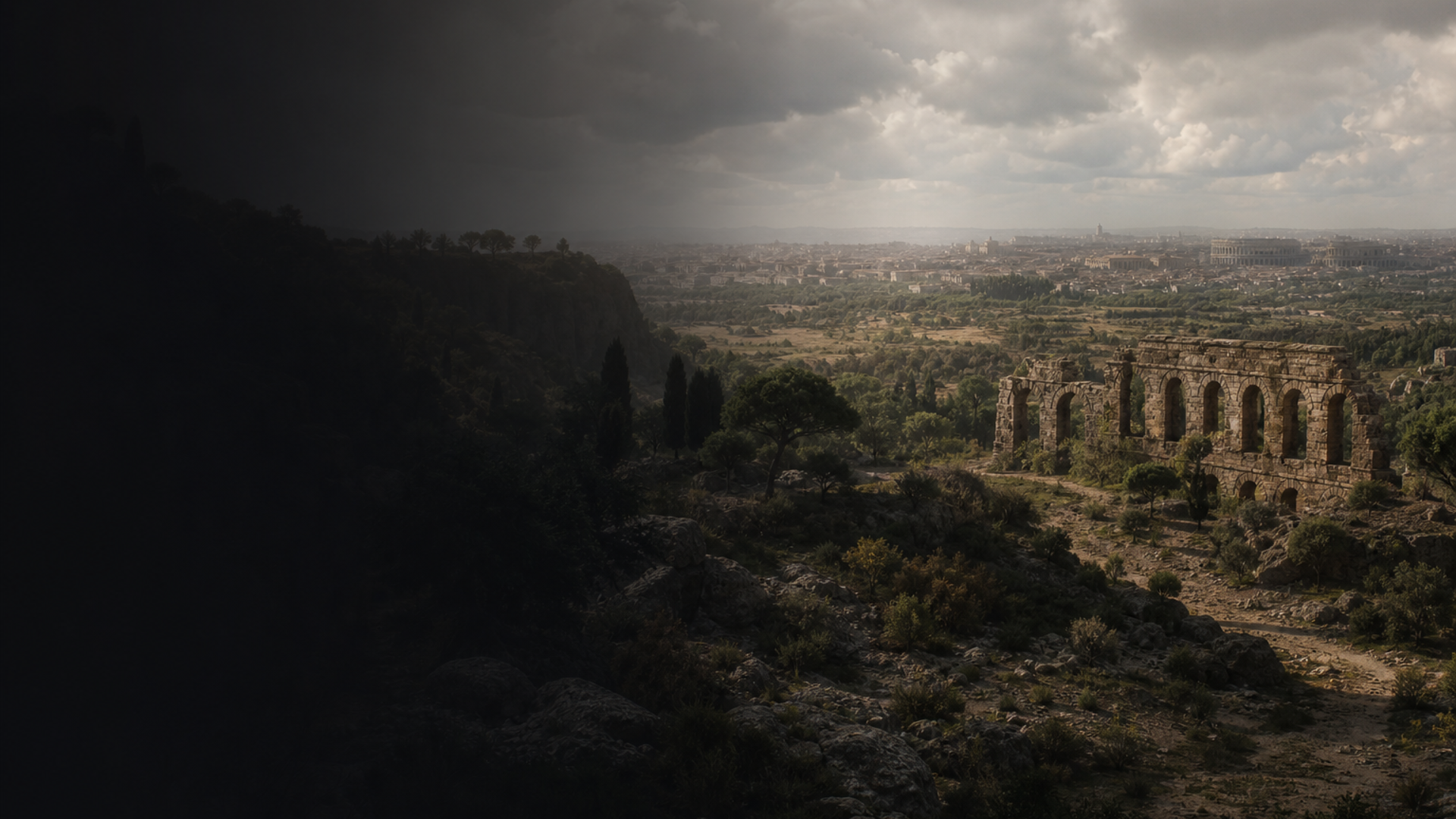
Voices of Imperial Italy

下载的 PDF 是图像副本。如需可选中文本及更好的辅助技术支持,请使用打印功能。

Voices of Imperial Italy

揭开一个失落的文明

正在加载考古记录……

正在收集古代记录

跳转到主内容
Voices of Imperial Italy
文明焦点

Voices of Imperial Italy

Archaeology and DNA reveal life in Rome's first centuries CE

27 BCE - 400 CE
Italy (Rome area)
滚动开始
Chapter I

剧情

了解 Voices of Imperial Italy 文化

Genomic and archaeological data from 48 burials across Rome-area cemeteries (27 BCE–400 CE) reveal a cosmopolitan Imperial population with eastern Mediterranean and longstanding Italian ancestry. Findings show diversity in Y- and mtDNA, consistent with mobility and urban mixing.

Time Period

27 BCE - 400 CE

Region

Italy (Rome area)

Common Y-DNA

J (13), G (5), R (4), E (1), T (1)

Common mtDNA

U (10), H (7), T (7), K (3), J (3)

Chapter II

时间线

这种文化历史上的关键时刻

27 BCE

Beginning of the Imperial era

Augustus establishes the Principate (27 BCE), marking political changes that shaped mobility and urban growth reflected in these burials.

Chapter III

Origins & Emergence

The Italy_Imperial assemblage sits squarely in the age when Rome transformed from a Mediterranean power into an empire of cities and seas (27 BCE–400 CE). Archaeological contexts include urban and suburban cemeteries—Isola Sacra, Necropoli Salaria (Via Paisiello and Viale Rossini), Palestrina Antina, Monterotondo, Mazzano Romano, Centocelle, Casale del dolce, Marcellino & Pietro, and ANAS excavation locations—each a pulse point in the living landscape of Imperial Italy. Material culture from these sites (funerary goods, inscriptions, burial types) indicates continuity with Late Republican and early Imperial practices but also the layered presence of migrants, sailors, merchants and rural arrivals.

Genetically and archaeologically, this population appears as a palimpsest: a base of long-standing Italian and central Mediterranean ancestry overlaid by eastern Mediterranean and wider imperial-era mobility. Limited evidence suggests regular movement along maritime and overland routes to and from the eastern Mediterranean and beyond, but archaeological data indicate many individuals were integrated into local urban communities. The 48 sampled individuals provide moderately robust resolution of population structure in the Rome area, yet urban sampling can over-represent mobile individuals and certain socioeconomic groups. Where sample counts are lower for individual sites, interpretations must remain cautious.

  • Samples dated to 27 BCE–400 CE from 10 burial locations around Rome
  • Material culture shows continuity and new connections during the Imperial era
  • Population reflects local roots with layered incoming influences
Chapter IV

Daily Life & Society

Life in Imperial Italy unfolded in streets of marble and packed earth, in workshops, temples, and dockside warehouses. Funerary archaeology from sites like Isola Sacra and the Necropoli Salaria captures social rhythms: varied burial rites, grave goods ranging from modest pottery to imported amphorae, and inscriptions that mark language, origin, age and status. These cemeteries served diverse communities—artisans, sailors, freedpeople, and families whose lives were stitched into Rome's commercial and administrative heartbeat.

Osteological indicators from comparable Imperial cemeteries suggest a population shaped by urban stressors: signs of repetitive labor, dental wear from gritty grains, and healed fractures consistent with manual work or accidents. Isotopic studies elsewhere in Rome hint at diets that mixed local cereals, Mediterranean fish, and imported foods, implying both local subsistence and far-reaching trade. Archaeological contexts here indicate social stratification; yet the genetic data (see next section) show that ancestry did not map cleanly onto status—people of diverse origins could be integrated across social roles.

Caution: cemetery excavations sample those who were buried in particular ways and places, not a full census of the living city. Thus, material snapshots are powerful but partial.

  • Cemeteries contain varied burial rites and imported goods
  • Osteological and isotopic signals point to urban diets and labor patterns
Chapter V

Genetic Profile

The genomic portrait of Italy_Imperial (48 individuals) reveals a mosaic consistent with Rome's role as an imperial hub. Y-chromosome haplogroup J is the most frequent in this set (13/48, ≈27%), a lineage common today and historically in the eastern Mediterranean; its prevalence here is consistent with historical connectivity across the Mediterranean. Haplogroup G (5/48, ≈10%) often ties to long-standing Neolithic farmer ancestries in Europe, while R lineages (4/48, ≈8%) likely reflect broader European paternal backgrounds that include steppe-derived influences introduced in earlier millennia. Less frequent Y types (E, T) appear in single individuals and may reflect long-distance connections or low-frequency regional diversity.

On the maternal side, mtDNA haplogroups show a dominance of U (10/48, ≈21%), with H and T also common (7 each, ≈15%). These maternal lineages align with a broadly Mediterranean European maternal pool with deep local roots. The combination—eastern-linked paternal signals alongside diverse maternal lineages—supports a model of multidirectional mobility rather than a single-source migration.

Genetic heterogeneity is clear, but interpretive limits remain: 48 samples give moderate power to detect common ancestries but can miss rarer contributions. Urban cemeteries may overrepresent non-local individuals (sailors, traders, slaves) and underrepresent rural populations. Where particular haplogroups occur in low counts (<10), conclusions about their broader prevalence should be treated as preliminary.

  • Y-DNA dominated by J, with G and R present—suggests eastern Mediterranean and deep European components
  • MtDNA dominated by U, H, T—reflects long-established regional maternal diversity
Chapter VI

Legacy & Modern Connections

The genetic signals from Italy_Imperial resonate into the present: many modern Italians carry the same broad Y and mtDNA lineages seen here, reflecting continuity across two millennia of population dynamics. The prominence of eastern Mediterranean-associated Y haplogroups in Imperial-era samples echoes historical records of movement, trade, and settlement that knit the Mediterranean into a single economic and cultural space.

However, continuity is not uniform. Later migrations, medieval population shifts, and recent mobility have further reshaped regional genetic landscapes. Archaeogenetics from the Imperial period provides a crucial anchor point: a glimpse of Rome's population during a formative era. It helps bridge archaeological narratives of trade, migration and social life with the genetic ancestries traced in modern genomes. As sampling expands and integrates isotopic and textual data, our picture will become richer and more nuanced.

  • Imperial-era ancestry contributes to modern Italian genetic diversity
  • Findings link archaeological mobility with genetic signals; further sampling will refine connections
AI 电源

AI 助手

就 Voices of Imperial Italy 文化提问

AI 助手 由DNAGENICS公司制作

解锁此特性
Ask questions about the Voices of Imperial Italy culture. Our AI assistant can explain genetic findings, historical context, archaeological evidence, and modern connections.
AI 样本分析

Voices of Imperial Italy 文化是人类历史中值得了解的一章……

遗传分析揭示了与早期种群的联系,同时显示了独特的适应和文化创新的证据。 古代DNA样本提供了对迁徙模式、社会结构以及古代种群之间的生物关系的深刻见解。

这是人工智能分析的预览。 解锁全AI 助手, 以探索关于:

  • 遗传组成和祖先
  • 移徙模式和起源
  • 日常生活和文化习俗
  • 现代遗传遗产

探索更古老的文化

揭开古代世界文明的故事

使用优惠码 可减免 35% • 11月12日 到期