Wolfholz Horizon

下载的 PDF 是图像副本。如需可选中文本及更好的辅助技术支持,请使用打印功能。

跳转到主内容
文明焦点

Wolfholz Horizon

A lone Neolithic individual at Brunn Wolfholz between foragers and early farmers

5604 CE - 5230 BCE
Austria (Brunn Wolfholz)

剧情

Single sample from Brunn Wolfholz (5604–5230 BCE) illuminates contacts between Mesolithic hunter-gatherers and early Linear Pottery groups in Austria. Genetic signals (Y: CT, mt: U) are preliminary; archaeological context suggests a forager–farmer mosaic.

Time Period

5604–5230 BCE

Region

Austria (Brunn Wolfholz)

Common Y-DNA

CT (single sampled individual)

Common mtDNA

U (single sampled individual)

时间线

2500 BCE

Later cultural echoes

By 2500 BCE, regional descendant communities display transformed economies and greater genetic admixture from multiple sources, long after the Wolfholz frontier phases.

Origins & Emergence

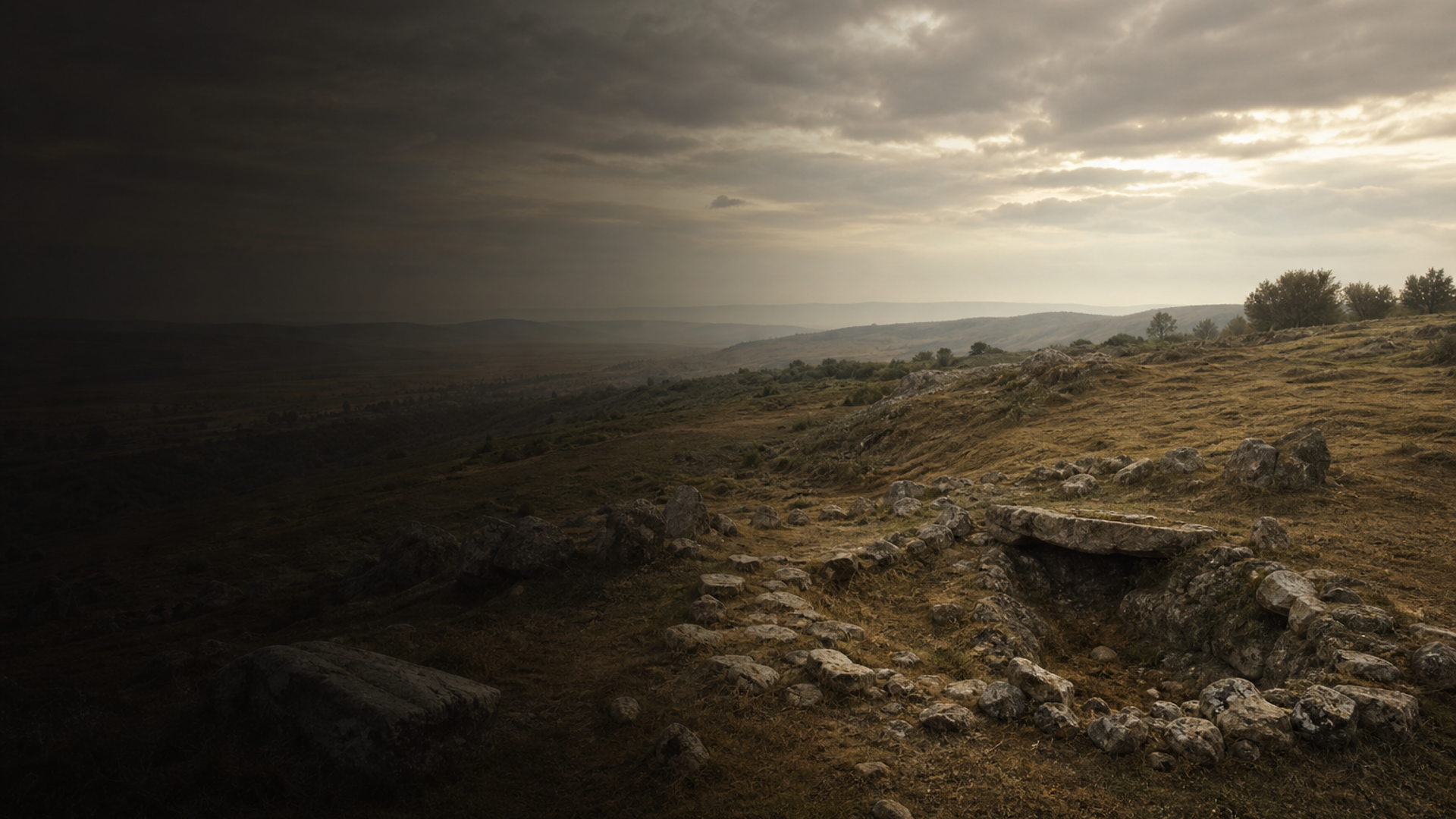
Brunn Wolfholz sits in the rich loess landscapes of lower Austria, dated here to 5604–5230 BCE. Archaeological data indicates this place lay on the threshold between long-established Mesolithic lifeways and the expanding Linear Pottery Culture (LBK).

The material record in the region shows a mosaic: occasional pottery and longhouse architecture associated with LBK neighbors, alongside lithic traditions and subsistence traces more typical of local foragers. Limited evidence suggests episodes of contact, exchange and perhaps assimilation rather than abrupt replacement at every locality. The lone genetic sample assigned to the Austria_N_HG_LBK label captures an individual within this liminal zone.

Caution is essential. With a single specimen, we cannot map population structure or demography confidently. Still, the archaeological signature at Brunn Wolfholz portrays a cinematic frontier — fields and domesticated herds beginning to appear on the horizon while woodland hunters and fisher groups remained active in rivers and wetlands. This liminal context is precisely where one expects biological and cultural interactions, providing fertile ground for later Neolithic dynamics across Central Europe.

Key uncertainties: the sample count is extremely low (<10), so demographic models are provisional, and the genetic picture must be integrated carefully with stratigraphic and material evidence.

  • Located at Brunn Wolfholz, Austria (5604–5230 BCE)
  • Archaeological data indicates a forager–farmer contact zone
  • Conclusions are preliminary due to a single sampled individual

Daily Life & Society

Life around Brunn Wolfholz likely unfurled as a patchwork of landscapes and economies. Archaeobotanical and zooarchaeological patterns in nearby LBK zones show cultivation of emmer and einkorn wheat, pulses, and managed cattle and pigs; in the immediate periphery, wild resources — game, fish and foraged plants — continued to matter. Archaeological data indicates that people here mixed sedentary practices with seasonal mobility, exploiting riverside wetlands and wooded uplands.

Material culture would have reflected this hybridity: coarse pottery forms and simple LBK ceramics might sit alongside locally produced stone tools and microlithic technologies. Social life probably ranged from small kin groups engaging in exchange networks to emerging village clusters influenced by LBK house plans and communal sites. Ritual and mortuary behavior in the region shows variability, suggesting both continuity of older rites and adoption of new symbols tied to agricultural life.

Because only one genome is available from this specific context, inferences about household structure, kinship, and inequality remain speculative. Archaeological data provides the stage-setting — fields, flintknapping spots, hearths and seasonal camps — while genetic data (when expanded) can reveal family ties, mobility and marriage networks that underpin daily life.

  • Mixed subsistence: early cultivation alongside wild resource use
  • Material culture likely combined LBK traits with local traditions

Genetic Profile

The genetic record for Austria_N_HG_LBK is extremely limited: a single sampled individual from Brunn Wolfholz. That person carries Y-chromosome lineage labeled CT and mitochondrial haplogroup U.

Interpretation of Y-CT is constrained. CT is a broad, early-branching haplogroup that predates many downstream lineages; when observed in low-coverage or early contexts it often represents an unresolved paternal lineage rather than a precise population marker. Mitochondrial haplogroup U, conversely, is commonly associated with European hunter-gatherer maternal lineages during the Mesolithic and into the early Neolithic in many regions.

Archaeogenetic patterns across Central Europe indicate that incoming Anatolian-derived Early European Farmers mixed to varying degrees with local hunter-gatherers, producing a gradient of ancestry. In this site’s timeframe and locale, the presence of an mtDNA U lineage is consistent with maternal continuity from hunter-gatherer groups or with admixture where hunter-gatherer women entered farming communities. The Y-CT call cannot yet speak to paternal continuity or replacement without further resolution.

Because sample count is below ten (here, n=1), any population-level conclusions are preliminary. Additional genomes from Brunn Wolfholz and surrounding LBK contexts are needed to test hypotheses about sex-biased admixture, kinship structures, and the pace of genomic change during the Neolithic transition in Austria.

  • Single individual: Y = CT (broad lineage), mtDNA = U (hunter‑gatherer‑associated)
  • Findings are tentative; larger sample sizes are needed to resolve admixture patterns

Legacy & Modern Connections

The story of Brunn Wolfholz is a whisper in the long narrative of European prehistory: a single genome that hints at the complex weaving of forager and farmer ancestries. Archaeologically, the site exemplifies the patchwork process by which Neolithic lifeways spread — sometimes by movement of people, sometimes by cultural transmission and exchange.

Genetically, the signal from this individual contributes to the broader picture that modern Central Europeans are descended from multiple ancestral streams: indigenous hunter-gatherers, Anatolian-derived early farmers, and later incoming groups. However, with one sample we cannot trace direct lines to present populations; instead we note that mitochondrial U lineages and traces of hunter-gatherer ancestry persist at low levels in many European genomes, evidence of deep continuity amid change.

Limited evidence suggests Brunn Wolfholz and sites like it were important crucibles where new subsistence strategies and social forms took hold. These scenes — fields edging onto forests, trading of pots and flint, marriages linking different lifeways — left an imprint that, in aggregate across many sites, shaped the genetic and cultural landscape of Europe.

  • Represents a point of contact between hunter-gatherers and LBK farmers
  • Single-sample data caution against making direct links to modern populations

AI 助手

AI 助手 由DNAGENICS公司制作

解锁此特性
Ask questions about the Wolfholz Horizon culture. Our AI assistant can explain genetic findings, historical context, archaeological evidence, and modern connections.
AI 样本分析

Wolfholz Horizon 文化是人类历史中值得了解的一章……

遗传分析揭示了与早期种群的联系,同时显示了独特的适应和文化创新的证据。 古代DNA样本提供了对迁徙模式、社会结构以及古代种群之间的生物关系的深刻见解。

这是人工智能分析的预览。 解锁全AI 助手, 以探索关于:

  • 遗传组成和祖先
  • 移徙模式和起源
  • 日常生活和文化习俗
  • 现代遗传遗产
使用优惠码 可减免 30% • 11月15日 到期