Wuzan Iron Age Burials

下载的 PDF 是图像副本。如需可选中文本及更好的辅助技术支持,请使用打印功能。

跳转到主内容
文明焦点

Wuzan Iron Age Burials

Five hearths of the Yili: bones, beads, and maternal lineages at Wuzan

743 CE - 386 BCE
Xinjiang, Yili Region (Nileke County), China

剧情

Archaeological remains from Wuzan (Nileke County, Yili, Xinjiang) dated 743–386 BCE reveal diverse maternal haplogroups (W3b, U, G, A, C). Limited samples (n=5) hint at regional connections across Xinjiang and Central Eurasia; conclusions are preliminary pending larger ancient DNA datasets.

Time Period

743–386 BCE

Region

Xinjiang, Yili Region (Nileke County), China

Common Y-DNA

Not reported / low sample count

Common mtDNA

W3b, U, G, A, C (each n=1)

时间线

743 BCE

Earliest dated Wuzan burial (sampled)

One of the recovered individuals dates to about 743 BCE, anchoring part of the assemblage in the early Iron Age.

386 BCE

Latest dated Wuzan burial (sampled)

A sampled burial from Wuzan dates to about 386 BCE, marking the upper bound of the current dataset.

Origins & Emergence

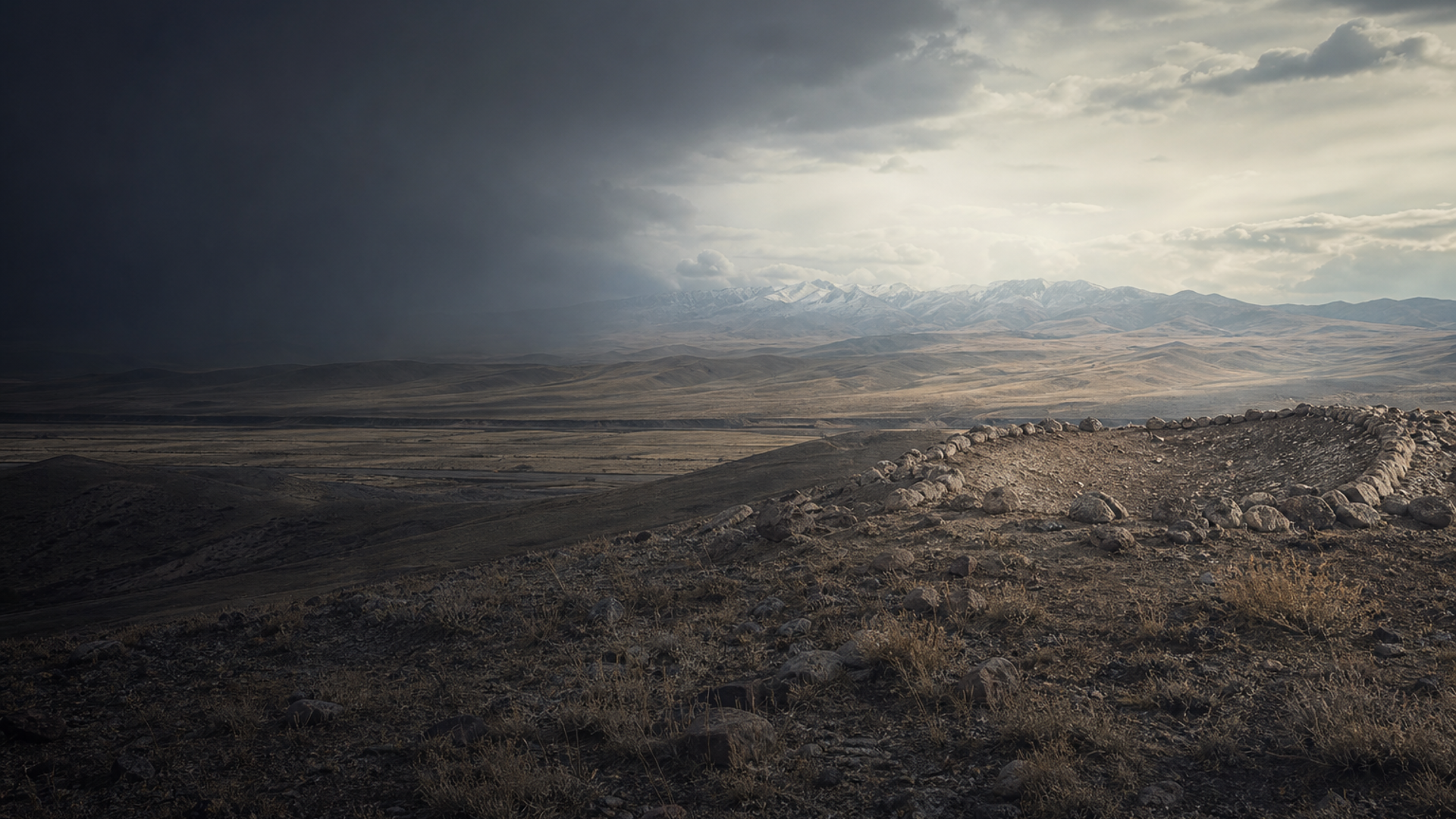
The Wuzan assemblage sits in the deep steppe-descending valleys of the Yili basin, a crossroads where mountain passes and river corridors funnel human movement between the Tien Shan and the Tarim Basin. Archaeological data indicates burials and associated grave goods at Wuzan (Nileke County) date between 743 and 386 BCE, placing these remains firmly in the Iron Age context of Xinjiang.

Material culture from nearby sites suggests a mosaic of local pastoral economies, long-distance exchange, and technological shifts accompanying iron use. Ceramic types, animal remains, and funerary practice show affinities with contemporaneous Iron Age groups in northern Xinjiang, but also display unique local expressions. Limited evidence suggests population mobility played a role: Wuzan lies along routes later known for Silk Road exchange, and even in the first millennium BCE there were episodic flows of people and materials.

Because the dataset from Wuzan comprises only five genomes, interpretations about origins remain tentative. Archaeology frames the site as a local node within broader Central Eurasian networks; genetics provides hints about maternal diversity that are consistent with contacts across the region but cannot yet resolve precise migration events.

  • Located in Wuzan, Nileke County, Yili Region, Xinjiang (China)
  • Datation: calibrated context between 743–386 BCE (Iron Age)
  • Evidence points to a regional crossroads with long-distance links

Daily Life & Society

Excavations at Wuzan reveal funerary practices that illuminate daily life: burials accompanied by personal ornaments, domestic pottery fragments, and faunal remains speak of pastoral-herding economies interlaced with small-scale agriculture and craft. Osteological indicators—including wear patterns and isotopic baselines in the region—typically suggest diets rich in domesticated animal protein and seasonal foraging.

Grave goods and burial orientation at contemporary Xinjiang Iron Age sites show social differentiation: some individuals are interred with ornaments or trade items hinting at status or long-distance connections. At Wuzan, preservation is variable, but the presence of diverse maternal haplogroups (mtDNA lineages) among a small sample may reflect kinship networks that included women from several maternal backgrounds—perhaps brought by marriage ties or local exogamous practices.

Archaeological layers at Wuzan also preserve craft residues and lithic/iron debris indicating localized production. While dramatic monumental architecture is absent, the site’s material culture paints a cinematic scene of small communities negotiating mobility, resource zones, and social bonds in a rugged borderland.

All reconstructions remain cautious due to limited excavation area and small genetic sample size.

  • Material culture indicates pastoralism with craft production
  • Burials suggest social differentiation and possible exogamy

Genetic Profile

Ancient DNA retrieved from five individuals at Wuzan provides a preliminary maternal portrait: each individual carries a different mtDNA lineage—W3b, U, G, A, and C—reflecting a mosaic of West Eurasian and East Eurasian maternal ancestries common to Xinjiang’s role as a contact zone. These haplogroups span broad geographies: U and W subclades have strong associations with West Eurasian maternal ancestries, while A, C, and G are prevalent in East Eurasian and Siberian populations. The coexistence of these lineages in a single site is consistent with archaeological inferences of cultural connectivity.

No consistent, dominant maternal lineage emerges from this tiny sample, and Y-chromosome data are not reported or are insufficient, limiting paternal inference. Because the dataset includes only five genomes, population-level statistics (admixture proportions, sex-biased mobility tests, and fine-scale phylogeography) are underpowered. Thus, any narrative about migration directionality, demographic replacement, or the timing of admixture must be treated as provisional.

Combined, the genetic and archaeological signals suggest Wuzan was inhabited by people with diverse maternal ancestries, compatible with patterns of marriage networks and mobility across Central Eurasia. Expanded sampling across Xinjiang and time transects will be needed to move from evocative possibilities to robust demographic models.

  • mtDNA diversity: W3b, U, G, A, C (each observed once)
  • Y-DNA not reported or insufficient—paternal patterns unresolved

Legacy & Modern Connections

Wuzan’s small but vivid genetic signal reminds us that modern populations of Xinjiang and the broader Eurasian interior are heirs to long-standing mixtures. The maternal lineages found at Wuzan resonate with haplogroups still present across Central and East Asia, suggesting continuity of certain maternal threads even as cultural and linguistic landscapes shifted.

Archaeologically, Wuzan helps trace the deep-time fabric of connectivity that would later underlie Silk Road networks. Genetically, these early Iron Age individuals underscore how borderland communities could carry and transmit diverse ancestries. However, because only five individuals were analyzed, any direct link between Wuzan genomes and specific modern groups should be made cautiously. Broader sampling and integration with regional archaeology are necessary to clarify how these maternal lineages contributed to later population histories in Xinjiang and adjacent regions.

  • Maternal haplogroups match broader Eurasian diversity still present today
  • Findings emphasize continuity of mobility corridors that predate the Silk Road

AI 助手

AI 助手 由DNAGENICS公司制作

解锁此特性
Ask questions about the Wuzan Iron Age Burials culture. Our AI assistant can explain genetic findings, historical context, archaeological evidence, and modern connections.
AI 样本分析

Wuzan Iron Age Burials 文化是人类历史中值得了解的一章……

遗传分析揭示了与早期种群的联系,同时显示了独特的适应和文化创新的证据。 古代DNA样本提供了对迁徙模式、社会结构以及古代种群之间的生物关系的深刻见解。

这是人工智能分析的预览。 解锁全AI 助手, 以探索关于:

  • 遗传组成和祖先
  • 移徙模式和起源
  • 日常生活和文化习俗
  • 现代遗传遗产
使用优惠码 可减免 25% • 11月13日 到期




