
Yinwang Cave: Guangxi Ming-Era Trace

下载的 PDF 是图像副本。如需可选中文本及更好的辅助技术支持,请使用打印功能。

Yinwang Cave: Guangxi Ming-Era Trace

揭开一个失落的文明

正在加载考古记录……

正在收集古代记录

跳转到主内容
Yinwang Cave: Guangxi Ming-Era Trace
文明焦点

Yinwang Cave: Guangxi Ming-Era Trace

A lone mitochondrial voice from Yinwang Cave links Guangxi's past to maternal lineages of East Asia

1400 CE - 1700 CE
Guangxi, China (Baise City, Pingguo County)
滚动开始
Chapter I

剧情

了解 Yinwang Cave: Guangxi Ming-Era Trace 文化

Archaeological remains from Yinwang Cave (Liming Village, Guangxi) dated to 1400–1700 CE yield one ancient DNA mtDNA M sample. Excavation context and genetic data suggest local maternal continuity during the Ming era, but conclusions are preliminary due to a single sample.

Time Period

1400–1700 CE (Ming era)

Region

Guangxi, China (Baise City, Pingguo County)

Common Y-DNA

Not reported (sample count 1)

Common mtDNA

M (1)

Chapter II

时间线

这种文化历史上的关键时刻

1500 CE

Probable Yinwang Cave burial (dated context)

Contextual dating places the burial within 1400–1700 CE, aligning with Ming-era activity in Guangxi. Evidence is limited to a single sampled individual.

Chapter III

Origins & Emergence

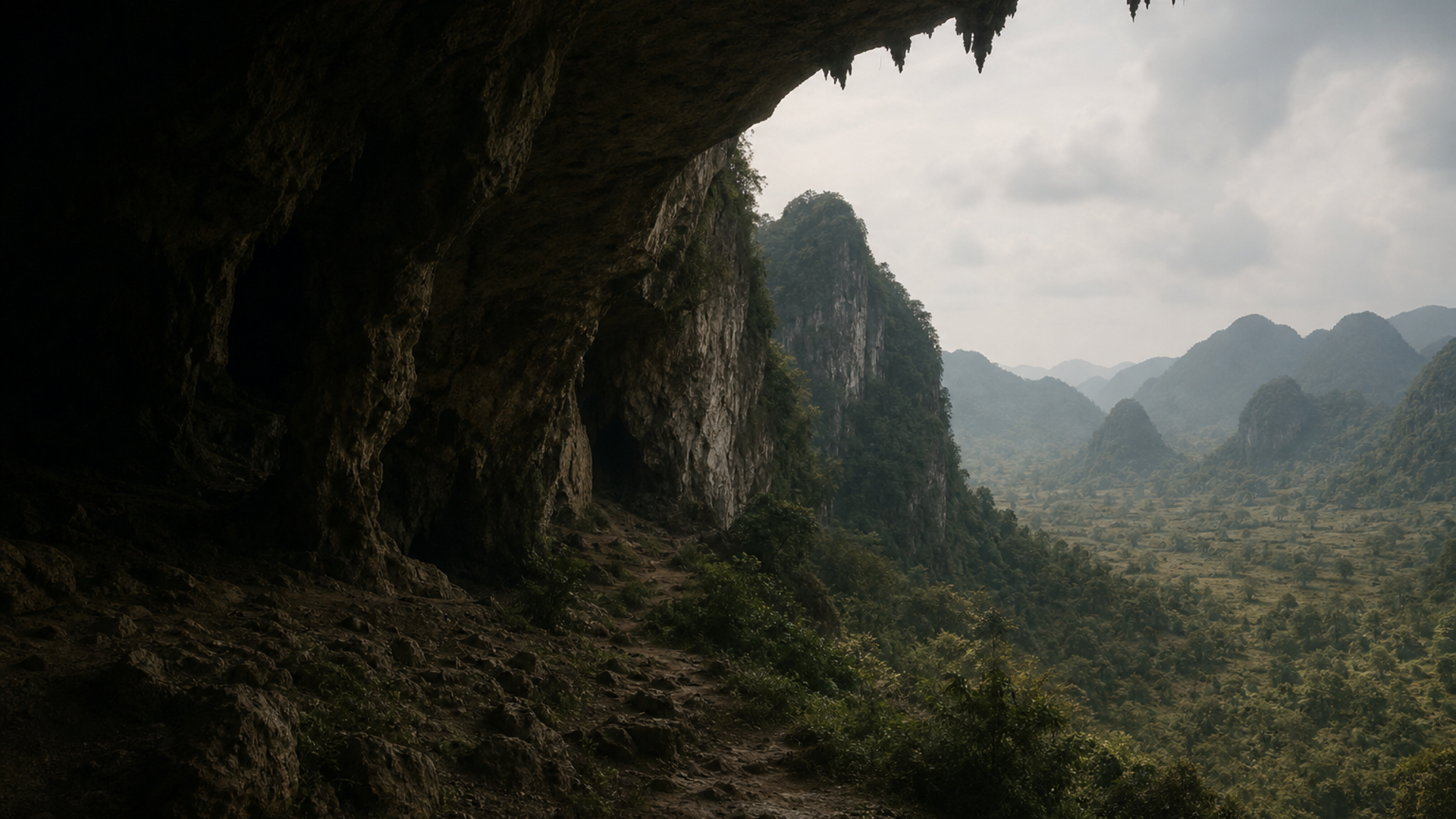
Perched on the flanks of Nian Mountain, the rock-hewn throat of Yinwang Cave preserves a quiet conversation between archaeology and genetics. Archaeological data indicates human use of the cave during the late medieval to early modern period—broadly within the Ming dynasty (1368–1644 CE) and into the early Qing transition. Excavators recorded stratified deposits of charcoal, ceramic sherds consistent with local Ming-period pottery traditions, and human remains recovered in a sealed pocket of the cave interior. Radiocarbon dating of associated charcoal and contextual artifacts places the burial context within 1400–1700 CE.

Limited evidence suggests occupation by small, likely local groups rather than large, transient populations; cave use in Guangxi commonly reflects mortuary and occasional ritual practice. Regional historical sources describe Guangxi as a borderland of diverse ethnic communities and shifting administrative ties during the Ming era, a background that archaeological material culture alone cannot fully resolve.

This assemblage situates Yinwang within the landscape of southern Chinese cave burials and upland settlement patterns. However, given the single dated burial and limited excavation area, the site's origins and social significance remain provisional pending wider survey and additional sampling.

  • Site: Yinwang Cave, Liming Village, Nian Mountain (Pingguo County, Baise City, Guangxi)
  • Date range: 1400–1700 CE (Ming era contexts)
  • Evidence: stratified charcoal, Ming-era ceramics, sealed burial pocket
Chapter IV

Daily Life & Society

Archaeological traces from the Yinwang context offer faint but evocative glimpses of daily life in upland Guangxi during the late Ming period. Ceramic fragments recovered include utilitarian ware consistent with household cooking and storage; small amounts of charcoal and fragmented bone suggest local subsistence based on mixed agriculture and foraged resources common to subtropical hill environments. The cave burial itself, placed in a sealed niche, hints at localized funerary practices—possibly familial—distinct from large cemetery complexes found on the plains.

Material culture indicates adaptation to a rugged landscape: pottery forms and tool fragments echo regional craft traditions rather than long-distance elite exchange. Ethnographic analogy and historical records point to multiethnic communities in Guangxi, including Han settlers and indigenous Tai-Kadai and Hmong-Mien speaking groups; however, the archaeological assemblage at Yinwang alone cannot assign a definitive cultural identity.

In sum, the site evokes a small, rooted community whose daily rhythms were shaped by upland terrains, with mortuary choices reflecting intimate social networks rather than conspicuous display.

  • Material remains suggest household production and upland subsistence
  • Burial in a sealed cave niche implies localized funerary practice
Chapter V

Genetic Profile

Ancient DNA analysis recovered mitochondrial DNA assigning the individual to haplogroup M. Haplogroup M is broadly distributed across East and Southeast Asia and is common in many modern populations of southern China; its presence at Yinwang is consistent with regional maternal lineages. Because mtDNA traces only the maternal line, it provides a single-thread glimpse into ancestry rather than a full genomic portrait.

Critically, this dataset comprises one sample. With sample count equal to one (<10), conclusions must be explicitly preliminary. The absence of reported Y‑DNA precludes insights into paternal lineages for this burial. Archaeological DNA preservation in subtropical caves can be variable; the recovery of mtDNA here demonstrates the potential for future genomic work but also underscores sampling limitations.

Genetically, the Yinwang individual may reflect local maternal continuity in Guangxi across the late medieval period, or they may represent one thread in a tapestry of regional diversity. Future genome-wide sequencing, additional samples from contemporaneous sites, and comparative analyses with modern and ancient reference panels will be required to test hypotheses about population continuity, migration, and admixture.

  • mtDNA haplogroup M recovered—consistent with widespread East/Southeast Asian maternal lineages
  • Single sample limits inference; Y‑DNA not reported
Chapter VI

Legacy & Modern Connections

Yinwang Cave offers a cinematic snapshot: a single mitochondrial lineage emerging from the dark throat of a Guangxi cave, tying a named place to maternal ancestry threads that continue in the region today. Archaeological data indicates probable local continuity, but genetic claims must remain cautious until additional samples are analyzed.

For modern communities in Guangxi and scholars of Chinese population history, Yinwang underscores the value of integrating archaeology, historical sources, and genetics. Even a lone ancient mtDNA sequence can guide sampling strategies, highlight preservation hotspots, and raise targeted questions—about migration, kinship, and how upland societies navigated the social landscapes of Ming-era China.

Ultimately, Yinwang's legacy is methodological: it exemplifies how careful excavation and even limited aDNA can open pathways toward richer portraits of the past when treated as provisional evidence in a larger, ongoing research story.

  • Provides a preliminary maternal link between late Ming Guangxi and broader East Asian lineages
  • Highlights need for expanded sampling to clarify population continuity and admixture
AI 电源

AI 助手

就 Yinwang Cave: Guangxi Ming-Era Trace 文化提问

AI 助手 由DNAGENICS公司制作

解锁此特性
Ask questions about the Yinwang Cave: Guangxi Ming-Era Trace culture. Our AI assistant can explain genetic findings, historical context, archaeological evidence, and modern connections.
AI 样本分析

Yinwang Cave: Guangxi Ming-Era Trace 文化是人类历史中值得了解的一章……

遗传分析揭示了与早期种群的联系,同时显示了独特的适应和文化创新的证据。 古代DNA样本提供了对迁徙模式、社会结构以及古代种群之间的生物关系的深刻见解。

这是人工智能分析的预览。 解锁全AI 助手, 以探索关于:

  • 遗传组成和祖先
  • 移徙模式和起源
  • 日常生活和文化习俗
  • 现代遗传遗产

探索更古老的文化

揭开古代世界文明的故事

使用优惠码 可减免 35% • 11月12日 到期




