Menu
Store
Blog
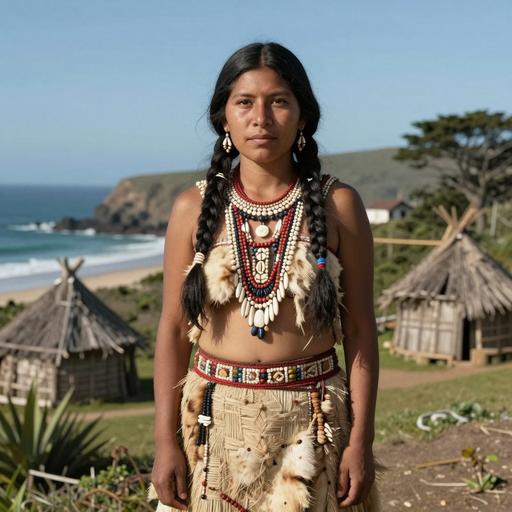
Portrait reconstruction of CR-01
Ancient Individual

A woman buried in USA in the Pre-Columbian North America era

CR-01
774 CE - 1022 CE
Female
Santa Cruz Island Chumash Culture, California, USA
USA
Scroll to begin
Chapter I

Identity

The biological and cultural markers that define this ancient individual

Sample ID

CR-01

Date Range

774 CE - 1022 CE

Biological Sex

Female

mtDNA Haplogroup

A2

Cultural Period

Santa Cruz Island Chumash Culture, California, USA

Chapter II

Place

Where this individual was discovered

Country USA
Locality San Cruz Island. CA
Chapter III

Time

When this individual lived in the broader context of human history

CR-01 774 CE - 1022 CE
Chapter IV

Story

The narrative of this ancient life

The Santa Cruz Island Chumash represent an integral component of the broader Chumashan cultural and linguistic group, indigenous to the coastal and island regions of Southern California. The Chumash people, with a history reaching back thousands of years, developed sophisticated societies well-adapted to the diverse environments of the Channel Islands and the adjacent mainland.

Geography and Environment

Santa Cruz Island, one of the Channel Islands off the coast of California, is the largest island in the archipelago, spanning roughly 96 square miles. The island's diverse landscapes include rugged mountains, broad valleys, extensive coasts, and unique ecosystems that offered abundant resources. The temperate Mediterranean climate, characterized by wet winters and dry summers, provided a stable environment conducive to sustaining life.

Subsistence and Economy

The Chumash on Santa Cruz Island were expert maritime people. They constructed distinctive planked canoes known as tomols, which enabled them to navigate the channels between islands and the mainland. This facilitated not only fishing and hunting marine mammals like seals and sea otters but also trade with mainland communities.

Fishing was central to the Chumash diet, and they utilized nets, lines, and hooks, crafted from available materials, to catch species such as sardines, rockfish, and halibut. Additionally, they gathered shellfish like abalone and mussels, augmenting their diet with terrestrial mammals and plants, including acorns, seeds, and various fruits and roots. The abundance and variety of resources permitted the development of complex social structures.

Social and Political Organization

The Santa Cruz Island Chumash, like their mainland counterparts, were organized in a network of villages, typically led by a chief or wot. These leaders played significant roles in social, economic, and ceremonial life, overseeing the distribution of resources and resolving disputes. The society was stratified, with social classes often determined by lineage, wealth, and skill.

Trade was vital to the Chumash economy and facilitated by their navigational prowess. Shell beads, particularly the Olivella shell beads, were widely used as a form of currency, enabling the exchange of goods like obsidian, steatite, animal hides, and foodstuffs.

Art and Craftsmanship

The Chumash are known for their exceptional craftsmanship, which extended to basketry, pottery, and bead-making. The Chumash baskets, renowned for their intricate designs and fine craftsmanship, were made from a variety of local plant materials such as willow and juncus. These baskets served both practical uses and ceremonial purposes.

Their rock art, including the vibrant pictographs found in caves and on rock surfaces, provide insights into their spiritual and daily life, depicting anthropomorphic and zoomorphic figures that likely held symbolic meaning.

Language and Culture

The Chumash language, part of the Hokan linguistic family, comprised several regional dialects. While these languages are no longer widely spoken, efforts have been made to revitalize them. Chumash spiritual life was rich with mythology and ritual, revolving around a pantheon of deities and spirits. Ceremonies often included music, dance, and the use of steatite effigies and pipes.

Contact and Change

The arrival of Spanish explorers in the 16th century, followed by the establishment of missions in California during the late 18th century, dramatically altered the Chumash way of life. Spanish colonialism imposed new socio-economic structures, religion, and diseases, which, alongside missionization, devastated the indigenous populations, disrupting their traditional ways of living.

Despite these challenges, the Santa Cruz Island Chumash and their descendants continue to preserve and celebrate their rich cultural heritage, striving for cultural revitalization and recognition in contemporary society.

In conclusion, the Santa Cruz Island Chumash culture exemplifies a highly adaptable and innovative society, deeply connected to the maritime environment that shaped their economic and social structures for millennia.

Chapter V

Genetics

The genetic ancestry of this ancient individual

Ancient Genetic Admixture

This analysis compares the DNA profile of CR-01 with ancient reference populations, showing the genetic composition in terms of prehistoric ancestral groups.

Ancient Native Americans 74.8%
Ancient Asians 22.1%
Western Steppe Pastoralists 3.1%

Modern Genetic Admixture

This analysis compares the DNA profile with present-day reference populations, showing what percentage of genetic makeup resembles modern populations from different regions.

America 87.8%
America 87.8%
Native American 87.8%
Asia 11.7%
Northern Asian 7.5%
Siberian 7.5%
Central Asian, Northern Indian & Pakistani 1.6%
Central Asian 1.6%
Chinese & Southeast Asian 1.5%
Chinese 1.4%
Japanese & Korean 1.2%
Japanese 1.2%

Closest Modern Populations

These are the modern populations showing the closest statistical alignment to A woman buried in USA in the Pre-Columbian North America era, ranked by genetic distance. Lower distance values indicate closer statistical similarity.

1
Cachi
2.3152
2
Mayan
2.3634
3
Mixe
2.5863
4
Bolivian Lapaz
2.6791
5
Pima
2.7607
6
Colla
2.8287
7
Huichol
2.8951
8
Nahua
3.0526
9
Zapotec
3.0741
10
Mixtec
3.1709
Chapter VI

Context

Other ancient individuals connected to this sample

Sources

References

Scientific publications and genetic data

Scientific Publication

Ancient human parallel lineages within North America contributed to a coastal expansion

Authors Scheib CL, Li H, Desai T
Abstract

Little is known regarding the first people to enter the Americas and their genetic legacy. Genomic analysis of the oldest human remains from the Americas showed a direct relationship between a Clovis-related ancestral population and all modern Central and South Americans as well as a deep split separating them from North Americans in Canada. We present 91 ancient human genomes from California and Southwestern Ontario and demonstrate the existence of two distinct ancestries in North America, which possibly split south of the ice sheets. A contribution from both of these ancestral populations is found in all modern Central and South Americans. The proportions of these two ancestries in ancient and modern populations are consistent with a coastal dispersal and multiple admixture events.

G25 Coordinates

The G25 coordinates for sample CR-01 can be used for detailed admixture analysis in our G25 Studio tool.

CR-01,0.05750792,-0.30838554,0.10981212,0.09622032,-0.11038976,-0.01090154,-0.28578282,-0.33687004,-0.01406968,-0.01689112,0.00220662,-0.0006583,-0.00017452,0.02156526,-0.00674292,0.0011926,0.00582572,0.00440596,0.00168342,-0.00185568,-0.00201622,0.00793476,-0.00221422,-0.00329642,-0.0040633
Analyze in G25 Studio
Use code for 40% off Expires Feb 27