Menu
Store
Blog
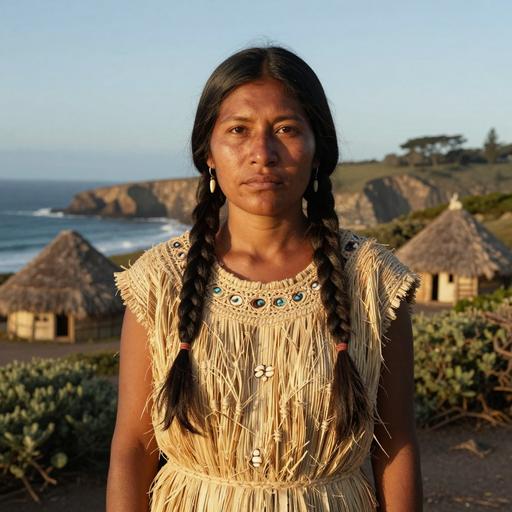
Portrait reconstruction of SM-02
Ancient Individual

A woman buried in USA in the Pre-Columbian North America era

SM-02
1174 CE - 1269 CE
Female
San Miguel Island Chumash Culture, California, USA
USA
Scroll to begin
Chapter I

Identity

The biological and cultural markers that define this ancient individual

Sample ID

SM-02

Date Range

1174 CE - 1269 CE

Biological Sex

Female

mtDNA Haplogroup

A2

Cultural Period

San Miguel Island Chumash Culture, California, USA

Chapter II

Place

Where this individual was discovered

Country USA
Locality San Miguel Island. CA
Chapter III

Time

When this individual lived in the broader context of human history

SM-02 1174 CE - 1269 CE
Chapter IV

Story

The narrative of this ancient life

The San Miguel Island Chumash culture represents a fascinating and integral part of the broader Chumash cultural region, which once spanned along the coastal and channel islands of Southern California. San Miguel Island, one of the Channel Islands, played a significant role in the history and development of the Chumash people, who are renowned for their complex society, seafaring prowess, and rich cultural traditions.

Location and Environment

San Miguel Island is the westernmost of California's Channel Islands, situated approximately 26 miles off the coast of Santa Barbara. As the island is subject to cool temperatures, strong winds, and rich marine biodiversity, its environment necessitated adaptive strategies among the Chumash who settled there. The island's rugged terrain, with its cliffs, grassy plains, and sand dunes, provided both challenges and resources, shaping the lifestyles and culture of its inhabitants. The surrounding Pacific Ocean, filled with diverse marine life, was a key resource for sustenance and trade.

Subsistence and Economy

The Chumash of San Miguel Island relied heavily on the rich marine ecosystem for their subsistence. They were expert fishermen and hunters, utilizing tools like fishing nets, hooks, and harpoon-like implements to catch a variety of fish, shellfish, and marine mammals such as seals and sea lions. The island’s resources also included edible plants and seeds, which were gathered seasonally.

One of the most remarkable aspects of Chumash culture was their development and use of the \tomol," a plank-built canoe, which demonstrated advanced shipbuilding techniques. These canoes enabled the Chumash to navigate the challenging waters of the Channel Islands, facilitating trade, communication, and fishing expeditions. They traded goods such as shell beads, fish, and manufactured tools with mainland Chumash groups and other neighboring tribes.

Social Structure and Organization

The Chumash society on San Miguel Island, like other Chumash communities, was complex and hierarchically organized. Their social structure was composed of a network of villages, each led by a chief who wielded political, economic, and spiritual authority. The chief’s role was pivotal in decision-making and maintaining social order, as well as managing resources and trade relations with other groups.

Craft specialization was notable among the Chumash, with specific communities and individuals skilled in producing items such as shell beads, ornaments, and baskets. These items were often used in trade or as cultural symbols, indicating social status and wealth.

Spirituality and Religion

Spirituality was integral to the Chumash way of life, with a rich body of myths, rituals, and ceremonies. Their belief system was deeply connected to the natural world and celestial phenomena. They believed in powerful spiritual beings and forces that influenced daily life and the environment. Rituals, led by spiritual leaders or shaman figures, were conducted to ensure harmony, good fortune, and successful harvests or hunts.

Rock art, which includes elaborate pictographs and petroglyphs, is one of the most intriguing aspects of the Chumash spiritual expression. Although San Miguel Island itself has fewer known rock art sites compared to the mainland, these artworks are considered to hold religious and cultural significance, often relating to Chumash mythology and cosmology.

Archaeological and Historical Significance

The archaeological record of San Miguel Island has provided valuable insights into the Chumash culture. Excavations have unearthed remains of village sites, artifacts, and tools that illustrate the day-to-day life and advanced technological achievements of the Chumash. These findings help historians and archaeologists understand the adaptive strategies and innovations that enabled the Chumash to thrive in their island environment.

Contemporary Relevance

While the traditional way of life of the San Miguel Island Chumash has largely disappeared due to colonial impacts, including Spanish missions and later American expansion, the cultural heritage and legacy of the Chumash people continue to endure. Today, descendants of the Chumash work to preserve their cultural heritage, language, and traditions, ensuring that the story of their ancestors remains a vibrant and respected part of California's history.

In summary, the San Miguel Island Chumash culture is emblematic of the adaptive prowess, technological innovation, and rich spiritual traditions of the indigenous peoples who once inhabited the Channel Islands of California. Their legacy offers profound insights into the complex societies that existed in pre-colonial North America."

Chapter V

Genetics

The genetic ancestry of this ancient individual

Ancient Genetic Admixture

This analysis compares the DNA profile of SM-02 with ancient reference populations, showing the genetic composition in terms of prehistoric ancestral groups.

Ancient Native Americans 74.2%
Ancient Asians 22.9%
Western Steppe Pastoralists 2.9%

Modern Genetic Admixture

This analysis compares the DNA profile with present-day reference populations, showing what percentage of genetic makeup resembles modern populations from different regions.

America 91.4%
America 91.4%
Native American 91.4%
Asia 8.3%
Japanese & Korean 3.8%
Japanese 3.8%
Northern Asian 2.3%
Siberian 2.0%
Chinese & Southeast Asian 2.2%
Tibetan 1.4%
Chinese 0.6%

Closest Modern Populations

These are the modern populations showing the closest statistical alignment to A woman buried in USA in the Pre-Columbian North America era, ranked by genetic distance. Lower distance values indicate closer statistical similarity.

1
Aymara
2.6455
2
Mixe
2.8224
3
Bolivian Lapaz
2.8816
4
Piapoco
3.1493
5
Yukpa
3.3852
6
Colla
3.5088
7
Wichi
3.5218
8
Cachi
3.5404
9
Huichol
3.7990
10
Pima
3.8148
Chapter VI

Context

Other ancient individuals connected to this sample

Sources

References

Scientific publications and genetic data

Scientific Publication

Ancient human parallel lineages within North America contributed to a coastal expansion

Authors Scheib CL, Li H, Desai T
Abstract

Little is known regarding the first people to enter the Americas and their genetic legacy. Genomic analysis of the oldest human remains from the Americas showed a direct relationship between a Clovis-related ancestral population and all modern Central and South Americans as well as a deep split separating them from North Americans in Canada. We present 91 ancient human genomes from California and Southwestern Ontario and demonstrate the existence of two distinct ancestries in North America, which possibly split south of the ice sheets. A contribution from both of these ancestral populations is found in all modern Central and South Americans. The proportions of these two ancestries in ancient and modern populations are consistent with a coastal dispersal and multiple admixture events.

G25 Coordinates

The G25 coordinates for sample SM-02 can be used for detailed admixture analysis in our G25 Studio tool.

SM-02,0.05574552,-0.32189306,0.1137498,0.0958717,-0.11754788,-0.0141047,-0.29220314,-0.34351342,-0.01298982,-0.01535224,0.00334948,-0.00037594,-0.00159972,0.02486864,-0.00617674,-0.0007682,0.00585274,0.00395744,0.00211146,-0.00116874,0.00106626,0.00567958,-0.00252006,-0.0043193,-0.00449394
Analyze in G25 Studio
Use code for 40% off Expires Feb 27