Menu
Store
Blog
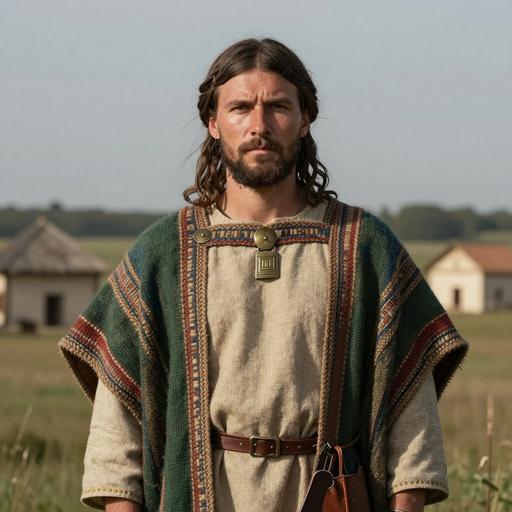
Portrait reconstruction of DA171
Ancient Individual

A man buried in Lithuania in the Late Iron Age era

DA171
50 CE - 650 CE
Male
Late Antiquity Lithuania
Lithuania
Scroll to begin
Chapter I

Identity

The biological and cultural markers that define this ancient individual

Sample ID

DA171

Date Range

50 CE - 650 CE

Biological Sex

Male

mtDNA Haplogroup

H2a1

Y-DNA Haplogroup

N-L1025

Cultural Period

Late Antiquity Lithuania

Chapter II

Place

Where this individual was discovered

Country Lithuania
Coordinates 55.7438, 24.2280
Chapter III

Time

When this individual lived in the broader context of human history

DA171 50 CE - 650 CE
Chapter IV

Story

The narrative of this ancient life

The period known as Late Antiquity broadly encompasses the transformative centuries from approximately the 3rd to the 8th century CE. It marks a time of transition, bridging the classical era and the Middle Ages in Europe. While much of the focus of Late Antiquity typically revolves around the Roman Empire and its successor states, this era was also crucial in the development of cultures and societies further north, including those in the Baltic region such as what is now modern-day Lithuania.

Geographic and Cultural Context

During Late Antiquity, the region that is now Lithuania was inhabited by Baltic tribes. The Baltics are part of a larger ethno-linguistic group that also includes the contemporary Latvians, and the now extinct Old Prussians. This period is characterized by these tribes’ gradual development in isolation from the enormous cultural shifts happening in the Roman Empire and its fringes. Despite limited influence directly from Rome, these areas were not completely isolated and were indirectly affected by broader movements, such as the migration of peoples and the spread of trade networks.

Society and Economy

The Baltic tribes during Late Antiquity were predominantly agrarian societies, with significant development in agriculture, fishing, and hunting. These tribes lived in small, scattered settlements and villages that were often fortified. The social structure was likely based on tribal and clan systems, with chieftains or local leaders wielding power and influence within their territories. These tribal systems were not centralized, and power was dispersed among various local leaders.

Lithuanian tribes engaged in trade with merchants from the Roman Empire and later, emerging European cultures. Amber, in particular, was a valuable commodity, traded along trade routes that stretched all the way to the Mediterranean. This trade not only enriched the local economies but also facilitated some cultural exchanges, as ideas and goods flowed along these routes.

Cultural and Religious Practices

The spiritual and religious practices of the Baltic tribes during Late Antiquity revolved around paganism, with a strong emphasis on nature worship. They venerated natural phenomena, such as trees, bodies of water, and celestial bodies, which they believed to be infused with spiritual significance. Their pantheon likely included multiple deities associated with natural elements and life aspects.

Archaeological evidence suggests the presence of wooden idols and sacred groves where religious rituals would be conducted. The social fabric was deeply entwined with these spiritual beliefs, which prescribed roles, festivities, and communal gatherings.

Military and Conflicts

The tribes of Lithuania during this period were relatively autonomous, although their strategic location meant they were sometimes involved in broader regional conflicts. They were known to engage in raids and skirmishes, both amongst themselves and against neighboring tribes and groups, such as the Slavs and various Germanic tribes. The need to defend against these threats contributed to the development of fortified settlements and warrior classes.

Transition and Legacy

By the end of Late Antiquity, the Baltic tribes had laid the groundwork for future social and political structures that would eventually lead to the formation of more centralized states, such as the Grand Duchy of Lithuania. The period's legacy is evident in the continuity of language and certain cultural practices that persisted despite external pressures from the Christianization and integration into European medieval structures.

Overall, the Late Antiquity period in Lithuania and the Baltic region marked a foundational era, characterized by gradual social transformation, the establishment of trade networks, and the endurance of vibrant cultural traditions that would influence later historical developments in the region.

Chapter V

Genetics

The genetic ancestry of this ancient individual

Ancient Genetic Admixture

This analysis compares the DNA profile of DA171 with ancient reference populations, showing the genetic composition in terms of prehistoric ancestral groups.

European Hunter-Gatherers 50.5%
Western Steppe Pastoralists 37.8%
Neolithic Farmers 11.7%

Modern Genetic Admixture

This analysis compares the DNA profile with present-day reference populations, showing what percentage of genetic makeup resembles modern populations from different regions.

Europe 100.0%
Northwestern European 53.3%
Northwestern European 27.3%
Finnish 22.9%
Scandinavian 3.1%
Eastern European 46.6%

Closest Modern Populations

These are the modern populations showing the closest statistical alignment to A man buried in Lithuania in the Late Iron Age era, ranked by genetic distance. Lower distance values indicate closer statistical similarity.

1
Lithuanian PA
1.6824
2
Belarusian
1.7429
3
Russian Kursk
1.7741
4
Russian Pskov
1.8580
5
Estonian
1.9093
6
Russian Tver
1.9454
7
Lithuanian VA
2.0596
8
Russian Kaluga
2.0870
9
Russian Smolensk
2.0912
10
Russian Orel
2.1569
Chapter VI

Context

Other ancient individuals connected to this sample

Sources

References

Scientific publications and genetic data

Scientific Publication

137 ancient human genomes from across the Eurasian steppes

Authors Damgaard PB, Marchi N, Rasmussen S
Abstract

For thousands of years the Eurasian steppes have been a centre of human migrations and cultural change. Here we sequence the genomes of 137 ancient humans (about 1× average coverage), covering a period of 4,000 years, to understand the population history of the Eurasian steppes after the Bronze Age migrations. We find that the genetics of the Scythian groups that dominated the Eurasian steppes throughout the Iron Age were highly structured, with diverse origins comprising Late Bronze Age herders, European farmers and southern Siberian hunter-gatherers. Later, Scythians admixed with the eastern steppe nomads who formed the Xiongnu confederations, and moved westward in about the second or third century BC, forming the Hun traditions in the fourth-fifth century AD, and carrying with them plague that was basal to the Justinian plague. These nomads were further admixed with East Asian groups during several short-term khanates in the Medieval period. These historical events transformed the Eurasian steppes from being inhabited by Indo-European speakers of largely West Eurasian ancestry to the mostly Turkic-speaking groups of the present day, who are primarily of East Asian ancestry.

G25 Coordinates

The G25 coordinates for sample DA171 can be used for detailed admixture analysis in our G25 Studio tool.

DA171,0.1355786,0.1144598,0.0791198,0.07286212,0.03746218,0.0295075,0.01113496,0.01412548,-0.00088886,-0.02685706,-0.00647342,-0.0075917,0.0199183,0.0238932,-0.00970584,0.00330596,-0.0013818,-0.00079892,0.00261696,0.00049926,0.0006431,-0.00237512,0.00743758,-0.00127922,-0.00264596
Analyze in G25 Studio
Use code for 40% off Expires Feb 26