Menu
Store
Blog
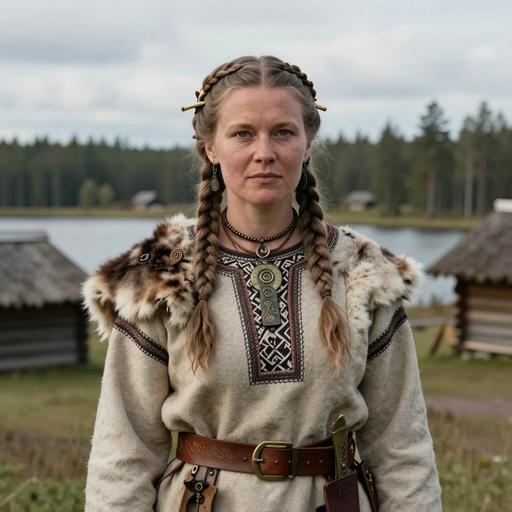
Portrait reconstruction of DA237
Ancient Individual

A woman buried in Finland in the Iron Age era

DA237
436 CE - 644 CE
Female
Iron Age Saami, Finland
Finland
Scroll to begin
Chapter I

Identity

The biological and cultural markers that define this ancient individual

Sample ID

DA237

Date Range

436 CE - 644 CE

Biological Sex

Female

mtDNA Haplogroup

H1-e

Cultural Period

Iron Age Saami, Finland

Chapter II

Place

Where this individual was discovered

Country Finland
Locality Levanluhta
Coordinates 62.9000, 22.4000
Chapter III

Time

When this individual lived in the broader context of human history

DA237 436 CE - 644 CE
Chapter IV

Story

The narrative of this ancient life

The Iron Age Saami of Finland represent a fascinating period and culture within the broader context of Finno-Ugric history. The Saami people, indigenous to the northern regions of Scandinavia and known for their unique cultural and linguistic heritage, experienced significant developments during the Iron Age, roughly spanning from about 500 BCE to 1200 CE. This era was marked by transformations in social structures, subsistence strategies, and external influences.

Geography and Environment

The Saami inhabited a vast region across northern Scandinavia, with the Finnish territories primarily centered in areas such as Lapland. The landscape was characterized by a harsh but resource-rich environment dominated by forests, rivers, lakes, and tundra. The climate, cold and challenging, demanded resilience and adaptation, which were hallmarks of the Saami way of life.

Social Structure and Settlements

During the Iron Age, the Saami were primarily organized in small, kin-based communities. These groups were semi-nomadic, moving seasonally to optimize the use of resources. Settlements consisted of simple dwellings such as turf huts or tent-like structures known as lavvu, which were efficient for the nomadic lifestyle.

Social organization was relatively egalitarian, with leadership based on kinship and communal decision-making. Shamans, or noaidi, played vital roles as spiritual leaders and mediators with the spirit world, emphasizing the Saami's animistic beliefs and deep connection to nature.

Economic Activities and Subsistence

The economy of the Iron Age Saami was diverse and adapted to the northern environment. Hunting, fishing, and gathering were crucial components. Reindeer herding, which later came to be emblematic of the Saami culture, began to take shape during this period but was not yet the extensive practice it would become in later centuries.

The Saami also engaged in small-scale agriculture in more temperate areas, supplementing their diet with crops such as barley and turnips. Trade with neighboring groups, including Norse and Finnish tribes, facilitated the exchange of goods like furs, skins, and iron tools, which were integral to daily life.

Material Culture and Technology

Iron Age Saami were skilled in metalwork and produced various tools, weapons, and ornaments from iron and bronze. Their craftsmanship is evident in the production of knives, arrowheads, and fish hooks, which were essential for hunting and survival.

In terms of clothing, the Saami utilized animal skins and furs for warmth, with intricate designs that reflected their identity and status. Ornamentation and traditional crafts, such as duodji, included weaving, carving, and embroidery, showcasing artistic skill and cultural expressions.

Religion and Beliefs

The Iron Age Saami spiritual worldview was deeply rooted in animism, a belief in the presence and influence of spirits in all natural entities. Sacred landscapes, such as mountains, lakes, and specific trees, held particular significance and were integral to spiritual practices.

Shamans were central figures in religious life, conducting rituals, healing, and divination. Saami mythology featured a rich tapestry of deities, such as the Sun Goddess Beaivi and the moon god Máttáráhkká, reflecting the importance of celestial bodies in their cosmology.

External Influences and Interactions

The Saami were influenced by their interactions with Norse, Finnish, and later, Viking cultures. This period saw increased trade and occasional conflicts, which sometimes resulted in cultural exchange and assimilation of foreign technologies and goods.

Over time, external pressures from expanding Scandinavian kingdoms and the Christianization of the region began to affect traditional Saami life, eventually leading to significant social and cultural changes.

Legacy

The Iron Age Saami represent a unique blend of resilience and adaptation to one of Europe's most challenging environments. Despite external influences and pressures, they maintained a distinct culture with a profound connection to the natural world. Today, the legacy of the Iron Age Saami is evident in the contemporary Saami communities, who continue to preserve and celebrate their rich heritage in the face of modern challenges.

Chapter V

Genetics

The genetic ancestry of this ancient individual

Ancient Genetic Admixture

This analysis compares the DNA profile of DA237 with ancient reference populations, showing the genetic composition in terms of prehistoric ancestral groups.

Ancient Asians 42.9%
European Hunter-Gatherers 29.0%
Western Steppe Pastoralists 28.2%

Modern Genetic Admixture

This analysis compares the DNA profile with present-day reference populations, showing what percentage of genetic makeup resembles modern populations from different regions.

Europe 68.6%
Northwestern European 39.9%
Finnish 39.9%
Eastern European 28.6%
Asia 26.7%
Northern Asian 26.7%
Siberian 26.7%
America 4.7%
America 4.7%
Native American 4.7%

Closest Modern Populations

These are the modern populations showing the closest statistical alignment to A woman buried in Finland in the Iron Age era, ranked by genetic distance. Lower distance values indicate closer statistical similarity.

1
Besermyan
3.6886
2
Chuvash
3.9442
3
Udmurt
4.4664
4
Tatar Kazan
5.3973
5
Saami
6.0137
6
Komi A
6.5667
7
Saami Kola
6.5688
8
Khanty O1
7.4243
9
Mari
7.6111
10
Tatar Mishar
7.6883
Chapter VI

Context

Other ancient individuals connected to this sample

Sources

References

Scientific publications and genetic data

Scientific Publication

The population history of northeastern Siberia since the Pleistocene

Authors Sikora M, Pitulko VV, Sousa VC
Abstract

Northeastern Siberia has been inhabited by humans for more than 40,000 years but its deep population history remains poorly understood. Here we investigate the late Pleistocene population history of northeastern Siberia through analyses of 34 newly recovered ancient genomes that date to between 31,000 and 600 years ago. We document complex population dynamics during this period, including at least three major migration events: an initial peopling by a previously unknown Palaeolithic population of 'Ancient North Siberians' who are distantly related to early West Eurasian hunter-gatherers; the arrival of East Asian-related peoples, which gave rise to 'Ancient Palaeo-Siberians' who are closely related to contemporary communities from far-northeastern Siberia (such as the Koryaks), as well as Native Americans; and a Holocene migration of other East Asian-related peoples, who we name 'Neo-Siberians', and from whom many contemporary Siberians are descended. Each of these population expansions largely replaced the earlier inhabitants, and ultimately generated the mosaic genetic make-up of contemporary peoples who inhabit a vast area across northern Eurasia and the Americas.

G25 Coordinates

The G25 coordinates for sample DA237 can be used for detailed admixture analysis in our G25 Studio tool.

DA237,0.10756134,-0.01272912,0.08266982,0.05739474,-0.00502514,-0.00515868,0.00217346,0.00769438,0.00114236,-0.01983918,0.02056832,-0.00861812,0.01788746,-0.02526374,-0.0165213,-0.01544324,-0.01017706,-0.0038017,-0.01655638,-0.01571804,0.00459614,0.0083895,-0.01452568,-0.00104942,-0.00404873
Analyze in G25 Studio
Use code for 40% off Expires Feb 27