Menu
Store
Blog
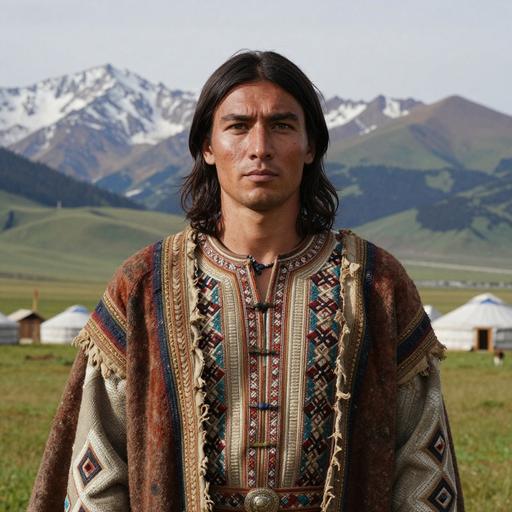
Portrait reconstruction of DA29
Ancient Individual

A man buried in Kazakhstan in the Middle Ages era

DA29
1200 CE - 1600 CE
Male
Golden Horde Period Kazakhstan (European Influence)
Kazakhstan
Scroll to begin
Chapter I

Identity

The biological and cultural markers that define this ancient individual

Sample ID

DA29

Date Range

1200 CE - 1600 CE

Biological Sex

Male

mtDNA Haplogroup

I1b

Y-DNA Haplogroup

R-BY160093

Cultural Period

Golden Horde Period Kazakhstan (European Influence)

Chapter II

Place

Where this individual was discovered

Country Kazakhstan
Locality Tian Shan. Central Steppe
Coordinates 43.0686, 68.2489
Chapter III

Time

When this individual lived in the broader context of human history

DA29 1200 CE - 1600 CE
Chapter IV

Story

The narrative of this ancient life

The Golden Horde period in Kazakhstan is a fascinating historical era, reflecting a blend of steppe traditions, Mongol governance, Islamic influence, and a degree of European interaction. The Golden Horde was a Mongol and later Turkicized khanate established in the western part of the Mongol Empire, covering parts of modern Russia, Ukraine, and Kazakhstan. This period lasted roughly from the mid-13th century until the end of the 15th century, though its influence lingered even later in some regions.

Origins and Formation

The Golden Horde was founded by Batu Khan, a grandson of Genghis Khan, following the Mongol conquests in Eastern Europe. As Genghis Khan's empire was divided among his heirs, the western portion became known as the Ulus of Jochi, named after Genghis Khan's eldest son. Batu Khan expanded this domain vigorously, creating what became the Golden Horde.

Governance and Administration

The political structure of the Golden Horde was heavily influenced by Mongol administrative practices, which included efficient taxation and a robust communication network. The Mongols were adept at utilizing the skills of local administrators and artisans, allowing them to govern vast territories effectively. This administrative acumen was maintained in Kazakhstan, with cities like Sighnaq serving as regional centers of power.

Cultural and Religious Influences

Initially, the Golden Horde remained largely shamanistic, in line with traditional Mongol beliefs. However, the gradual conversion to Islam began in the late 13th century and accelerated under subsequent khans, particularly under the reign of Berke Khan. Islamic missionaries and scholars had a profound impact, with Islam becoming a unifying cultural and religious force, further solidifying the link between the Golden Horde and the Islamic world.

Economic Activities

The Golden Horde’s location was strategically significant, straddling crucial trade routes between Europe and Asia. This geography facilitated vibrant trade activities, with goods such as silk, spices, and furs passing through Kazakh territories. The Silk Road, a significant artery of trade, contributed to the prosperity of cities within the Horde.

European Interactions

Although the primary interactions were with fellow Mongol khanates and Islamic states, the Golden Horde also had notable engagements with European states. Diplomatic and trade relations were established, particularly with Venice and Genoa, which had trading colonies in the Crimea. These European contacts brought new cultural influences and technological exchanges to the Horde’s territories, including Kazakhstan.

Legacy and Influence

The collapse of the centralized power of the Golden Horde in the late 15th century led to a fragmentation into several smaller khanates, including the Kazakh Khanate. This period is crucial for understanding the development of Kazakh identity and statehood. The legacy of the Golden Horde is visible in the linguistic, cultural, and political developments of the Central Asian steppes, influencing the evolution of Turkic-Mongol societies.

Conclusion

The Golden Horde period in Kazakhstan represents an era of cultural fusion and economic prosperity, bridging the nomadic traditions of the Mongols with Islamic and European influences. It laid the groundwork for subsequent developments in the region, setting the stage for the rise of new powers and cultural identities. The blending of ideas and practices during this time had an enduring impact on the history and culture of Kazakhstan and its people.

Chapter V

Genetics

The genetic ancestry of this ancient individual

Ancient Genetic Admixture

This analysis compares the DNA profile of DA29 with ancient reference populations, showing the genetic composition in terms of prehistoric ancestral groups.

European Hunter-Gatherers 46.5%
Western Steppe Pastoralists 35.4%
Neolithic Farmers 15.6%
Ancient Asians 2.6%

Modern Genetic Admixture

This analysis compares the DNA profile with present-day reference populations, showing what percentage of genetic makeup resembles modern populations from different regions.

Europe 100.0%
Northwestern European 36.4%
Finnish 15.0%
English 10.7%
Scandinavian 9.6%
Northwestern European 1.1%
Eastern European 34.5%
Southern European 29.1%
Balkan 29.1%

Closest Modern Populations

These are the modern populations showing the closest statistical alignment to A man buried in Kazakhstan in the Middle Ages era, ranked by genetic distance. Lower distance values indicate closer statistical similarity.

1
Lithuanian PA
1.2806
2
Belarusian
1.4829
3
Lithuanian VA
1.6919
4
Russian Smolensk
1.7387
5
Ukrainian Chernihiv
1.8693
6
Russian Kursk
1.8978
7
Russian Pskov
1.9260
8
Ukrainian Rivne
2.1052
9
Russian Voronez
2.1236
10
Russian Orel
2.1357
Chapter VI

Context

Other ancient individuals connected to this sample

Sources

References

Scientific publications and genetic data

Scientific Publication

137 ancient human genomes from across the Eurasian steppes

Authors Damgaard PB, Marchi N, Rasmussen S
Abstract

For thousands of years the Eurasian steppes have been a centre of human migrations and cultural change. Here we sequence the genomes of 137 ancient humans (about 1× average coverage), covering a period of 4,000 years, to understand the population history of the Eurasian steppes after the Bronze Age migrations. We find that the genetics of the Scythian groups that dominated the Eurasian steppes throughout the Iron Age were highly structured, with diverse origins comprising Late Bronze Age herders, European farmers and southern Siberian hunter-gatherers. Later, Scythians admixed with the eastern steppe nomads who formed the Xiongnu confederations, and moved westward in about the second or third century BC, forming the Hun traditions in the fourth-fifth century AD, and carrying with them plague that was basal to the Justinian plague. These nomads were further admixed with East Asian groups during several short-term khanates in the Medieval period. These historical events transformed the Eurasian steppes from being inhabited by Indo-European speakers of largely West Eurasian ancestry to the mostly Turkic-speaking groups of the present day, who are primarily of East Asian ancestry.

G25 Coordinates

The G25 coordinates for sample DA29 can be used for detailed admixture analysis in our G25 Studio tool.

DA29,0.13485794,0.12364276,0.07567148,0.07084212,0.03889614,0.02945162,0.01081868,0.01366376,-0.00182334,-0.02651944,-0.00763054,-0.00746982,0.01795932,0.02662636,-0.00830182,0.0050266,0.0018268,-0.00014336,0.00483552,0.00221076,0.00110434,-0.0030097,0.00962468,-0.00265684,-0.0019579
Analyze in G25 Studio
Use code for 40% off Expires Feb 26