Menu
Store
Blog
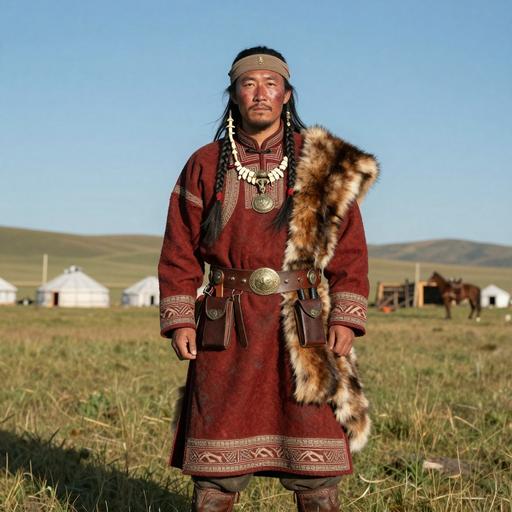
Portrait reconstruction of DA43
Ancient Individual

A man buried in Mongolia in the Iron Age era

DA43
400 BCE - 100 CE
Male
Xiongnu Period Mongolia
Mongolia
Scroll to begin
Chapter I

Identity

The biological and cultural markers that define this ancient individual

Sample ID

DA43

Date Range

400 BCE - 100 CE

Biological Sex

Male

mtDNA Haplogroup

D4a6

Y-DNA Haplogroup

O-MF2463

Cultural Period

Xiongnu Period Mongolia

Chapter II

Place

Where this individual was discovered

Country Mongolia
Locality Siberia. Tungus & Eastern Steppe
Chapter III

Time

When this individual lived in the broader context of human history

DA43 400 BCE - 100 CE
Chapter IV

Story

The narrative of this ancient life

The Xiongnu period is a fascinating and pivotal era in the history of Mongolia and the wider Central Asian steppe region. It refers to the time when the Xiongnu confederation rose to prominence, emerging as a dominant power in the eastern Eurasian Steppe from around the 3rd century BCE to the late 1st century CE. This era is marked by the complex interplay of nomadic and sedentary cultures, military prowess, socio-political organization, and cross-cultural interactions that would shape the historical trajectory of the region.

Historical Context

Origins and Rise

The Xiongnu were one of the earliest of the great nomadic empires of Inner Asia. Emerging in Mongolia, their origins remain the subject of scholarly debate, often intertwined with those of other nomadic groups in the vast Eurasian Steppe. The Xiongnu are first clearly documented in Chinese historical sources, which describe them as formidable adversaries of the Han Dynasty.

The rise of the Xiongnu is often linked to the unification efforts of a leader named Modu Chanyu, who is credited with consolidating various tribes into a formidable confederation around 209 BCE. Under Modu Chanyu and his successors, the Xiongnu engaged in extensive military campaigns and diplomatic maneuvers, expanding their influence across the steppe and into parts of China and Central Asia.

Geography and Environment

Mongolia's harsh but resource-rich landscape of vast steppes, deserts, and mountain ranges played a crucial role in shaping the Xiongnu way of life. The region requires adaptability to extreme climates and provides ample grazing land, which was essential for the nomadic pastoralist lifestyle of the Xiongnu. Their mobility allowed them to exploit these resources effectively, supporting large populations and military forces.

Cultural and Social Organization

Nomadic Lifestyle

The Xiongnu, like other nomadic groups, were primarily pastoralists, relying on herds of horses, cattle, sheep, goats, and camels. Their society was highly mobile, moving seasonally to access pastures and water resources. This mobility was central to their economic system and military strategy, providing flexibility and resilience in the face of environmental and human challenges.

Social Structure and Leadership

The Xiongnu society was organized into a hierarchical structure with a nucleus of noble families at the top. The Chanyu served as the supreme leader, akin to an emperor, with subordinate leaders managing different tribes or regions within the confederation. Alliances were key to maintaining power, often secured through marriage and tribute systems.

The confederation was a sophisticated political entity for its time, capable of large-scale organization and sustained military campaigns. This political structure allowed the Xiongnu to wield influence over vast territories and diverse peoples.

Interactions with China and Other Cultures

Conflicts and Diplomacy

The Xiongnu are famous for their interactions with the Han Dynasty, marked by both conflict and cooperation. The Han engaged in protracted military campaigns against the Xiongnu, building fortifications such as parts of what became the Great Wall of China to protect against raids. However, diplomacy also played a role, with exchange of gifts, marriage alliances, and treaties like the heqin, where Chinese princesses were married to Xiongnu leaders for peace.

Cultural Exchange

These interactions facilitated cultural exchanges, with the Xiongnu adopting some aspects of Chinese art, technology, and even administrative practices. Simultaneously, they influenced Chinese society, as seen in the military and strategic adjustments made by the Han to deal with the Xiongnu threat.

Economic Activities

Trade and Tribute

The Xiongnu controlled significant portions of the Silk Road, contributing to their wealth and power. They engaged in trade not only with China but also with other nomadic and sedentary societies across Central Asia. They traded horses, furs, and even slaves for silk, grain, and other luxury goods from China and other civilizations.

Additionally, as a demonstration of their power, the Xiongnu extracted tribute from neighboring tribes and states, further enriching their empire.

Decline and Legacy

Internal Strife and Fragmentation

By the 1st century CE, internal strife and pressures from the Han Dynasty led to the fragmentation of the Xiongnu confederation. Disputes over succession weakened central authority, and some groups splintered off, migrating into other areas of Asia.

Legacy

Despite their decline, the Xiongnu left an indelible mark on the history of Central Asia. They served as a blueprint for later nomadic empires, including the Turks and Mongols, in military and political organization. The legacy of the Xiongnu is also reflected in the complex interactions between nomadic and sedentary civilizations throughout Asian history.

In summary, the Xiongnu period in Mongolia was a transformative time that showcases the dynamic relationships between nomadic cultures and the sedentary civilizations around them. Their social structure, military strategies, and interactions helped define a significant era in the history of the Eurasian Steppe.

Chapter V

Genetics

The genetic ancestry of this ancient individual

Ancient Genetic Admixture

This analysis compares the DNA profile of DA43 with ancient reference populations, showing the genetic composition in terms of prehistoric ancestral groups.

Ancient Asians 96.9%
Neolithic Farmers 3.1%

Modern Genetic Admixture

This analysis compares the DNA profile with present-day reference populations, showing what percentage of genetic makeup resembles modern populations from different regions.

Asia 98.2%
Chinese & Southeast Asian 78.0%
Chinese 72.0%
Tibetan 6.0%
Japanese & Korean 9.5%
Japanese 9.5%
Northern Asian 9.4%
Mongolian 9.1%
Central Asian, Northern Indian & Pakistani 0.9%
Central Asian 0.9%
Europe 1.2%
Southern European 1.2%
Sardinian 1.2%
Africa 0.6%
West African 0.6%

Closest Modern Populations

These are the modern populations showing the closest statistical alignment to A man buried in Mongolia in the Iron Age era, ranked by genetic distance. Lower distance values indicate closer statistical similarity.

1
Manchu
3.1201
2
Han Shandong
3.1875
3
Manchu Jinzhou
3.1964
4
Han Sichuan
3.2010
5
Han Jiangsu
3.2449
6
Han Hubei
3.2814
7
Manchu Liaoning
3.4064
8
Han Guizhou
3.4552
9
Bai
3.4668
10
Han Zhejiang
3.5198
Chapter VI

Context

Other ancient individuals connected to this sample

Sources

References

Scientific publications and genetic data

Scientific Publication

137 ancient human genomes from across the Eurasian steppes

Authors Damgaard PB, Marchi N, Rasmussen S
Abstract

For thousands of years the Eurasian steppes have been a centre of human migrations and cultural change. Here we sequence the genomes of 137 ancient humans (about 1× average coverage), covering a period of 4,000 years, to understand the population history of the Eurasian steppes after the Bronze Age migrations. We find that the genetics of the Scythian groups that dominated the Eurasian steppes throughout the Iron Age were highly structured, with diverse origins comprising Late Bronze Age herders, European farmers and southern Siberian hunter-gatherers. Later, Scythians admixed with the eastern steppe nomads who formed the Xiongnu confederations, and moved westward in about the second or third century BC, forming the Hun traditions in the fourth-fifth century AD, and carrying with them plague that was basal to the Justinian plague. These nomads were further admixed with East Asian groups during several short-term khanates in the Medieval period. These historical events transformed the Eurasian steppes from being inhabited by Indo-European speakers of largely West Eurasian ancestry to the mostly Turkic-speaking groups of the present day, who are primarily of East Asian ancestry.

G25 Coordinates

The G25 coordinates for sample DA43 can be used for detailed admixture analysis in our G25 Studio tool.

DA43,0.0227242,-0.4448436,0.00310362,-0.06036162,0.05657012,0.02085962,0.00549884,0.00075504,-0.0080176,0.00398658,-0.0448393,-0.00448936,0.00454496,-0.0069145,-0.0035621,-0.00263946,0.00232174,-0.001547,-0.00454212,-0.00351926,0.01216986,0.00333042,0.00954488,0.0001511,-9.383E-05
Analyze in G25 Studio
Use code for 40% off Expires Feb 26