Menu
Store
Blog
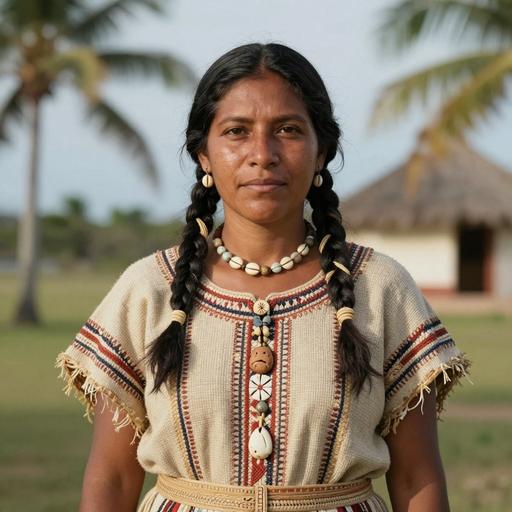
Portrait reconstruction of ELM001
Ancient Individual

A woman buried in Cuba in the Pre-Columbian Caribbean era

ELM001
1403 CE - 1439 CE
Female
Ceramic Period El Morrillo, Cuba
Cuba
Scroll to begin
Chapter I

Identity

The biological and cultural markers that define this ancient individual

Sample ID

ELM001

Date Range

1403 CE - 1439 CE

Biological Sex

Female

mtDNA Haplogroup

C1b2

Cultural Period

Ceramic Period El Morrillo, Cuba

Chapter II

Place

Where this individual was discovered

Country Cuba
Locality Matanzas. El Morrillo
Chapter III

Time

When this individual lived in the broader context of human history

ELM001 1403 CE - 1439 CE
Chapter IV

Story

The narrative of this ancient life

The Ceramic Period in Cuba, particularly at sites like El Morrillo, is an essential era that provides insight into the life and culture of the Arawak people. This period roughly spans from 500 CE to the time of European contact in the late 15th century. The Arawak, including subgroups such as the Taíno, were the indigenous peoples of the Caribbean and parts of South America, and they played a significant role in the pre-Columbian history of Cuba.

Cultural and Social Structure

  1. Settlement Patterns:

    • The Arawak people, during the Ceramic Period, established semi-permanent to permanent villages, often near water sources like rivers or coastlines. El Morrillo, situated in such a location, serves as an archaeological testament to these settlement patterns.
    • Villages typically consisted of small clusters of circular or oval dwellings made with wooden posts and thatched roofs, known as bohíos. The more significant structures, serving communal or ceremonial purposes, were larger and sometimes rectangular, called caneyes.
  2. Social Organization:

    • Their society was organized into a hierarchical structure led by a cacique (chief), who was responsible for governance, religious rituals, and the distribution of resources.
    • The community was comprised of various roles, including farmers, fishermen, craftsmen, warriors, and religious leaders (behiques or shamans).

Material Culture

  1. Ceramics:

    • Ceramic production is a defining characteristic of this period. Arawak pottery, including items found at sites like El Morrillo, exhibits intricate designs and craftsmanship.
    • The pottery was often made using coiling and molding techniques and decorated with incised patterns, painted designs, and sometimes anthropomorphic or zoomorphic figures. Vessels were used for cooking, storage, and ceremonial purposes.
  2. Tools and Artifacts:

    • Stone, shell, and bone tools were common, including axes, adzes, and various implements for fishing and hunting. These tools highlight the Arawaks' adaptability and understanding of their natural environment.
    • Artifacts such as zemis (carved figures representing deities) reflect the spiritual and religious life of the Arawak people.

Economy and Subsistence

  1. Agriculture and Diet:

    • The Arawak of the Ceramic Period practiced slash-and-burn agriculture, cultivating crops such as cassava (manioc), maize, sweet potatoes, beans, and squash. Cassava was particularly significant and staple in their diet.
    • They also engaged in fishing, hunting, and gathering, exploiting the rich biodiversity of Cuba's coasts, rivers, and forests. Marine resources, including fish, mollusks, and crustaceans, were vital components of their diet.
  2. Trade:

    • Evidence suggests a network of trade existed between different Arawak communities across the Caribbean. They exchanged goods such as ceramics, precious stones, and foodstuffs.
    • Trade was not only economic but also facilitated cultural and social exchanges, influencing art, technology, and societal norms.

Religion and Spirituality

  1. Belief Systems:

    • The Arawak maintained a polytheistic belief system in which they worshipped a pantheon of deities associated with natural elements and ancestors.
    • Religious practices included rituals, ceremonies, and feasts conducted by spiritual leaders, where music, dance, and the consumption of hallucinogenic substances like cohoba played a part.
  2. Burial Practices:

    • Mortuary practices reflect their beliefs in an afterlife. The dead were sometimes buried in a fetal position, accompanied by grave goods, which could include pottery, tools, and personal ornaments.

Significance of El Morrillo

El Morrillo stands as a crucial site for understanding the Arawak during the Ceramic Period in Cuba. It provides valuable archaeological records that help piece together the daily life, spiritual beliefs, and societal structure of the Arawak people. Examination of this site has contributed not only to the historical understanding of pre-Columbian Cuba but also to the broader Caribbean context as it relates to indigenous cultures prior to European colonization. The study of sites like El Morrillo thus remains essential for preserving and interpreting the rich cultural heritage of the region's first inhabitants.

Chapter V

Genetics

The genetic ancestry of this ancient individual

Ancient Genetic Admixture

This analysis compares the DNA profile of ELM001 with ancient reference populations, showing the genetic composition in terms of prehistoric ancestral groups.

Ancient Native Americans 80.8%
Ancient Asians 16.4%
Western Steppe Pastoralists 2.8%

Modern Genetic Admixture

This analysis compares the DNA profile with present-day reference populations, showing what percentage of genetic makeup resembles modern populations from different regions.

America 81.1%
America 81.1%
Native American 81.1%
Oceania 18.9%
Melanesian 18.9%
Papuan 18.9%

Closest Modern Populations

These are the modern populations showing the closest statistical alignment to A woman buried in Cuba in the Pre-Columbian Caribbean era, ranked by genetic distance. Lower distance values indicate closer statistical similarity.

1
Piapoco
1.7767
2
Aymara
2.0057
3
Wichi
2.0802
4
Yukpa
2.2353
5
Bolivian Lapaz
3.0497
6
Karitiana
3.2753
7
Colla
3.5458
8
Cachi
4.0802
9
Surui
4.3254
10
Mixe
4.4063
Chapter VI

Context

Other ancient individuals connected to this sample

Sources

References

Scientific publications and genetic data

Scientific Publication

Genomic insights into the early peopling of the Caribbean

Authors Nägele K, Posth C, Iraeta Orbegozo M
Abstract

The Caribbean was one of the last regions of the Americas to be settled by humans, but where they came from and how and when they reached the islands remain unclear. We generated genome-wide data for 93 ancient Caribbean islanders dating between 3200 and 400 calibrated years before the present and found evidence of at least three separate dispersals into the region, including two early dispersals into the Western Caribbean, one of which seems connected to radiation events in North America. This was followed by a later expansion from South America. We also detected genetic differences between the early settlers and the newcomers from South America, with almost no evidence of admixture. Our results add to our understanding of the initial peopling of the Caribbean and the movements of Archaic Age peoples in the Americas.

G25 Coordinates

The G25 coordinates for sample ELM001 can be used for detailed admixture analysis in our G25 Studio tool.

ELM001,0.0566918,-0.31582846,0.11204702,0.10211766,-0.11544552,-0.01340072,-0.30566644,-0.3590513,-0.01480674,-0.01647936,0.00142036,-0.00093642,-0.0014313,0.0253563,-0.00595422,-0.00072954,0.00624818,0.00290964,0.00075462,-0.00173322,-0.00061776,0.0074566,-0.00240166,-0.00535158,-0.00582963
Analyze in G25 Studio
Use code for 40% off Expires Feb 27