Menu
Store
Blog
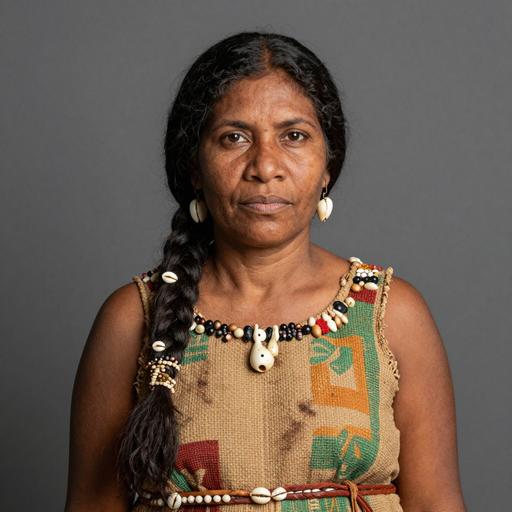
Portrait reconstruction of I13255
Ancient Individual

A woman buried in Bahamas in the Pre-Columbian Caribbean era

I13255
900 CE - 1500 CE
Female
Ceramic Period Crooked Island, Bahamas
Bahamas
Scroll to begin
Chapter I

Identity

The biological and cultural markers that define this ancient individual

Sample ID

I13255

Date Range

900 CE - 1500 CE

Biological Sex

Female

mtDNA Haplogroup

Not available

Cultural Period

Ceramic Period Crooked Island, Bahamas

Chapter II

Place

Where this individual was discovered

Country Bahamas
Locality Unknown Site (Crooked Island)
Chapter III

Time

When this individual lived in the broader context of human history

I13255 900 CE - 1500 CE
Chapter IV

Story

The narrative of this ancient life

The Ceramic Period on Crooked Island, part of the larger Bahamian archipelago, represents a significant era in the pre-Columbian history of the indigenous Taíno people. This period, which spans approximately from 500 CE to the contact with Europeans in the late 15th century, is characterized by the development and utilization of ceramics, marking an evolution in the lifestyle, culture, and technological advancements of the Taíno.

Cultural and Historical Context

The Taíno were an Arawakan-speaking people who migrated from the northern coast of South America and eventually spread throughout the Greater and Lesser Antilles, including the Bahamas. By the time of the Ceramic Period, they had established a rich cultural presence in the Caribbean with distinct social, economic, and religious structures.

Crooked Island, located in the Southeastern Bahamas, served as a critical waypoint and settlement for the Taíno due to its strategic positioning and resource availability. This island was part of the \Lucayan" subgroup of the Taíno people, named after the native term for the Bahamian archipelago.

Ceramic Technology

The hallmark of this period is the introduction and refinement of ceramic pottery. The Taíno crafted pottery using local resources, including clay and temper materials like crushed shell or sand. These ceramics were often utilitarian in nature, used for cooking, storage, and ceremonial purposes.

Taíno ceramics from this era are renowned for their intricate designs and decorations, which often included geometric patterns, anthropomorphic figures, and incised motifs. These designs not only served an aesthetic purpose but also had cultural and possibly spiritual significance, reflecting the Taíno's interaction with their environment, beliefs, and ancestral traditions.

Social Structure and Economy

During the Ceramic Period, the Taíno on Crooked Island maintained a highly organized society. The social hierarchy consisted of a cacique (chief) who governed the community, nitainos (nobles), and naborias (commoners). This stratification was pivotal in organizing labor, trade, and religious activities.

The economy of the Taíno was based on a combination of agriculture, fishing, and trade. They cultivated crops such as cassava, maize, beans, and squash using sophisticated agricultural techniques like conuco (raised mound farming) to maximize yield. Additionally, the surrounding waters provided a bounty of marine life, which was crucial to their diet and trade networks.

Trading networks extended across the Caribbean, allowing the Taíno to exchange goods such as ceramics, stone tools, shells, and foodstuffs with other island communities. This trade fostered cultural exchanges and the spread of technological innovations.

Religious and Cultural Practices

Religion played a central role in the daily life and governance of the Taíno on Crooked Island. They practiced animism, believing that spirits inhabited natural elements such as rocks, trees, and rivers. Religious ceremonies often involved rituals led by a shaman, or behique, who communicated with these spirits.

The zemi, a carved figure representing deities or ancestor spirits, was an essential religious artifact. These zemis were often crafted from stone, bone, wood, or clay and were integral to Taíno spiritual practices and societal identity.

Art and Symbolism

Art was an integral aspect of Taíno culture during the Ceramic Period. Besides ceramics, they adorned themselves and their surroundings with artwork crafted from bone, shell, stone, and wood. The Taíno were skilled in crafting small, intricate objects, including pendants, belts, and other decorative items.

Their art is characterized by symbolic representations that provide insights into their cosmology. Common motifs included coiled serpents, the sun, the moon, and other celestial bodies, highlighting the Taíno's reverence for natural cycles and their environment.

Legacy and Impact

The impact of the Ceramic Period on Crooked Island and the broader Bahamian and Caribbean region is profound. The technological advancements, cultural practices, and societal structures established during this era laid the groundwork for later developments and interactions with European explorers.

By the time of European contact, Taíno society was highly developed, with rich traditions and a complex socio-political organization. The legacy of the Taíno during the Ceramic Period is visible in the lasting influence on Caribbean culture and the archaeological remnants that continue to be a focus of study to understand the pre-Columbian history of the region."

Chapter V

Context

Other ancient individuals connected to this sample

Sources

References

Scientific publications and genetic data

Scientific Publication

A genetic history of the pre-contact Caribbean

Authors Fernandes DM, Sirak KA, Ringbauer H
Abstract

Humans settled the Caribbean about 6,000 years ago, and ceramic use and intensified agriculture mark a shift from the Archaic to the Ceramic Age at around 2,500 years ago1-3. Here we report genome-wide data from 174 ancient individuals from The Bahamas, Haiti and the Dominican Republic (collectively, Hispaniola), Puerto Rico, Curaçao and Venezuela, which we co-analysed with 89 previously published ancient individuals. Stone-tool-using Caribbean people, who first entered the Caribbean during the Archaic Age, derive from a deeply divergent population that is closest to Central and northern South American individuals; contrary to previous work4, we find no support for ancestry contributed by a population related to North American individuals. Archaic-related lineages were >98% replaced by a genetically homogeneous ceramic-using population related to speakers of languages in the Arawak family from northeast South America; these people moved through the Lesser Antilles and into the Greater Antilles at least 1,700 years ago, introducing ancestry that is still present. Ancient Caribbean people avoided close kin unions despite limited mate pools that reflect small effective population sizes, which we estimate to be a minimum of 500-1,500 and a maximum of 1,530-8,150 individuals on the combined islands of Puerto Rico and Hispaniola in the dozens of generations before the individuals who we analysed lived. Census sizes are unlikely to be more than tenfold larger than effective population sizes, so previous pan-Caribbean estimates of hundreds of thousands of people are too large5,6. Confirming a small and interconnected Ceramic Age population7, we detect 19 pairs of cross-island cousins, close relatives buried around 75 km apart in Hispaniola and low genetic differentiation across islands. Genetic continuity across transitions in pottery styles reveals that cultural changes during the Ceramic Age were not driven by migration of genetically differentiated groups from the mainland, but instead reflected interactions within an interconnected Caribbean world1,8.

Use code for 40% off Expires Feb 27