Menu
Store
Blog
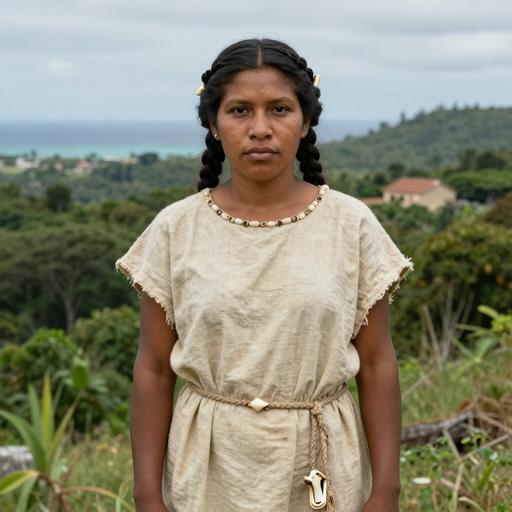
Portrait reconstruction of I10126
Ancient Individual

A woman buried in Dominican Republic in the Pre-Columbian Caribbean era

I10126
1192 BCE - 1005 BCE
Female
Archaic Period Andres, Dominican Republic
Dominican Republic
Scroll to begin
Chapter I

Identity

The biological and cultural markers that define this ancient individual

Sample ID

I10126

Date Range

1192 BCE - 1005 BCE

Biological Sex

Female

mtDNA Haplogroup

D1

Cultural Period

Archaic Period Andres, Dominican Republic

Chapter II

Place

Where this individual was discovered

Country Dominican Republic
Locality Andres
Chapter III

Time

When this individual lived in the broader context of human history

I10126 1192 BCE - 1005 BCE
Chapter IV

Story

The narrative of this ancient life

The Archaic Period, specifically in regions such as the Dominican Republic, represents an era predating the Taíno culture, typically characterized by early human habitation before the widespread development of agriculture and large, complex societies. The Archaic Age in the Caribbean, including areas like Andrés in the Dominican Republic, presents a fascinating glimpse into prehistoric times, often marked by the activities of early hunter-gatherer communities.

Archaeological and Historical Context

Timeline and Migration

The Archaic Period in the Caribbean, including the Dominican Republic, spans approximately from 5000 BCE to 500 CE. The exact timeline can vary regionally, but this period broadly represents the era before the significant development of agriculture and the rise of complex societies characterized by the Taíno culture. Migration patterns indicate that the initial inhabitants likely arrived from mainland South America, moving through the Lesser Antilles and gradually occupying the Greater Antilles, including what is now known as the Dominican Republic.

Material Culture

  1. Lithic Tools: The early inhabitants of the Archaic Period are often distinguished by their use of lithic tools. These tools were typically made from locally available materials such as flint, chert, and other stones. The artifacts include scrapers, blades, and spear points, which depict their subsistence strategies centering on hunting and gathering.

  2. Shell Middens and Tools: Archaeological findings in sites like Andrés have included shell middens that suggest the consumption of marine resources. Shell tools, such as beads and other ornaments, indicate both utilitarian and cultural uses. Shells were also used for making hoes and other types of agricultural tools, reflecting a gradual shift to horticultural activities.

  3. Pottery: While pottery becomes more prevalent during the later Ceramic Age, early forms of rudimentary pottery have occasionally been discovered. This indicates a transitionary phase in social practices and craftsmanship.

Subsistence and Lifestyle

Economy

The Archaic period communities were primarily hunter-gatherers, with evidence pointing towards the exploitation of terrestrial and marine resources. The diet consisted of fish, mollusks, small game, fruits, and roots. The reliance on both terrestrial and coastal resources suggests a semi-nomadic lifestyle with settlements located near rich, diverse ecological niches.

Social Organization

The social structures of Archaic societies were likely egalitarian, with small groups or bands cooperating to exploit their environments. Evidence of burial customs, though limited, hints at developing spiritual and ritualistic practices, indicative of increasingly complex social structures as the period progressed.

Environment and Adaptation

Climate and Vegetation

During this era, the climate of the Greater Antilles, including the Dominican Republic, was likely similar to today but with less anthropogenic alteration. The verdant tropical forests and rich coastal ecosystems provided a conducive environment for early settlers. Adaptation to these environments was critical, with settlement patterns often revolving around abundant food sources, such as coastal areas and riverine systems.

Transition to Taíno Culture

As the Archaic Period progressed, there was a gradual evolution of cultural practices that led to the formation of the Taíno culture, which became prominent around 600 to 700 CE. This transition involved significant changes in subsistence, including the domestication of plants like cassava and the development of more complex societal structures. The introduction of agriculture marked a profound shift from the reliance on foraging.

Conclusion

The Archaic Period in the Dominican Republic represents a formative era of human history, providing vital insights into the adaptability and resilience of early human communities. By examining the archaeological evidence from regions like Andrés, historians and archaeologists can reconstruct the lifeways of these early inhabitants and understand the origins and development of the rich cultural heritage that ultimately culminated in the Taíno civilization. The enduring legacy of these early settlers is evident in the ongoing archaeological and anthropological interest in their lives and environments.

Chapter V

Genetics

The genetic ancestry of this ancient individual

Ancient Genetic Admixture

This analysis compares the DNA profile of I10126 with ancient reference populations, showing the genetic composition in terms of prehistoric ancestral groups.

Ancient Native Americans 79.8%
Ancient Asians 20.2%

Modern Genetic Admixture

This analysis compares the DNA profile with present-day reference populations, showing what percentage of genetic makeup resembles modern populations from different regions.

America 91.2%
America 91.2%
Native American 91.2%
Asia 8.6%
Northern Asian 4.0%
Siberian 4.0%
Chinese & Southeast Asian 2.7%
Chinese 2.4%
Japanese & Korean 1.9%
Japanese 1.9%

Closest Modern Populations

These are the modern populations showing the closest statistical alignment to A woman buried in Dominican Republic in the Pre-Columbian Caribbean era, ranked by genetic distance. Lower distance values indicate closer statistical similarity.

1
Aymara
2.6728
2
Mixe
2.8262
3
Bolivian Lapaz
2.8743
4
Piapoco
3.0051
5
Yukpa
3.1135
6
Cachi
3.4296
7
Colla
3.4431
8
Wichi
3.5876
9
Pima
3.7169
10
Huichol
3.8538
Chapter VI

Context

Other ancient individuals connected to this sample

Sources

References

Scientific publications and genetic data

Scientific Publication

A genetic history of the pre-contact Caribbean

Authors Fernandes DM, Sirak KA, Ringbauer H
Abstract

Humans settled the Caribbean about 6,000 years ago, and ceramic use and intensified agriculture mark a shift from the Archaic to the Ceramic Age at around 2,500 years ago1-3. Here we report genome-wide data from 174 ancient individuals from The Bahamas, Haiti and the Dominican Republic (collectively, Hispaniola), Puerto Rico, Curaçao and Venezuela, which we co-analysed with 89 previously published ancient individuals. Stone-tool-using Caribbean people, who first entered the Caribbean during the Archaic Age, derive from a deeply divergent population that is closest to Central and northern South American individuals; contrary to previous work4, we find no support for ancestry contributed by a population related to North American individuals. Archaic-related lineages were >98% replaced by a genetically homogeneous ceramic-using population related to speakers of languages in the Arawak family from northeast South America; these people moved through the Lesser Antilles and into the Greater Antilles at least 1,700 years ago, introducing ancestry that is still present. Ancient Caribbean people avoided close kin unions despite limited mate pools that reflect small effective population sizes, which we estimate to be a minimum of 500-1,500 and a maximum of 1,530-8,150 individuals on the combined islands of Puerto Rico and Hispaniola in the dozens of generations before the individuals who we analysed lived. Census sizes are unlikely to be more than tenfold larger than effective population sizes, so previous pan-Caribbean estimates of hundreds of thousands of people are too large5,6. Confirming a small and interconnected Ceramic Age population7, we detect 19 pairs of cross-island cousins, close relatives buried around 75 km apart in Hispaniola and low genetic differentiation across islands. Genetic continuity across transitions in pottery styles reveals that cultural changes during the Ceramic Age were not driven by migration of genetically differentiated groups from the mainland, but instead reflected interactions within an interconnected Caribbean world1,8.

G25 Coordinates

The G25 coordinates for sample I10126 can be used for detailed admixture analysis in our G25 Studio tool.

I10126,0.05507628,-0.32199454,0.1099114,0.09665532,-0.11284418,-0.01399254,-0.29276354,-0.34454824,-0.01427624,-0.01586044,0.00067262,-0.00055348,-0.0012588,0.02469954,-0.00597774,-0.00027694,0.0058148,0.00374048,0.00137432,-0.0016953,-0.0003138,0.00680894,-0.00266444,-0.00438764,-0.00507186
Analyze in G25 Studio
Use code for 40% off Expires Feb 27