Menu
Store
Blog
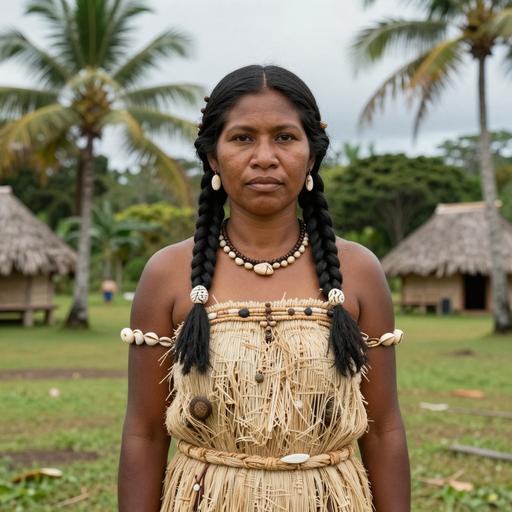
Portrait reconstruction of I1369
Ancient Individual

A woman buried in Vanuatu in the Early Prehistoric era

I1369
1070 BCE - 800 BCE
Female
Vanuatu 2,900 Years Ago
Vanuatu
Scroll to begin
Chapter I

Identity

The biological and cultural markers that define this ancient individual

Sample ID

I1369

Date Range

1070 BCE - 800 BCE

Biological Sex

Female

mtDNA Haplogroup

B4a1a1

Cultural Period

Vanuatu 2,900 Years Ago

Chapter II

Place

Where this individual was discovered

Country Vanuatu
Locality Efate. Teouma
Chapter III

Time

When this individual lived in the broader context of human history

I1369 1070 BCE - 800 BCE
Chapter IV

Story

The narrative of this ancient life

Approximately 2,900 years ago, the archipelago now known as Vanuatu was a key location for the expansion of Austronesian-speaking peoples across the Pacific. This period marks an important era in the history of Melanesia, characterized by the spread of culture, technology, and new ways of life that were part of the wider Lapita cultural complex.

Geography and Environment

Vanuatu during this time was much as it is today: a series of islands scattered across the South Pacific. The climate was tropical, with a mix of volcanic high islands and smaller, lower coral atolls. The fertile volcanic soil, lush rainforests, and abundant marine resources provided a rich environment for settlement and subsistence.

The Lapita Culture

The people of Vanuatu around 2,900 years ago were part of the Lapita culture, a society distinguished by its uniquely decorated pottery. The Lapita people are considered the ancestors of many modern Pacific Islanders. They are renowned for their navigational skills and were among the first to sail across vast stretches of ocean, colonizing remote islands.

Pottery and Artifacts: The Lapita pottery was characterized by intricate geometric designs, often made using dentate stamping. These artifacts have been crucial in identifying Lapita sites throughout the Pacific. Beyond pottery, they crafted tools from materials like stone, bone, and shell.

Social Structure and Settlements: Settlements during this time were likely organized into villages, often located near the coast where resources were readily available. Social structures were built around kinship, with extended families likely functioning as the primary social unit.

Subsistence and Economy

The economy of Vanuatu in this era was predominantly subsistence-based, relying heavily on both marine and terrestrial resources.

Agriculture: Agriculture was a cornerstone of Lapita sustenance, with root crops such as taro and yam cultivated alongside bananas and coconuts.

Fishing and Maritime Skills: The surrounding ocean provided an abundant supply of fish and other marine life, supplementing the diet and reinforcing the maritime nature of the society. The Lapita people are known to have been skilled at constructing outrigger canoes, which allowed them to travel and fish efficiently.

Inter-island Connections

Vanuatu’s location made it a critical juncture for inter-island trade and interaction. The Austronesian expansion carried not only people but also plants and animals across the Pacific. There is evidence of widespread trade networks and cultural exchanges between island groups, facilitated by advanced navigation techniques.

Cultural and Spiritual Beliefs

While specific details about the spiritual beliefs of Vanuatu's inhabitants from this period are scarce, it is likely they practiced animistic and ancestral worship traditions, similar to other Austronesian societies. Ritual sites and objects, such as those found at Lapita and other archaeological digs, suggest a complex spiritual life.

Legacy

The Austronesian expansion into Vanuatu marked a critical point in the human settlement of the Pacific. The legacy of the Lapita culture, with its skills in navigation, horticulture, and craftsmanship, laid the groundwork for the diverse cultures that would evolve in the Pacific Islands.

As the progenitors of the people who spread throughout much of Polynesia, Micronesia, and parts of Melanesia, the people settling Vanuatu were instrumental in the broader story of human exploration and adaptability. Today's Ni-Vanuatu people carry forward this rich heritage, embedded in languages, traditions, and the archaeological record scattered across the islands.

Chapter V

Genetics

The genetic ancestry of this ancient individual

Ancient Genetic Admixture

This analysis compares the DNA profile of I1369 with ancient reference populations, showing the genetic composition in terms of prehistoric ancestral groups.

Ancient Asians 97.4%
Ancient Oceanians 2.6%

Modern Genetic Admixture

This analysis compares the DNA profile with present-day reference populations, showing what percentage of genetic makeup resembles modern populations from different regions.

Asia 92.9%
Chinese & Southeast Asian 92.5%
Chinese 58.5%
Vietnamese 34.0%
Oceania 4.1%
Melanesian 4.1%
Papuan 4.1%
Africa 3.0%
West African 3.0%
Senegambian & Guinean 3.0%

Closest Modern Populations

These are the modern populations showing the closest statistical alignment to A woman buried in Vanuatu in the Early Prehistoric era, ranked by genetic distance. Lower distance values indicate closer statistical similarity.

1
Kinh Vietnam
2.4655
2
Dai
2.7393
3
Tai Lue
2.9414
4
Gelao
3.1998
5
Zhuang
3.3869
6
Mulam
3.4946
7
Maonan
3.7784
8
Changshan Yao Guizhou
3.7910
9
Dong Guizhou
3.9096
10
Baiku Yao Guizhou
3.9115
Chapter VI

Context

Other ancient individuals connected to this sample

Sources

References

Scientific publications and genetic data

Scientific Publication

Population Turnover in Remote Oceania Shortly after Initial Settlement

Authors Lipson M, Skoglund P, Spriggs M
Abstract

Ancient DNA from Vanuatu and Tonga dating to about 2,900-2,600 years ago (before present, BP) has revealed that the "First Remote Oceanians" associated with the Lapita archaeological culture were directly descended from the population that, beginning around 5000 BP, spread Austronesian languages from Taiwan to the Philippines, western Melanesia, and eventually Remote Oceania. Thus, ancestors of the First Remote Oceanians must have passed by the Papuan-ancestry populations they encountered in New Guinea, the Bismarck Archipelago, and the Solomon Islands with minimal admixture [1]. However, all present-day populations in Near and Remote Oceania harbor >25% Papuan ancestry, implying that additional eastward migration must have occurred. We generated genome-wide data for 14 ancient individuals from Efate and Epi Islands in Vanuatu from 2900-150 BP, as well as 185 present-day individuals from 18 islands. We find that people of almost entirely Papuan ancestry arrived in Vanuatu by around 2300 BP, most likely reflecting migrations a few hundred years earlier at the end of the Lapita period, when there is also evidence of changes in skeletal morphology and cessation of long-distance trade between Near and Remote Oceania [2, 3]. Papuan ancestry was subsequently diluted through admixture but remains at least 80%-90% in most islands. Through a fine-grained analysis of ancestry profiles, we show that the Papuan ancestry in Vanuatu derives from the Bismarck Archipelago rather than the geographically closer Solomon Islands. However, the Papuan ancestry in Polynesia-the most remote Pacific islands-derives from different sources, documenting a third stream of migration from Near to Remote Oceania.

G25 Coordinates

The G25 coordinates for sample I1369 can be used for detailed admixture analysis in our G25 Studio tool.

I1369,0.01478076,-0.43164208,-0.05056794,-0.05011412,0.11485786,0.04304946,-0.00040132,-0.00460038,-0.01949148,-0.0109274,0.0014989,0.00059344,0.00386918,-0.0091278,0.00170828,0.00243998,0.0081797,-0.00305074,-0.00180584,-0.0131801,0.01223172,0.01048762,0.01817236,0.00418282,0.00564417
Analyze in G25 Studio
Use code for 40% off Expires Feb 27