Menu
Store
Blog
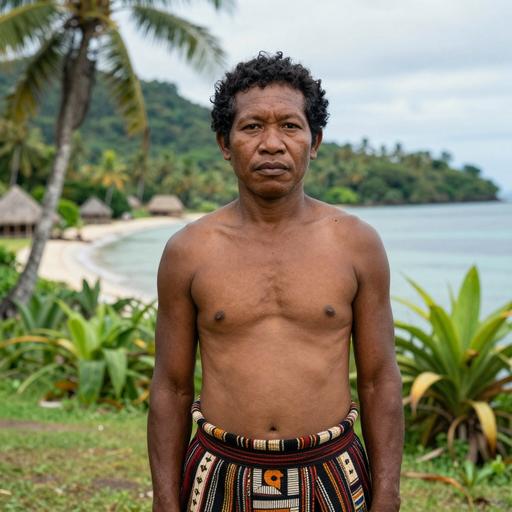
Portrait reconstruction of I4105
Ancient Individual

A man buried in Vanuatu in the Proto-Historic era

I4105
1650 CE - 1950 CE
Male
Vanuatu 150 Years Ago
Vanuatu
Scroll to begin
Chapter I

Identity

The biological and cultural markers that define this ancient individual

Sample ID

I4105

Date Range

1650 CE - 1950 CE

Biological Sex

Male

mtDNA Haplogroup

M28a-a

Y-DNA Haplogroup

O-M110

Cultural Period

Vanuatu 150 Years Ago

Chapter II

Place

Where this individual was discovered

Country Vanuatu
Locality Epi Island. Wam Bay
Chapter III

Time

When this individual lived in the broader context of human history

I4105 1650 CE - 1950 CE
Chapter IV

Story

The narrative of this ancient life

Vanuatu, an archipelago in the South Pacific Ocean, was part of the broader Melanesian cultural area 150 years ago, placing us around the year 1873. At this time, the islands of Vanuatu were deeply rooted in traditional Melanesian culture, characterized by a rich tapestry of social structures, spiritual beliefs, and interactions with European influences.

Geographic and Environmental Context

Vanuatu is composed of approximately 83 islands, offering a diverse landscape of rainforests, volcanoes, and coastal areas. These environments significantly influenced the lifestyle and culture of its inhabitants, providing abundant resources for fishing, farming, and hunting. The tropical climate supported a plethora of vegetation, and the islands were surrounded by rich marine biodiversity, which played a crucial role in the local diet and economy.

Social Structure and Organization

The social structure in Vanuatu was traditionally organized around kinship and clan systems. Extended families played a vital role in the communal way of life, with land held collectively rather than individually. Chiefs and elder councils wielded significant influence, overseeing social order, conflict resolution, and cultural rites. Leadership was often determined by lineage, personal achievement, and displays of skill or wisdom.

Language and Communication

The archipelago was home to a remarkable linguistic diversity, with over a hundred distinct languages spoken across the islands. This linguistic richness was a testament to the intricate network of small, often isolated communities. Bislama, an English-based creole language, was beginning to emerge as a lingua franca, bridging communication gaps among different language groups.

Cultural Practices and Beliefs

Spiritual Beliefs

Spirituality was interwoven with daily life in Vanuatu. Indigenous religious beliefs centered around a connection with the spirit world, ancestor worship, and nature-based deities. Rituals and ceremonies were essential in maintaining harmony with these spiritual entities, often involving offerings, dances, and chants. Sacred objects and totems were common, believed to hold protective powers and ancestral spirits.

Art and Music

Artistic expression in Vanuatu was vibrant and diverse, encompassing wood carving, weaving, and body adornment. Intricately carved masks and sculptures were used in ceremonies to represent spiritual beings. Music and dance were pivotal to cultural and ceremonial life, with traditional instruments such as slit drums and bamboo flutes accompanying rhythmic dances that narrated stories and celebrated communal events.

Economy and Subsistence

Agriculture was the backbone of Vanuatu's economy, with subsistence farming being the primary mode of food production. The cultivation of crops like yams, taro, and bananas was common, supplemented by fishing and hunting. Trade also played a crucial role, with inter-island exchange of goods like pigs, mats, and shells fostering connections between different communities.

European Contact and Influence

By 1873, European contact had begun to intensify, driven by the interests of missionaries, traders, and colonial powers. The introduction of Christianity was starting to transform religious and cultural landscapes, often clashing with traditional beliefs. At the same time, economic changes were underway, as European demand for sandalwood and labor for plantations abroad impacted indigenous ways of life.

Challenges and Changes

The influence of European settlers and colonists brought both opportunities and challenges. While new goods and technologies were introduced, there were also negative impacts, such as the spread of diseases to which the local population had no immunity, leading to significant demographic changes. The introduction of new social and political structures often disrupted traditional governance and social hierarchies.

Conclusion

Vanuatu 150 years ago was a society in a state of transition. While it retained much of its traditional Melanesian culture, it was also starting to adapt to external influences. The resilience and adaptability of its people were evident in how they navigated the complexities of maintaining their cultural heritage amidst growing global interactions. This period laid the foundation for the modern identity of Vanuatu, characterized by a blend of indigenous traditions and introduced influences.

Chapter V

Genetics

The genetic ancestry of this ancient individual

Ancient Genetic Admixture

This analysis compares the DNA profile of I4105 with ancient reference populations, showing the genetic composition in terms of prehistoric ancestral groups.

Ancient Oceanians 75.3%
Ancient Asians 21.4%
Neolithic Farmers 3.3%

Modern Genetic Admixture

This analysis compares the DNA profile with present-day reference populations, showing what percentage of genetic makeup resembles modern populations from different regions.

Oceania 88.1%
Melanesian 88.1%
Papuan 88.1%
Asia 9.9%
Central Asian, Northern Indian & Pakistani 7.0%
Indian 7.0%
Northern Asian 1.6%
Mongolian 1.3%
Chinese & Southeast Asian 1.4%
Indonesian Khmer Thai Myanma 1.4%
Africa 1.8%
Northern East African 0.9%
Eastern African 0.9%
West African 0.5%
Nigerian 0.5%

Closest Modern Populations

These are the modern populations showing the closest statistical alignment to A man buried in Vanuatu in the Proto-Historic era, ranked by genetic distance. Lower distance values indicate closer statistical similarity.

1
Papuan Highland B
4.8532
2
Australian
8.3949
3
Kosipe
10.5238
4
Papuan
12.6933
5
Koinanbe
12.7692
6
Papuan Highland A
13.2994
7
Nasoi
15.2882
8
Jarawa
47.6062
9
Onge
47.7596
10
Agta
49.4325
Chapter VI

Context

Other ancient individuals connected to this sample

Sources

References

Scientific publications and genetic data

Scientific Publication

Population Turnover in Remote Oceania Shortly after Initial Settlement

Authors Lipson M, Skoglund P, Spriggs M
Abstract

Ancient DNA from Vanuatu and Tonga dating to about 2,900-2,600 years ago (before present, BP) has revealed that the "First Remote Oceanians" associated with the Lapita archaeological culture were directly descended from the population that, beginning around 5000 BP, spread Austronesian languages from Taiwan to the Philippines, western Melanesia, and eventually Remote Oceania. Thus, ancestors of the First Remote Oceanians must have passed by the Papuan-ancestry populations they encountered in New Guinea, the Bismarck Archipelago, and the Solomon Islands with minimal admixture [1]. However, all present-day populations in Near and Remote Oceania harbor >25% Papuan ancestry, implying that additional eastward migration must have occurred. We generated genome-wide data for 14 ancient individuals from Efate and Epi Islands in Vanuatu from 2900-150 BP, as well as 185 present-day individuals from 18 islands. We find that people of almost entirely Papuan ancestry arrived in Vanuatu by around 2300 BP, most likely reflecting migrations a few hundred years earlier at the end of the Lapita period, when there is also evidence of changes in skeletal morphology and cessation of long-distance trade between Near and Remote Oceania [2, 3]. Papuan ancestry was subsequently diluted through admixture but remains at least 80%-90% in most islands. Through a fine-grained analysis of ancestry profiles, we show that the Papuan ancestry in Vanuatu derives from the Bismarck Archipelago rather than the geographically closer Solomon Islands. However, the Papuan ancestry in Polynesia-the most remote Pacific islands-derives from different sources, documenting a third stream of migration from Near to Remote Oceania.

G25 Coordinates

The G25 coordinates for sample I4105 can be used for detailed admixture analysis in our G25 Studio tool.

I4105,-0.04044086,-0.24421172,-0.23355418,0.25628176,0.16902442,-0.40673996,-0.00281258,0.00470202,-0.0266139,-0.00733474,-0.01192502,0.00276264,-0.00223848,-0.00279294,0.00088524,0.00038668,-0.00052476,-0.00096172,0.00089452,-0.00251196,0.00481468,-0.00181564,-0.0004651,0.00223428,0.00204079
Analyze in G25 Studio
Use code for 40% off Expires Feb 27