Menu
Store
Blog
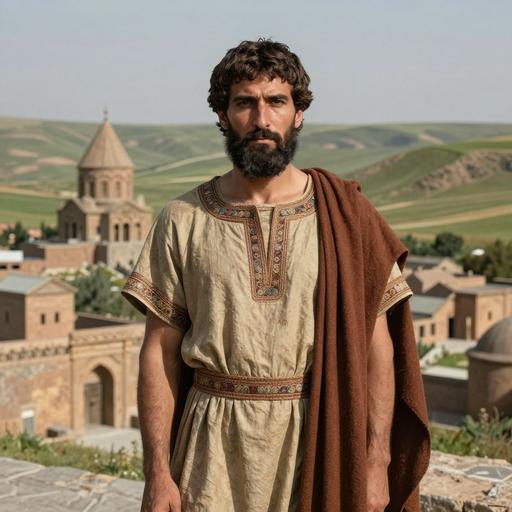
Portrait reconstruction of I16119
Ancient Individual

A man buried in Armenia in the Iron Age era

I16119
399 BCE - 231 BCE
Male
Hellenistic Armenia
Armenia
Scroll to begin
Chapter I

Identity

The biological and cultural markers that define this ancient individual

Sample ID

I16119

Date Range

399 BCE - 231 BCE

Biological Sex

Male

mtDNA Haplogroup

U3b2c

Y-DNA Haplogroup

Not available

Cultural Period

Hellenistic Armenia

Chapter II

Place

Where this individual was discovered

Country Armenia
Locality Karmir Blur. necropolis of Teishebaini
Coordinates 40.1512, 44.4432
Chapter III

Time

When this individual lived in the broader context of human history

I16119 399 BCE - 231 BCE
Chapter IV

Story

The narrative of this ancient life

Hellenistic Armenia refers to the period in Armenian history when the region came under the influence of Hellenistic civilization, following the conquests of Alexander the Great and the subsequent division of his empire among his generals. This era, roughly from the late 4th century BCE to the early 3rd century BCE, is characterized by a blend of Greek and Near Eastern cultural elements, seen in various aspects of Armenian society, including politics, art, architecture, religion, and language.

Political Context

The death of Alexander the Great in 323 BCE led to the partition of his vast empire among his generals, known as the Diadochi. Armenia, located at the crossroads between the Near East and the Mediterranean, became a contested territory due to its strategic and economic significance. Initially, it was under the influence of the Seleucid Empire, which controlled large parts of Alexander's Asian conquests. However, the region soon saw the rise of local dynasts who capitalized on the weakening of Seleucid power.

One such pivotal figure was Orontes III, who established a degree of autonomy for Armenia. The Orontid Dynasty, originally satraps under Persian rule, leveraged the chaotic power struggles among Alexander’s successors to expand their influence and solidify their control over Armenian lands.

Cultural and Social Influence

During this Hellenistic era, Armenian society witnessed a significant infusion of Greek culture. This was evident in varying degrees across different layers of society and aspects of daily life:

  1. Art and Architecture: The Hellenistic influence was prominently visible in Armenian art and architecture. Cities and towns replete with Hellenistic buildings, theaters, and gymnasiums began to emerge, although uniquely combining local styles with Greek designs. Greek-style sculptures and pottery also became commonplace, featuring distinct Hellenic motifs.

  2. Language and Literature: Koine Greek became a lingua franca for administrative and diplomatic communication, though the native Armenian language and scripts continued to thrive. Though the dominance of Greek was more pronounced in urban centers, it facilitated cultural exchange and the propagation of Greek literature, philosophy, and science.

  3. Religion and Philosophy: While traditional Armenian deities remained venerable, Greek gods and goddesses began to enter the local pantheon, often merging with indigenous deities. Philosophically, the period saw a spread of Greek ideas such as Stoicism and Epicureanism, accessed mainly by the elite, who could engage with these thoughts through education in famed centers of learning like Athens and Alexandria.

  4. Economy and Trade: Armenia became an integral part of the expansive trade networks that characterized the Hellenistic world. The region was strategically positioned along the Silk Road and other key trade routes that connected the east and west, facilitating the exchange of goods, cultures, and ideas. This era brought economic prosperity as Armenian merchants engaged with Greek, Persian, and other regional traders.

Military and Strategy

Armenian rulers, influenced by Hellenistic military tactics, adopted Greek-style phalanxes and cavalry units. They maintained a well-trained army that was not only essential for defense against Seleucid incursions but also a tool for asserting authority over neighboring regions. The exchange of military techniques and technologies with other Hellenistic states enriched Armenian martial capabilities.

Legacy

The Hellenistic period laid the foundations for Armenia’s subsequent political, cultural, and economic developments. The synthesis of Hellenistic and indigenous elements formed a distinctive Armenian civilization that persisted even after the eventual Roman and Parthian influences took hold in later centuries. The cultural amalgamation from this period is reflected in the nation's resilience and adaptability throughout the tumultuous periods of its history.

In summary, Hellenistic Armenia encapsulated a transformative era where the interaction between Greek and local traditions spawned a rich, syncretic culture. The impact of this period is enduring, having established key cultural and social trajectories that continued to shape Armenian identity in the ensuing epochs.

Chapter V

Genetics

The genetic ancestry of this ancient individual

Ancient Genetic Admixture

This analysis compares the DNA profile of I16119 with ancient reference populations, showing the genetic composition in terms of prehistoric ancestral groups.

Neolithic Farmers 65.4%
European Hunter-Gatherers 20.3%
Western Steppe Pastoralists 7.7%
Ancient Asians 6.6%

Modern Genetic Admixture

This analysis compares the DNA profile with present-day reference populations, showing what percentage of genetic makeup resembles modern populations from different regions.

Asia 91.5%
Northern West Asian 67.6%
Mesopotamian 33.3%
Caucasian 25.0%
Anatolian 5.4%
Cypriot 4.0%
Arab, Egyptian & Levantine 17.8%
Levantine 15.4%
Arabian 2.4%
Central Asian, Northern Indian & Pakistani 6.1%
Indian 3.4%
Pakistan 2.8%
Europe 8.5%
Northwestern European 4.7%
Southern European 3.8%
Italian 3.8%

Closest Modern Populations

These are the modern populations showing the closest statistical alignment to A man buried in Armenia in the Iron Age era, ranked by genetic distance. Lower distance values indicate closer statistical similarity.

1
Turkish Erzurum
2.0726
2
Udi
2.2662
3
Armenian Artsakh
2.4266
4
Armenian Syunik
2.5241
5
Azerbaijani Republic Shaki
2.6647
6
Kurd Zaza Turkey
2.6996
7
Alevi Dersim
2.8215
8
Andian A
2.8939
9
Kurd Kurmanji Turkey
2.9602
10
Kurd USSR
3.0110
Chapter VI

Context

Other ancient individuals connected to this sample

Sources

References

Scientific publications and genetic data

Scientific Publication

The genetic history of the Southern Arc: A bridge between West Asia and Europe | Science

Authors Lazaridis I, Alpaslan-Roodenberg S, Acar A
Abstract

The period from the Copper Age to the Bronze Age marked major social and economic transformations in West Eurasia. To better understand these changes and their genetic impacts, we generated genome-wide data from 727 individuals who lived between 5000 and 1000 BCE in southeastern Europe and southwestern Asia.

G25 Coordinates

The G25 coordinates for sample I16119 can be used for detailed admixture analysis in our G25 Studio tool.

I16119,0.09454338,0.12260834,-0.05325742,-0.0485083,-0.03529886,-0.01023662,0.00640348,-0.00752122,-0.0327733,-0.01785468,0.00120622,0.00198788,-0.0037559,0.00212262,0.00522518,0.00065324,0.00328236,-0.00091682,-0.00081354,0.0036175,0.00639312,0.00375132,0.00220828,-0.00394988,-0.00175263
Analyze in G25 Studio
Use code for 40% off Expires Feb 26