Menu
Store
Blog
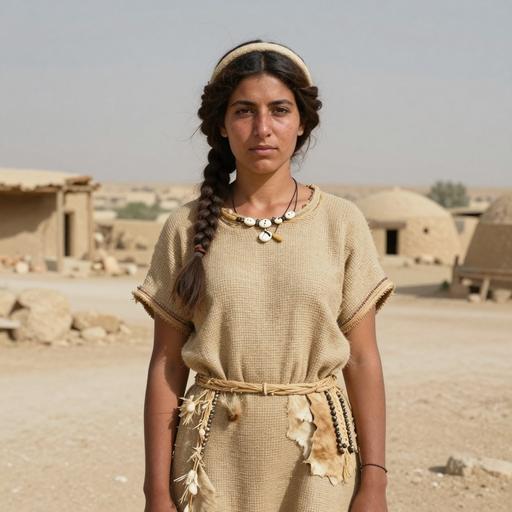
Portrait reconstruction of I1708
Ancient Individual

A woman buried in Jordan in the Neolithic era

I1708
6800 BCE - 6700 BCE
Female
Pre-Pottery Neolithic C Jordan
Jordan
Scroll to begin
Chapter I

Identity

The biological and cultural markers that define this ancient individual

Sample ID

I1708

Date Range

6800 BCE - 6700 BCE

Biological Sex

Female

mtDNA Haplogroup

R0a2

Cultural Period

Pre-Pottery Neolithic C Jordan

Chapter II

Place

Where this individual was discovered

Country Jordan
Locality 'Ain Ghazal
Coordinates 31.9880, 35.9760
Chapter III

Time

When this individual lived in the broader context of human history

I1708 6800 BCE - 6700 BCE
Chapter IV

Story

The narrative of this ancient life

The Pre-Pottery Neolithic C (PPNC) period in the Levantine region, particularly in what is now modern-day Jordan, is a fascinating era of human development. The Levant is a region that includes parts of modern-day countries like Jordan, Israel, Lebanon, Syria, and Palestine. The PPNC era, which dates from around 8200 to 7000 BCE, marks a transitional phase in the history of human settlement and cultural evolution following the Pre-Pottery Neolithic A (PPNA) and Pre-Pottery Neolithic B (PPNB) periods.

Environment and Geography: The climate of this era was generally more humid than today, although it was beginning to dry and become more varied, influencing the types of vegetation and wildlife present. This climate supported a diverse ecosystem that included woodlands, steppe, and grasslands, supporting a variety of flora and fauna. The region's geography encompassed fertile areas near rivers and more arid landscapes, providing different resources and challenges for settling communities.

Settlement Patterns: The PPNC period was characterized by more permanent settlements compared to the earlier Natufian culture, which was largely characterized by semi-nomadic lifestyles. The transition to agricultural societies became more pronounced during this era. Settlements typically featured mudbrick or stone-built structures, indicating a shift towards more enduring architectural practices.

Agriculture and Economy: Agriculture played a crucial role in the PPNC, with communities increasingly engaging in the cultivation of crops such as wheat, barley, and legumes. This era saw the beginning, or intensification, of domesticated animal rearing, with sheep and goats becoming more prevalent. These activities supported growing populations and allowed for the storage of surplus products, facilitating economic stability and trade.

Social Structure and Culture: Communities during the PPNC were likely organized into tribal or clan-based societies. Artifacts from the period suggest the presence of social stratification or specialization, indicated by the diversity in tool types and forms of artistic expression. The use of personal adornments, such as beads and pendants, was common, implying social or ritual significance.

The religious or spiritual life of the people may have included ancestor worship or veneration of natural elements, as suggested by burial practices and the orientation of some structures. Ritual objects and possible shrines discovered in sites like 'Ain Ghazal give credence to these interpretations.

Technology and Tools: The PPNC era continued to see advances in the technology and crafting of tools. The manufacture of flint tools such as arrowheads, knives, and scrapers became more sophisticated. Evidence of stone carving, particularly in limestone and basalt, represents a keen understanding of materials and an advance in artistic and functional craftsmanship.

Art and Symbolism: Art in the PPNC period was manifested in the form of small figurines, carvings, and decorated objects. These items reflected both everyday life and possibly spiritual beliefs. Figurines often depicted human or animal figures, which might have played roles in rituals or been used as amulets.

End of the Era: The end of the PPNC period saw further environmental shifts leading towards more arid conditions, which may have contributed to migrations and adaptive changes in human lifestyles. This period was succeeded by the Pottery Neolithic period, which was marked by the advent of pottery-making technology that significantly affected storage and cooking practices.

The Pre-Pottery Neolithic C of Jordan and the wider Levantine area stands as a crucial moment in prehistoric development, providing insights into human adaptability, social evolution, and the ingenious solutions developed by our ancestors in response to environmental and social challenges.

Chapter V

Genetics

The genetic ancestry of this ancient individual

Ancient Genetic Admixture

This analysis compares the DNA profile of I1708 with ancient reference populations, showing the genetic composition in terms of prehistoric ancestral groups.

Neolithic Farmers 87.5%
European Hunter-Gatherers 9.4%
Western Steppe Pastoralists 3.1%

Modern Genetic Admixture

This analysis compares the DNA profile with present-day reference populations, showing what percentage of genetic makeup resembles modern populations from different regions.

Asia 58.7%
Arab, Egyptian & Levantine 52.9%
Levantine 30.8%
Arabian 22.1%
Northern West Asian 5.2%
Cypriot 5.2%
Chinese & Southeast Asian 0.6%
Chinese 0.6%
Europe 28.9%
Southern European 28.9%
Sardinian 17.7%
Italian 11.2%
Africa 12.4%
North African 12.4%
North African 6.5%
Egyptian 5.9%

Closest Modern Populations

These are the modern populations showing the closest statistical alignment to A woman buried in Jordan in the Neolithic era, ranked by genetic distance. Lower distance values indicate closer statistical similarity.

1
Yemenite Ma'rib
5.2037
2
Yemenite Amran
5.2548
3
Yemenite Jew
5.2695
4
Saudia
5.3199
5
Yemenite Dhamar
5.4534
6
Yemenite Al Bayda
5.4955
7
Yemenite Al Jawf
5.4965
8
Egyptian Copt
5.9992
9
Saudib
6.2775
10
Bedouinb
6.3498
Chapter VI

Context

Other ancient individuals connected to this sample

Sources

References

Scientific publications and genetic data

Scientific Publication

The genetic history of the Southern Arc: A bridge between West Asia and Europe | Science

Authors Lazaridis I, Alpaslan-Roodenberg S, Acar A
Abstract

The period from the Copper Age to the Bronze Age marked major social and economic transformations in West Eurasia. To better understand these changes and their genetic impacts, we generated genome-wide data from 727 individuals who lived between 5000 and 1000 BCE in southeastern Europe and southwestern Asia.

G25 Coordinates

The G25 coordinates for sample I1708 can be used for detailed admixture analysis in our G25 Studio tool.

I1708,0.06213302,0.14763608,-0.03769656,-0.10147408,0.00735994,-0.04822616,-0.00702586,-0.00257092,0.05489878,0.0134336,0.00982756,-0.01469072,0.03469018,-0.00011554,-0.00377624,0.01550576,-0.02232776,0.0040379,0.0088027,0.01313224,0.01809538,0.01806766,-0.01313498,-0.00753712,-0.00404421
Analyze in G25 Studio
Use code for 40% off Expires Feb 26