Menu
Store
Blog
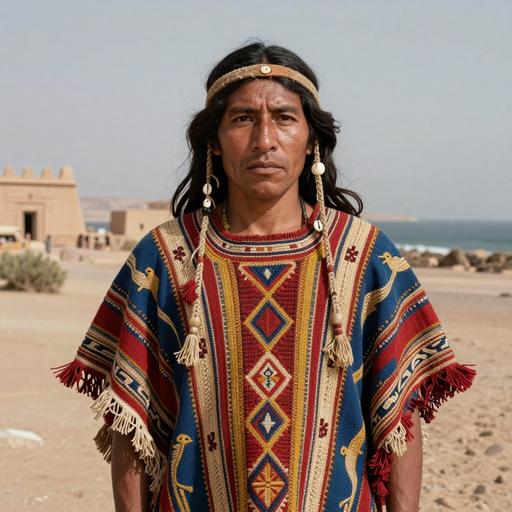
Portrait reconstruction of I2233
Ancient Individual

A man buried in Peru in the Ancient South America era

I2233
115 BCE - 205 CE
Male
Early Horizon Paracas Culture, Peru 2,250 Years Ago
Peru
Scroll to begin
Chapter I

Identity

The biological and cultural markers that define this ancient individual

Sample ID

I2233

Date Range

115 BCE - 205 CE

Biological Sex

Male

mtDNA Haplogroup

D1

Y-DNA Haplogroup

Q-M902

Cultural Period

Early Horizon Paracas Culture, Peru 2,250 Years Ago

Chapter II

Place

Where this individual was discovered

Country Peru
Locality Paracas Penisula. Wari Kayan
Chapter III

Time

When this individual lived in the broader context of human history

I2233 115 BCE - 205 CE
Chapter IV

Story

The narrative of this ancient life

The Paracas culture, flourishing approximately 2,250 years ago during the Early Horizon period (circa 900 BCE to 100 BCE), represents a pivotal epoch in Andean civilizations, particularly along the arid southern coast of modern-day Peru. This culture is primarily centered around the Paracas Peninsula in the Ica Region, a naturally arid and wind-swept region that influenced their lifestyle and material culture.

Geography and Environment:

The Paracas civilization developed in a harsh desert environment marked by extreme aridity, yet they thrived through innovative agricultural practices. They employed techniques such as irrigation to harness scarce water resources, alongside utilizing coastal and marine resources vital for their sustenance. The proximity to the Pacific Ocean provided a rich bounty of marine resources, including fish and shellfish.

Social and Political Organization:

While detailed records of Paracas political structures are scarce, archaeological evidence suggests a complex society with hierarchical structures. The presence of elaborate burials and varied grave offerings indicates social stratification, with elite individuals enjoying higher status, likely involving spiritual or political leadership roles.

Cultural Practices:

Textiles and Fashion: One of the most remarkable aspects of the Paracas culture is their exceptional skill in textile production. The Paracas are renowned for their richly colored and intricately woven textiles, which were made using cotton and camelid fibers. These textiles often featured vibrant colors and complex iconography, depicting motifs that include geometric patterns, mythical creatures, and anthropomorphic figures. The textiles were not only functional but served as significant cultural and ceremonial items, often used to wrap the deceased in mummy bundles.

Burials and Funerary Customs: Paracas funerary practices reflect their beliefs in the afterlife and the importance of ancestor veneration. The dead were typically interred in large underground shaft tombs, often in a seated position and wrapped in layered textiles, creating mummy bundles. These burials included offerings such as ceramics, food, implements, and even elaborate feathers, indicating both status and the belief in a life beyond death.

Art and Craftsmanship:

The Paracas exhibited a high level of craftsmanship in various artistic domains. Apart from textiles, they are known for their polychrome pottery, although their style is less refined than the subsequent Nazca culture. They also displayed remarkable skills in trepanning, a surgical intervention on the skull, suggesting advanced medical knowledge and a ritualistic aspect perhaps tied to spiritual practices or status.

Religion and Iconography:

While the specifics of Paracas religious beliefs are not fully understood, it is evident that they engaged in complex spiritual rituals, likely involving shamanistic practices. Religious iconography often depicted deities or mythical figures intertwined with natural symbols, perhaps linked to their environment and cosmology.

Legacy and Influence:

The Paracas culture laid important groundwork for subsequent Andean cultures, particularly the Nazca. Certain stylistic elements persisted in Nazca iconography, and technological and agricultural practices developed by the Paracas were further refined by their successors. The textiles and mummy bundles remain critical to understanding Pre-Columbian Andean civilizations, revealing much about social structure, religious practices, and artistic expression.

In summary, the Early Horizon Paracas culture represents a period of great innovation and artistry within ancient Andean civilizations. Despite the challenging environment, they developed a rich cultural and spiritual life, evidenced in their textiles, funerary practices, and enduring legacy in the history of Peru.

Chapter V

Genetics

The genetic ancestry of this ancient individual

Ancient Genetic Admixture

This analysis compares the DNA profile of I2233 with ancient reference populations, showing the genetic composition in terms of prehistoric ancestral groups.

Ancient Native Americans 71.8%
Ancient Asians 20.6%
Western Steppe Pastoralists 7.6%

Modern Genetic Admixture

This analysis compares the DNA profile with present-day reference populations, showing what percentage of genetic makeup resembles modern populations from different regions.

America 92.0%
America 92.0%
Native American 92.0%
Asia 8.0%
Northern Asian 7.7%
Mongolian 7.7%

Closest Modern Populations

These are the modern populations showing the closest statistical alignment to A man buried in Peru in the Ancient South America era, ranked by genetic distance. Lower distance values indicate closer statistical similarity.

1
Piapoco
2.5087
2
Aymara
2.5195
3
Yukpa
2.7716
4
Bolivian Lapaz
2.9635
5
Wichi
3.0417
6
Colla
3.1162
7
Cachi
3.3563
8
Mixe
4.3343
9
Karitiana
4.3748
10
Mayan
4.5316
Chapter VI

Context

Other ancient individuals connected to this sample

Sources

References

Scientific publications and genetic data

Scientific Publication

A Paleogenomic Reconstruction of the Deep Population History of the Andes

Authors Nakatsuka N, Lazaridis I, Barbieri C
Abstract

There are many unanswered questions about the population history of the Central and South Central Andes, particularly regarding the impact of large-scale societies, such as the Moche, Wari, Tiwanaku, and Inca. We assembled genome-wide data on 89 individuals dating from ∼9,000-500 years ago (BP), with a particular focus on the period of the rise and fall of state societies. Today's genetic structure began to develop by 5,800 BP, followed by bi-directional gene flow between the North and South Highlands, and between the Highlands and Coast. We detect minimal admixture among neighboring groups between ∼2,000-500 BP, although we do detect cosmopolitanism (people of diverse ancestries living side-by-side) in the heartlands of the Tiwanaku and Inca polities. We also highlight cases of long-range mobility connecting the Andes to Argentina and the Northwest Andes to the Amazon Basin. VIDEO ABSTRACT.

G25 Coordinates

The G25 coordinates for sample I2233 can be used for detailed admixture analysis in our G25 Studio tool.

I2233,0.04419422,-0.30892708,0.1083535,0.09821638,-0.11184712,-0.00965304,-0.30089668,-0.35522854,-0.01255156,-0.0193083,0.0006798,-0.0009978,-0.0015545,0.02525828,-0.00483148,-0.00120864,0.0065638,0.0034771,0.00052688,-0.00238152,-0.00109024,0.00843858,-0.0024038,-0.00538794,-0.00596617
Analyze in G25 Studio
Use code for 40% off Expires Feb 27