Menu
Store
Blog
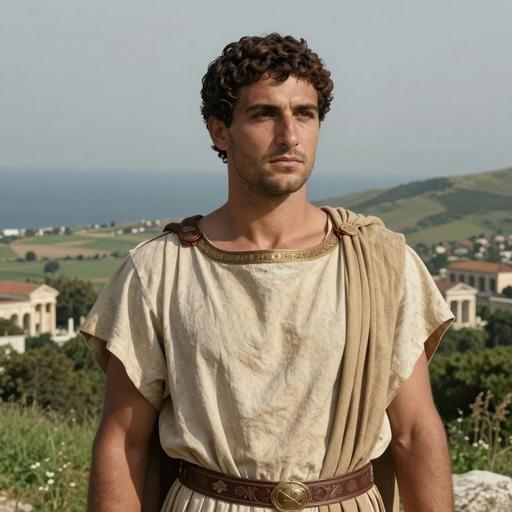
Portrait reconstruction of I4529
Ancient Individual

A man buried in Turkey in the Antiquity era

I4529
203 CE - 319 CE
Male
Roman Period 1 Turkey
Turkey
Scroll to begin
Chapter I

Identity

The biological and cultural markers that define this ancient individual

Sample ID

I4529

Date Range

203 CE - 319 CE

Biological Sex

Male

mtDNA Haplogroup

D4e1

Y-DNA Haplogroup

Not available

Cultural Period

Roman Period 1 Turkey

Chapter II

Place

Where this individual was discovered

Country Turkey
Locality Cedit. Basarabya (Black Sea. Samsun. llkadım)
Coordinates 41.3130, 36.3300
Chapter III

Time

When this individual lived in the broader context of human history

I4529 203 CE - 319 CE
Chapter IV

Story

The narrative of this ancient life

The Roman Period in what is now modern-day Turkey, often referred to as Asia Minor during ancient times, is a significant chapter in the region's complex history. This era began with the Roman Republic's expanding influence over Anatolia and continued into the Roman Empire, profoundly impacting the social, cultural, architectural, and economic landscapes of the region.

Historical Background

Roman Conquest and Administration:
The Roman involvement in Anatolia began in earnest with the defeat of King Antiochus III in 190 BC during the Roman-Syrian War. The Treaty of Apamea in 188 BC marked the start of Roman dominance in the region, although initially, it was indirect through local client kings and allied cities. By the 1st century BC, especially after the defeat of Mithridates VI of Pontus by Pompey, the region was more directly governed as a Roman province. Over time, Anatolian territories were further consolidated into several provinces, including Asia, Galatia, Cappadocia, Bithynia et Pontus, Cilicia, and Lycia et Pamphylia.

Cultural and Social Impact

Hellenization and Romanization:
Anatolia had already been significantly Hellenized due to the previous rule of Alexander the Great and his successors. The Romans built upon this cultural foundation, further Hellenizing the local population while also introducing Roman customs, law, and Latin, although Greek remained the dominant language, especially in the more urbanized areas.

Urbanization and Architecture:
The Roman period saw immense urban development. Cities like Ephesus, Smyrna (modern İzmir), Pergamon, and Antioch rose to prominence, boasting classic Roman architectural elements such as amphitheaters, baths, basilicas, forums, and temples. The city of Ephesus, in particular, became a vital hub in the Roman Empire, famous for its Temple of Artemis, one of the Seven Wonders of the Ancient World. These cities exemplified the Roman knack for engineering and urban planning, characterized by grid patterns, aqueducts, and efficient road networks linking them to other parts of the empire.

Religion and Society:
The Roman pantheon was integrated with local deities, leading to a syncretic blend of religious practices. Asia Minor was also a critical region for the spread of early Christianity. The Apostle Paul famously traveled throughout the region, establishing communities and spreading Christian teachings, leading to significant religious transformations by the late Roman period.

Economic Developments

Trade and Economy:
Asia Minor's wealth was derived from its strategic location at the crossroads of Europe and Asia, making it a bustling center for commerce and trade. The Romans exploited local resources such as grain, wine, marble, and precious metals. Cities became thriving trade hubs, with Ephesus, for example, serving as a major port city on the Aegean Sea.

Agriculture and Production:
The fertile lands of Anatolia supported extensive agricultural activities, with large estates producing grain, olive oil, and wine for export across the empire. Local crafts, such as weaving, tanning, and pottery, were also significant economic contributors.

Military and Political Aspects

Military Importance:
Given its strategic location, Anatolia was critical for military operations. It served as a staging ground for campaigns in the eastern provinces and as a defensive frontier against invasions from the east. Consequently, numerous Roman legions were stationed in the region, and fortifications were built to protect against incursions.

Political Influence:
Notably, during this period, the Roman political landscape influenced regional governance. Local elites often adopted Roman titles and roles, integrating into the Roman administrative system. Some provinces even occasionally produced individuals who played major roles in the broader imperial politics.

Decline and Transition

The decline of Roman influence in Anatolia can be traced to the administrative and financial strains that plagued the late empire. The division of the Roman Empire into Eastern and Western halves under Emperor Diocletian and the eventual rise of Constantinople as the new capital in 330 AD marked a shift in power. Over time, Anatolia transitioned into the Byzantine Empire, inheriting much of the Roman legacy but also developing its unique cultural and political identity.

In summary, the Roman Period in Turkey was a transformative era that laid foundational cultural, architectural, and socio-political elements that influenced the region for centuries to come. The synthesis of Greek and Roman traditions created a distinctive cultural milieu that persisted even beyond the fall of the Roman Empire, shaping the early Byzantine period that followed.

Chapter V

Genetics

The genetic ancestry of this ancient individual

Ancient Genetic Admixture

This analysis compares the DNA profile of I4529 with ancient reference populations, showing the genetic composition in terms of prehistoric ancestral groups.

Western Steppe Pastoralists 33.3%
Neolithic Farmers 30.1%
European Hunter-Gatherers 23.4%
Ancient Asians 13.2%

Modern Genetic Admixture

This analysis compares the DNA profile with present-day reference populations, showing what percentage of genetic makeup resembles modern populations from different regions.

Europe 56.7%
Northwestern European 31.7%
English 23.9%
Northwestern European 5.9%
Scandinavian 1.9%
Eastern European 24.5%
Southern European 0.6%
Balkan 0.6%
Asia 40.9%
Northern West Asian 20.7%
Caucasian 20.7%
Central Asian, Northern Indian & Pakistani 18.6%
Pakistan 14.2%
Indian 4.4%
Northern Asian 1.7%
Siberian 1.7%
America 2.4%
America 2.4%
Native American 2.4%

Closest Modern Populations

These are the modern populations showing the closest statistical alignment to A man buried in Turkey in the Antiquity era, ranked by genetic distance. Lower distance values indicate closer statistical similarity.

1
Pamiri Rushan
6.9024
2
Tatar Mishar
6.9224
3
Tajik Yaghnobi
6.9748
4
Tatar Kazan
7.4787
5
Turkish Deliorman
7.5706
6
Pamiri Shugnan
7.6780
7
Turkish Rumeli
7.8568
8
Lezgin
8.0547
9
Andian B
8.2500
10
Kumyk
8.3580
Chapter VI

Context

Other ancient individuals connected to this sample

Sources

References

Scientific publications and genetic data

Scientific Publication

The genetic history of the Southern Arc: A bridge between West Asia and Europe | Science

Authors Lazaridis I, Alpaslan-Roodenberg S, Acar A
Abstract

The period from the Copper Age to the Bronze Age marked major social and economic transformations in West Eurasia. To better understand these changes and their genetic impacts, we generated genome-wide data from 727 individuals who lived between 5000 and 1000 BCE in southeastern Europe and southwestern Asia.

G25 Coordinates

The G25 coordinates for sample I4529 can be used for detailed admixture analysis in our G25 Studio tool.

I4529,0.11281674,0.06349962,0.02009874,0.03589814,-0.01543444,0.01479812,0.0071844,0.00211576,-0.02283904,-0.02560896,0.00227494,0.0017297,0.00352252,-0.01327298,0.00329986,-0.00320676,-0.00727126,-0.00077584,-0.00873554,-0.00923558,0.00422974,0.00282278,-0.00510452,0.00954874,-0.00174561
Analyze in G25 Studio
Use code for 40% off Expires Feb 26