Menu
Store
Blog
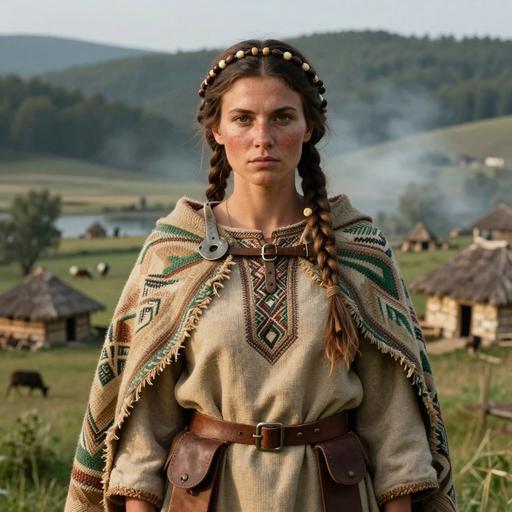
Portrait reconstruction of I5769
Ancient Individual

A woman buried in Bulgaria in the Iron Age era

I5769
771 BCE - 541 BCE
Female
Iron Age Bulgaria
Bulgaria
Scroll to begin
Chapter I

Identity

The biological and cultural markers that define this ancient individual

Sample ID

I5769

Date Range

771 BCE - 541 BCE

Biological Sex

Female

mtDNA Haplogroup

H-d9

Cultural Period

Iron Age Bulgaria

Chapter II

Place

Where this individual was discovered

Country Bulgaria
Locality Veliko Tarnovo. Dzhulyunitsa
Coordinates 43.1609, 25.8834
Chapter III

Time

When this individual lived in the broader context of human history

I5769 771 BCE - 541 BCE
Chapter IV

Story

The narrative of this ancient life

The Iron Age in Bulgaria, particularly focused on the Thracian culture, is a captivating period marked by significant developments in social structure, craftsmanship, and interaction with neighboring cultures. This era roughly spans from 1200 BCE to the Roman conquest in the 1st century CE, during which the Thracians established themselves as a prominent and distinctive group in Southeast Europe.

Geography and Setting

The Thracians occupied a region that includes present-day Bulgaria, parts of Greece, Turkey, and Romania. The geography of the area is diverse, featuring fertile plains, rugged mountains, and numerous rivers, which played a crucial role in the development and sustainability of the Thracian societies. The Rhodope Mountains and the Balkan range provided natural defenses, while the Thracian Plain offered rich agricultural land.

Society and Political Structure

Thracian society during the Iron Age was tribal and decentralized, composed of numerous tribes, each with its own king or chieftain. Among the most notable were the Odrysians, Triballi, Getae, and Bessi. Despite this fragmentation, there were periods when certain tribes, like the Odrysian Kingdom, managed to exert significant regional influence and unify several local tribes under centralized governance.

The social hierarchy was well-defined, with a ruling elite consisting of kings, nobility, and warriors, followed by priests, artisans, and farmers. The Thracians are often depicted as fierce warriors, and their reputation in the martial domain was well-known among their Greek and later Roman neighbors.

Economy and Craftsmanship

Agriculture was the backbone of the Thracian economy, with the region being ideal for growing wheat, barley, and grapes. Thracians were also known for their horse breeding skills, which contributed to their capability in warfare and trade. Besides agriculture, Thracian tribes engaged in mining, particularly of gold and silver, which was abundant in their territory.

Metalworking and pottery were highly developed arts among the Thracians. They are renowned for their intricate gold and silver jewelry and ceremonial items, many of which have been discovered in lavish burial mounds. These artifacts, such as the famous Panagyurishte Treasure, reflect not only the wealth of Thrace but also the high level of craftsmanship achieved by their artisans.

Religion and Beliefs

The Thracians practiced a polytheistic religion with a pantheon that had some overlap with Greek mythology. One of their most significant deities was Orpheus, a mythical figure associated with music and the underworld, reflecting the importance of music and ritual in Thracian culture. They believed in an afterlife, as evidenced by their burial practices, which included elaborate tombs and the placing of valuable goods with the deceased.

Kings and nobles were often buried in large tumuli, showcasing the Thracians’ engineering skills. These burial sites often contained frescoes and various grave goods, which provide insight into their beliefs and day-to-day life.

Cultural Interactions

Thracians maintained extensive contact with neighboring cultures, most notably the Greeks. These interactions were often marked by both conflict and cooperation. The Thracian coasts were dotted by Greek colonies, which served as trading outposts and cultural exchange centers. Thracians adopted elements of Greek architecture and art, merging them with their own styles, resulting in unique cultural artifacts.

With the rise of the Macedonian Empire and later the Romans, Thracian lands became areas of strategic importance and often the battleground for larger empires. The Thracians were known to be both adversaries and allies, sometimes serving as mercenaries in foreign armies.

Conclusion

The Iron Age Thracian culture in Bulgaria is characterized by a unique blend of indigenous developments and external influences. Their artistic, martial, and economic achievements laid a foundational cultural legacy that influenced the region well into the Roman period and beyond. Modern archaeological discoveries continue to shed light on the complexity and richness of Thracian society, highlighting its importance in the ancient world.

Chapter V

Genetics

The genetic ancestry of this ancient individual

Ancient Genetic Admixture

This analysis compares the DNA profile of I5769 with ancient reference populations, showing the genetic composition in terms of prehistoric ancestral groups.

Neolithic Farmers 64.9%
European Hunter-Gatherers 20.6%
Western Steppe Pastoralists 14.5%

Modern Genetic Admixture

This analysis compares the DNA profile with present-day reference populations, showing what percentage of genetic makeup resembles modern populations from different regions.

Europe 79.9%
Southern European 78.5%
Italian 45.1%
Sardinian 15.9%
Balkan 15.3%
Iberian 2.2%
Northwestern European 1.4%
Asia 20.1%
Northern West Asian 13.7%
Cypriot 7.1%
Mesopotamian 6.2%
Arab, Egyptian & Levantine 6.4%
Levantine 5.5%
Arabian 0.8%

Closest Modern Populations

These are the modern populations showing the closest statistical alignment to A woman buried in Bulgaria in the Iron Age era, ranked by genetic distance. Lower distance values indicate closer statistical similarity.

1
Sicilian West
2.1211
2
Italian Campania
2.3093
3
Sicilian East
2.3919
4
Italian Apulia
2.4635
5
Italian Calabria
2.4791
6
Italian Basilicata
2.5272
7
Italian Lazio
2.5441
8
Italian Abruzzo
2.5564
9
Maltese
2.7442
10
Italian Umbria
2.7635
Chapter VI

Context

Other ancient individuals connected to this sample

Sources

References

Scientific publications and genetic data

Scientific Publication

The genomic history of southeastern Europe

Authors Mathieson I, Alpaslan-Roodenberg S, Posth C
Abstract

Farming was first introduced to Europe in the mid-seventh millennium bc, and was associated with migrants from Anatolia who settled in the southeast before spreading throughout Europe. Here, to understand the dynamics of this process, we analysed genome-wide ancient DNA data from 225 individuals who lived in southeastern Europe and surrounding regions between 12000 and 500 bc. We document a west-east cline of ancestry in indigenous hunter-gatherers and, in eastern Europe, the early stages in the formation of Bronze Age steppe ancestry. We show that the first farmers of northern and western Europe dispersed through southeastern Europe with limited hunter-gatherer admixture, but that some early groups in the southeast mixed extensively with hunter-gatherers without the sex-biased admixture that prevailed later in the north and west. We also show that southeastern Europe continued to be a nexus between east and west after the arrival of farmers, with intermittent genetic contact with steppe populations occurring up to 2,000 years earlier than the migrations from the steppe that ultimately replaced much of the population of northern Europe.

G25 Coordinates

The G25 coordinates for sample I5769 can be used for detailed admixture analysis in our G25 Studio tool.

I5769,0.10466062,0.1456601,-0.00391996,-0.04245794,0.02381276,-0.01606296,-0.00526824,-0.00013828,0.0154137,0.03120068,-0.0020007,0.00716094,-0.00860406,-0.00403062,-0.0048561,0.00254432,0.00238028,0.00071266,0.0015188,-0.0041983,0.00112998,0.0026202,-0.00197416,-0.00581306,0.00274734
Analyze in G25 Studio
Use code for 40% off Expires Feb 27