Menu
Store
Blog
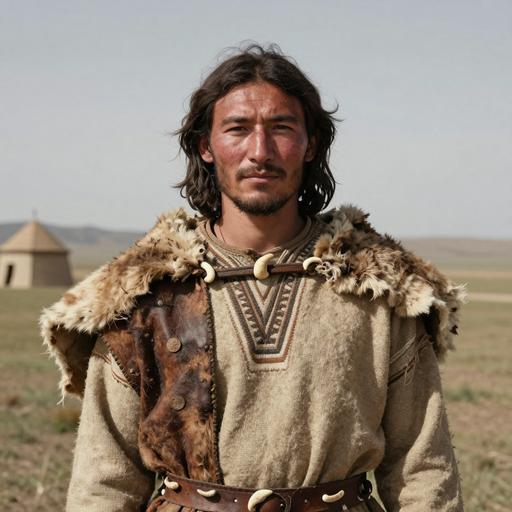
Portrait reconstruction of I6222
Ancient Individual

A man buried in Mongolia in the Copper Age era

I6222
3320 BCE - 2918 BCE
Male
Chalcolithic Afanasievo Culture 1, Mongolia
Mongolia
Scroll to begin
Chapter I

Identity

The biological and cultural markers that define this ancient individual

Sample ID

I6222

Date Range

3320 BCE - 2918 BCE

Biological Sex

Male

mtDNA Haplogroup

R or N1a1a1a1

Y-DNA Haplogroup

R1b1a1b-L773

Cultural Period

Chalcolithic Afanasievo Culture 1, Mongolia

Chapter II

Place

Where this individual was discovered

Country Mongolia
Locality Bayankhongor aimag. Erdenetsogt sum. Shatar chuluu kurgan 2
Chapter III

Time

When this individual lived in the broader context of human history

I6222 3320 BCE - 2918 BCE
Chapter IV

Story

The narrative of this ancient life

The Chalcolithic Afanasievo Culture represents a significant prehistoric culture within the Eurasian Steppe during the late 4th to early 3rd millennium BCE. It is named after the Afanasievo region where its remnants were first discovered in the Altai Mountains, extending into Mongolia and parts of Western Siberia. This culture is regarded as one of the earliest known cultures to have expanded into the vast steppe regions, and it bears distinct characteristics that illuminate early developments in metallurgy, domestication, and nomadic pastoralism.

Geographic and Temporal Context

The Afanasievo Culture occupies a space in time and geography where transitions between Neolithic lifestyles and more complex societal structures began to emerge. Situated primarily in the southern Siberian steppe, its reach extended into Mongolia, influencing local populations and interacting with subsequent and neighboring cultures. The culture flourished approximately between 3300 BCE to 2500 BCE, a period characterized by both innovations and continuities in earlier lifeways.

Material Culture

Artifacts from the Afanasievo Culture include a blend of Neolithic and emerging Bronze Age technologies. Chalcolithic or Copper Age denotes their utilization of copper tools and weapons, marking a step away from purely stone tools. Metalwork revealed simple but effective craftsmanship; the copper was cold-worked, or in some instances, smelted and cast.

Pottery is another significant element of Afanasievo material culture. Typically, ceramics were hand-built, often with cord impressions or simple geometric patterns, indicative of both utility and an emerging aesthetic sense. These vessels were primarily used for cooking and storage, reflecting settled or semi-nomadic life.

Economy and Subsistence

Economically, the Afanasievo Culture was a pioneering pastoral society. They were among the earliest pastoralists in the steppe, herding animals such as sheep, goats, and cattle, which constituted a crucial part of their diet alongside hunting and gathering. Evidence points to some incipient forms of agriculture, but pastoralism remained central.

The domestication and use of horses are subjects of significant interest. While not definitively proven to be the first horse domesticators, their lifestyle and expansion patterns suggest horses played a vital role, potentially for transportation, riding, or as a food source.

Burial Practices and Beliefs

Afanasievo burial practices offer a window into their social and spiritual lives. Burials often involved barrow constructions or kurgans, simple pit graves that sometimes contained multiple individuals. Grave goods typically included pottery, personal ornaments, and tools, implying a belief in an afterlife or the importance of material objects in the social status journey into the next realm.

There is also evidence of possible ancestor worship or reverence; some graves show careful placement of bodies and goods, hinting at ritualistic practices and symbolic significance. These rituals provide insights into their cosmology, social stratification, and community identities.

Genetic and Linguistic Insights

Genetic studies have linked the Afanasievo people with Europoid ancestry, particularly closer to the Yamnaya culture of the Pontic-Caspian steppe. This genetic evidence supports theories regarding migratory patterns into Asia, contributing to discussions about Proto-Indo-European languages. The Afanasievo may have played a role in the dispersal of Indo-European languages into Asia, although conclusive evidence remains elusive.

Interaction and Influence

The Afanasievo Culture’s interactions with other cultures and their eventual decline or transformation into subsequent cultural entities reflect a dynamic history of migration, assimilation, and innovation. Some scholars suggest that the Afanasievo were predecessors of the later Andronovo Culture, with technological and lifestyle shifts marking cultural transitions. Their interactions with East Asian populations and influence on regional developments set the stage for evolving cultural mosaics throughout the region.

In summary, the Chalcolithic Afanasievo Culture stands as a transformative and intriguing culture in Mongolia and the Eurasian Steppe. Through innovations in metallurgy, shifts toward pastoralism, and complex social structures, the Afanasievo mark a critical juncture in human history, heralding the advance from Neolithic ways of life towards more intricate societal forms in the Bronze Age.

Chapter V

Genetics

The genetic ancestry of this ancient individual

Ancient Genetic Admixture

This analysis compares the DNA profile of I6222 with ancient reference populations, showing the genetic composition in terms of prehistoric ancestral groups.

Western Steppe Pastoralists 53.4%
European Hunter-Gatherers 20.5%
Neolithic Farmers 13.8%
Ancient Asians 12.3%

Modern Genetic Admixture

This analysis compares the DNA profile with present-day reference populations, showing what percentage of genetic makeup resembles modern populations from different regions.

Europe 53.5%
Northwestern European 46.2%
Scandinavian 16.3%
Finnish 13.4%
Northwestern European 9.2%
English 7.2%
Eastern European 7.3%
Asia 43.2%
Northern West Asian 42.9%
Caucasian 42.9%
America 3.3%
America 3.3%
Native American 3.3%

Closest Modern Populations

These are the modern populations showing the closest statistical alignment to A man buried in Mongolia in the Copper Age era, ranked by genetic distance. Lower distance values indicate closer statistical similarity.

1
Tatar Mishar
5.9666
2
Moksha
6.9862
3
Mordovian
7.0332
4
Erzya
7.1366
5
Turkish Deliorman
7.3563
6
Tatar Kazan
7.4179
7
Russian Kostroma
7.7952
8
Russian Krasnoborsky
7.9445
9
Moldovan O
8.0151
10
Pamiri Rushan
8.0393
Chapter VI

Context

Other ancient individuals connected to this sample

Sources

References

Scientific publications and genetic data

Scientific Publication

Genomic insights into the formation of human populations in East Asia

Authors Wang CC, Yeh HY, Popov AN
Abstract

The deep population history of East Asia remains poorly understood owing to a lack of ancient DNA data and sparse sampling of present-day people1,2. Here we report genome-wide data from 166 East Asian individuals dating to between 6000 BC and AD 1000 and 46 present-day groups. Hunter-gatherers from Japan, the Amur River Basin, and people of Neolithic and Iron Age Taiwan and the Tibetan Plateau are linked by a deeply splitting lineage that probably reflects a coastal migration during the Late Pleistocene epoch. We also follow expansions during the subsequent Holocene epoch from four regions. First, hunter-gatherers from Mongolia and the Amur River Basin have ancestry shared by individuals who speak Mongolic and Tungusic languages, but do not carry ancestry characteristic of farmers from the West Liao River region (around 3000 BC), which contradicts theories that the expansion of these farmers spread the Mongolic and Tungusic proto-languages. Second, farmers from the Yellow River Basin (around 3000 BC) probably spread Sino-Tibetan languages, as their ancestry dispersed both to Tibet-where it forms approximately 84% of the gene pool in some groups-and to the Central Plain, where it has contributed around 59-84% to modern Han Chinese groups. Third, people from Taiwan from around 1300 BC to AD 800 derived approximately 75% of their ancestry from a lineage that is widespread in modern individuals who speak Austronesian, Tai-Kadai and Austroasiatic languages, and that we hypothesize derives from farmers of the Yangtze River Valley. Ancient people from Taiwan also derived about 25% of their ancestry from a northern lineage that is related to, but different from, farmers of the Yellow River Basin, which suggests an additional north-to-south expansion. Fourth, ancestry from Yamnaya Steppe pastoralists arrived in western Mongolia after around 3000 BC but was displaced by previously established lineages even while it persisted in western China, as would be expected if this ancestry was associated with the spread of proto-Tocharian Indo-European languages. Two later gene flows affected western Mongolia: migrants after around 2000 BC with Yamnaya and European farmer ancestry, and episodic influences of later groups with ancestry from Turan.

G25 Coordinates

The G25 coordinates for sample I6222 can be used for detailed admixture analysis in our G25 Studio tool.

I6222,0.11384182,0.0718017,0.03016446,0.04626014,-0.00861294,0.01862462,0.00623122,0.0031058,-0.02100882,-0.02971368,0.00182362,-0.00164944,0.00490474,-0.002673,0.0015133,-0.0023523,-0.00536536,-0.00106868,-0.00297738,-0.0059286,9.74E-05,0.00144754,-0.00408382,0.00785594,-0.00180169
Analyze in G25 Studio
Use code for 40% off Expires Feb 27